The 5Cs Framework — Don't Run It in a Room Together
The 5Cs Framework promises a shared view of your market. That consensus is manufactured in the room — and the disagreement it erases was your only real data.
A technology company in Dubai could not describe itself. Sales called it the most customer-centric platform in the region. Marketing called it the most innovative solution in the market. The CEO called it the most reliable partner for enterprise clients. Three sentences about one company, and no two of them the same.
The usual reading of that story is that it's a messaging problem — pick a line, get everyone on it. It wasn't. Those three sentences were three different theories of why customers paid, held by the three people whose decisions depended on the answer. Sales was discounting to defend a value story marketing wasn't telling. Product was building for a buyer the CEO wasn't selling to. Nobody was confused. Everybody was certain, and they were certain about different things.
When the team finally mapped its competitive position properly, the answer turned out to be none of the three. Customers stayed because leaving was expensive. The advantage was switching cost, not preference. And the competitor that mattered wasn't the rival they benchmarked every quarter — it was a faster newer player they had barely registered.
They ran a 5Cs analysis to find that out. Our uncomfortable observation is that the most important finding had been sitting in the open for months, free: three leaders answered the same question three different ways. Nobody looked at the disagreement, because nobody thought of the disagreement as data.
The finding that was already free
We asked the CEO what he'd have done differently. He didn't talk about the research.
"The thing I keep turning over is that we could have found this in an afternoon. We didn't need six weeks and a consultant to notice that my three best people describe the company three different ways. I heard all three of those sentences. I just heard them in different meetings, and I thought I was hearing emphasis."
I thought I was hearing emphasis. That's the whole failure in one line. Disagreement inside a leadership team almost never arrives labelled as disagreement. It arrives distributed across weeks, one plausible sentence at a time, in rooms that don't overlap, each version sounding like a reasonable person stressing their piece. You only see it when the answers sit side by side — and nothing in the normal operation of a company ever puts them there.
That is the job the 5Cs is quietly good at, and it's not the job it advertises.
What is the 5Cs framework actually measuring?
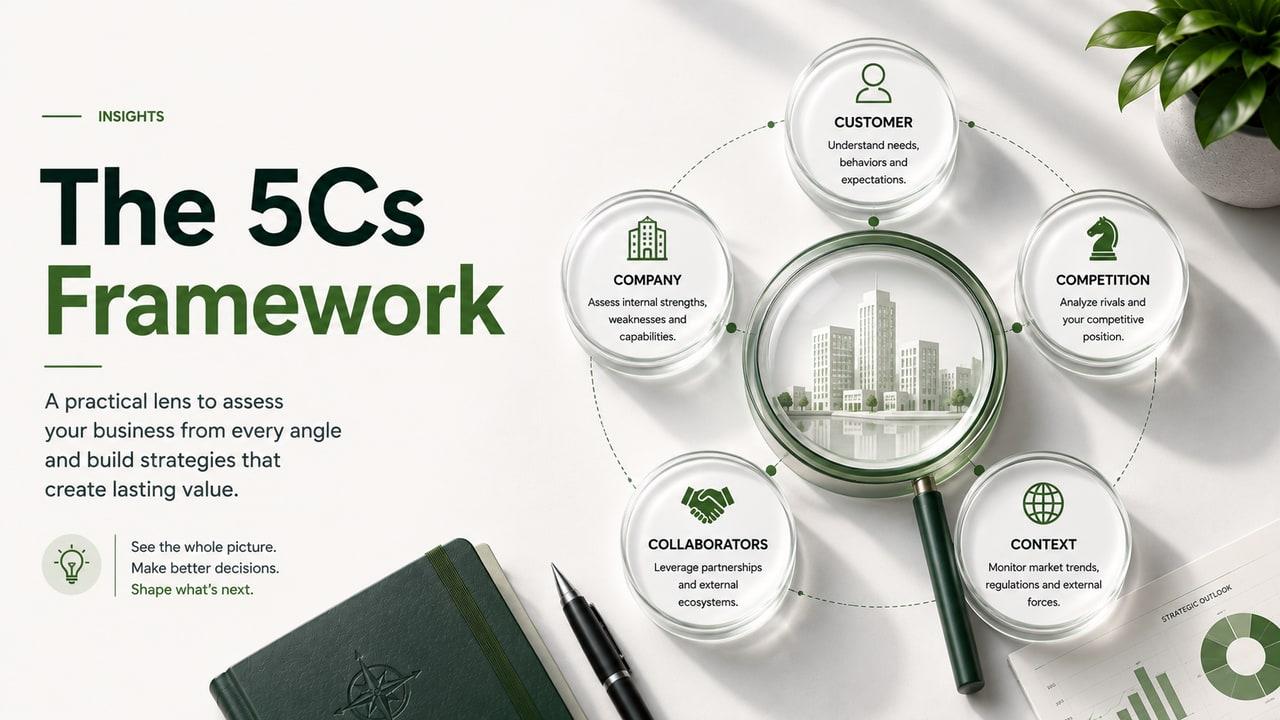
The five Cs are customer, company, collaborators, competition, and context — five dimensions you're meant to work through before setting strategy, on the theory that a plan built on all five beats a plan built on one.
The lineage usually given is that the 5Cs grew out of Kenichi Ohmae's strategic triangle (corporation, customer, competition), which reached English readers in 1982 in The Mind of the Strategist, adapted from Japanese work published seven years before that. It's a tidy story and we could find no evidence for it. The canonical 5Cs source, Robert Dolan's Harvard note, doesn't mention Ohmae at all; the ancestry it claims is entirely inside marketing. Two traditions that happen to share letters. Dolan calls it the classic five Cs (what people write when a thing arrived without an author), and the earliest citation anyone can actually produce is his note from 1997.
That story is repeated everywhere, with total confidence, by people who never checked it — including, until we checked, us. It sounds right. It has the shape of a fact. Which is exactly the failure the framework is about to produce at a scale that costs you money: the tool arrives already demonstrating it.
Because the five columns are five questions, not five research projects. In practice they all get answered the same way — from memory, in a room, by whoever speaks first. Who are our competitors has a real answer out in the world, but almost nobody goes and gets it. They recall it. And recall isn't a market measurement. It's a measurement of the person recalling.
The framework: the spread
Every strategy tool tells you what to decide. None of them tell you whether your organization can do it. The 5Cs has a sharper version of that problem, because it's the tool most likely to be mistaken for the answer it obscures:
The spread — how far apart your own leaders' answers are, before anybody reconciles them.
Five questions, answered independently and in writing, before any meeting exists. Then you diff them. The distance between the answers is the finding, and it's a different finding per C:
- Wide spread on Competition — your functions are fighting different wars. Sales is discounting against one rival, product is building against another, and neither knows.
- Wide spread on Company — you have no shared account of why you win. Every pitch, every job spec, and every roadmap argument is quietly about a different company.
- Wide spread on Customer — you're building for one buyer and selling to another. This one shows up in the numbers last and hurts longest.
- Wide spread on Collaborators — nobody agrees who you actually depend on, which means nobody is managing the dependency that will eventually bite.
- Wide spread on Context — your leaders are braced for different futures, so every planning conversation is really an unspoken argument about which one is coming.
A narrow spread isn't proof that you're right. It's proof that you're aligned, which is a different and rarer thing, and which you can act on. Wide spread means the strategy question in front of you isn't the strategy question you have. Your real one is upstream, and it's organizational.
Note what the spread costs to obtain: nothing. No research budget, no consultant, no data you don't already own. The market half of a 5Cs can be bought — anyone can buy it, including your competitors, which is exactly why it rarely separates anyone. The spread can't be bought, and it only exists in the moment before you average it away.
Why does a 5Cs workshop delete its own finding?
Almost every 5Cs is run as a session. Whiteboard, five columns, a facilitator, a good day. That format destroys the measurement before it's taken, for three reasons that have nothing to do with anyone doing a bad job.
The room has a rank order. The most senior answer becomes the consensus answer, not because anyone is a coward, but because agreeing is faster and the CEO's answer is rarely obviously wrong. The first confident sentence in the room sets an anchor, and everything after it is an adjustment.
Consensus is the deliverable. Somebody has to leave with a document. Five confident boxes look like completed work; "our three leaders named three different competitors" looks like a failed workshop. So the artifact quietly selects for agreement, and the most valuable thing that happened in the room is the one thing the document cannot contain.
Nobody wrote down the first answers. Without independent, recorded answers, there is no diff to take. This is the one that matters most, because the variance isn't suppressed — it's simply never captured. It evaporates in the first ten minutes and leaves no trace that it was ever there.
None of this is fixed by running a better session. You cannot facilitate your way to a measurement you never took. A team that has been talking for an hour will always produce more agreement than a team that hasn't — which is why agreement produced that way tells you about the hour, not the company. It's the mechanism behind Departmental Ping-Pong: functions don't drift apart because they disagree, they drift apart because nothing ever forces the disagreement into the same room at the same time.
Did stc and Apple just analyze better than everyone else?
No. And in one of the two cases, the analysis that everybody repeats is flatly wrong — which is the more useful lesson.
Apple is the most-analysed company on earth, and the standard read of its customer strategy is that it ignores market share and sells only to the premium segment. It isn't true. Apple finished 2025 first in global smartphone unit share: 20% against Samsung's 19%, with a record 25% in the fourth quarter (Counterpoint). It sells a $599 iPhone 16e and a $599 MacBook Neo, introduced as its most affordable laptop ever. It runs Beats as a second earbud brand positioned below AirPods. Its premium smart speaker failed outright, and it recovered the category by going down-market with the $99 mini — the exact inverse of the strategy it gets credited with. What Apple actually does is anchor each category at the top, where it captures a disproportionate share of the profit, then ladder downward to widen the base: 2.5 billion active devices as of January 2026, the engine underneath $109 billion of Services revenue in FY2025. Both at once, not a preference between them.
So: a 5Cs of Apple's Customer column, performed from outside by thousands of competent people with unlimited public data and total confidence — and wrong. If the most scrutinized company in the world gets mapped that badly, the difficulty isn't the framework. And the internal version of that exercise isn't safer. It's just the one nobody fact-checks.
stc gets told the other way round: telecom margins compressed, so stc read its environment, saw commoditization coming, and diversified. It's a satisfying story and the dates don't support it. Its payments arm was established in 2017, years before the squeeze that supposedly revealed the need. Global telecom EBITDA margins have held roughly steady around 35%, and stc's own numbers run the wrong way for the narrative: FY2025 revenue up 2.5% to SAR 77.82 billion, net profit up 12.5% to SAR 14.83 billion. The compression isn't visible in the company it supposedly moved.
What is visible is commitment. That 2017 wallet is now STC Bank — licensed by the Saudi Central Bank, commercially launched February 2025, past 8 million customers inside its first year. Eight years of funding something that wasn't the core business, through every budget round where the telco had a better-looking claim on the money.
Every winner's story can be retold as a clean five-column analysis — which is exactly why a clean five-column story about a winner tells you nothing. The framework is unfalsifiable after the fact; it fits any outcome you already know. What you cannot see from outside is the analysis anybody ran. What you can see is whether an organization agreed, and stayed agreed long enough for the money to compound. That's not an analytical achievement. It's an organizational one, and it's the thing the 5Cs is silent about.
How do you measure the spread?
Run this before your next strategy offsite, not during it.
- Ask before you meet. Send the five questions to your leadership team individually. Written answers, no group thread, no preamble. If they talk first, the instrument is already broken and you'll get a measurement of the conversation instead.
- Demand names, not categories. "Our three most significant competitors" means three names. "Doing nothing," "built it in-house," and "a spreadsheet" are legitimate answers and are often the right ones.
- Diff before you discuss. Put the raw answers side by side, unattributed, and read them out to the room before anyone explains themselves. The reaction is your second finding: watch who is surprised, because surprise maps to who has been operating alone.
- Score each C separately. An overall "we're pretty aligned" is useless. You want to know which column is wide, because that's the one telling you where the organization is actually broken.
- Start with the widest, not the most interesting. The widest C is your strategic agenda whether or not it's the one you wanted to work on.
- Don't close the spread in the room. A number everyone nods at by 4pm on a Thursday is not alignment; it's compliance, and it will re-open the moment people are back at their desks. Closing a wide spread is a quarter of work, not an afternoon.
- Ask who decides. For every C where the answers diverge, name the person who owns the call. If there isn't one, the spread isn't the problem: it's the symptom, and you have a decision drift problem underneath it.
- Re-run it in six months. The spread is a vital sign, not a diagnosis. The trend tells you more than any single reading.
Ask yourself
- If you asked your five most senior people to name your three biggest competitors right now, separately and in writing, how many identical lists would you get? Would you be willing to find out?
- When did your leadership team last see its own disagreement laid out side by side, rather than distributed across a month of separate meetings?
- Your last strategy offsite ended in agreement. Was that alignment, or was it the most senior person's answer plus four hours?
- Which of the five Cs would your team be least able to answer consistently, and how long have you known that without measuring it?
- What are you currently treating as emphasis that is actually disagreement?
The takeaway
The 5Cs is a good set of questions and it was never an analysis. Four of its five columns describe a world your competitors can read as easily as you can, from the same public sources, on the same afternoon. Nothing there separates you.
The one thing the exercise produces that nobody else can obtain is the distance between your own leaders' answers — and the standard way of running it, in a room, together, out loud, destroys that in the first ten minutes and calls the destruction alignment.
So don't run it in a room together. Ask separately, write it down, and look at the gaps before anyone explains them away. The finding was never going to be who our competitors are. It was going to be that you employ five people who already knew, and no two of them knew the same thing. Compare this with what Porter's Five Forces and PESTLE can and can't tell you, and the pattern holds: the tool reads the market. It has nothing to say about the organization holding the pen.
Frequently asked questions
- What is the 5Cs framework?
- A situation-analysis lens covering company, customers, competitors, collaborators, and climate. It is the broadest of the common strategy frameworks, which is both its use and its risk.
- When should you use the 5Cs?
- Early, before narrowing to a specific question. It is a scan, not a decision tool: it tells you which of the five deserves a sharper framework next.
- Why shouldn't the 5Cs be done in one room together?
- Because the loudest C wins. Run in a single session, the analysis converges on whichever category the most senior person cares about, and the other four get written up to agree with it.
- What are the five Cs in the 5Cs framework?
- Company, customers, competitors, collaborators, and climate, sometimes called context. They are five dimensions you scan before setting strategy, on the theory that a plan built on all five beats one built on a single view.
- How do you measure the spread in a 5Cs analysis?
- Send the five questions to your leaders individually and in writing, before any meeting, then lay the answers side by side and diff them per C. The distance between their answers is the finding, and it disappears the moment a room averages it away.
Related articles
 StrategyWorkforce Planning for Next Year's Strategy — Start From the Bets, Not the Headcount7 min read
 StrategyWhy Strategy Execution Fails: The Five Breaks in the Execution Chain9 min read
 StrategyOKRs — The Target Is Not the Capability14 min read
 StrategyThe Business Model Canvas — A Coherent Canvas Is Not a Company12 min read