Ansoff's Matrix — Every Box Is a Different Company
The matrix everyone teaches ranks four growth moves from safe to risky. Ansoff never drew that ladder. The axis it replaced was the one that mattered — how much of a company you don't run yet each move would force you to build.
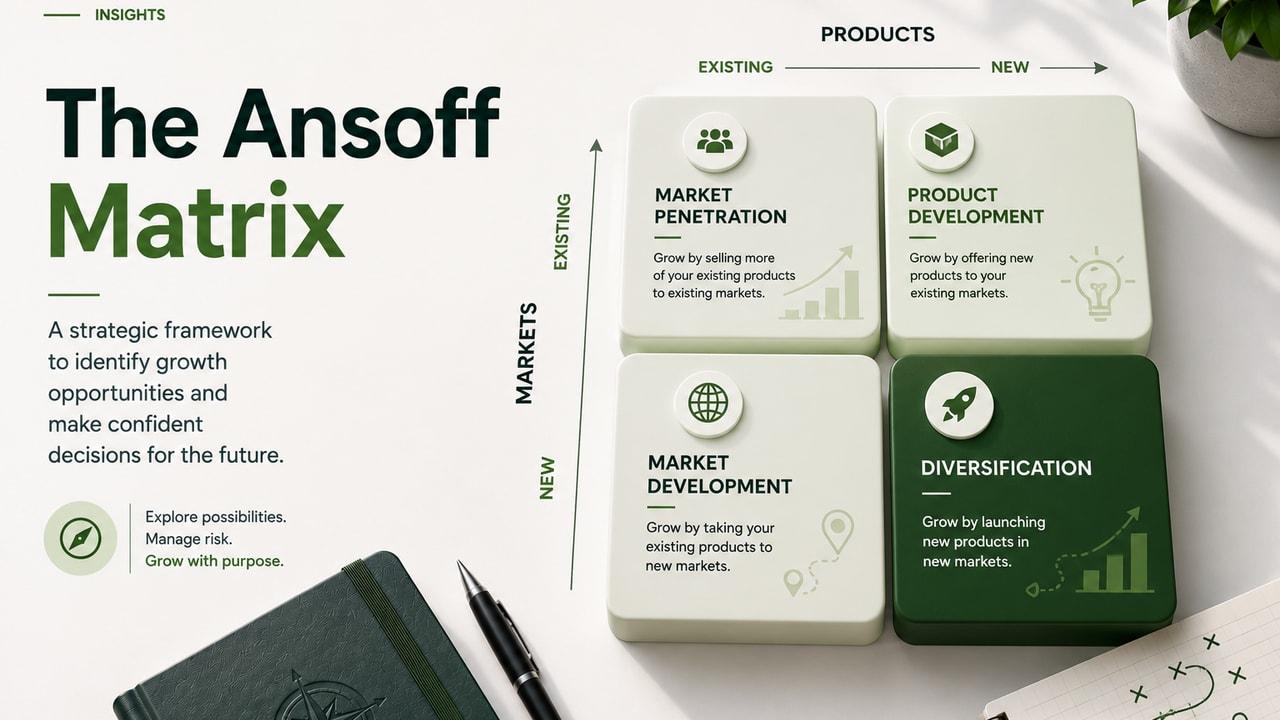
Here is a moment we have watched play out in more strategy offsites than we can count. A leadership team is arguing about a growth move — a new product, a new country, a new kind of customer. The argument is going in circles. Then somebody draws the four-box grid on the whiteboard, writes the initiative into one of the squares, and the room relaxes.
Watch what the relaxation is made of. The initiative went into market development, same product sold to new customers, and everyone has been taught that market development is the middle-risk box, safer than the scary one in the corner. So the grid didn't answer the question the team was fighting about. It reassigned it. The debate about whether the company could actually pull this off got quietly converted into a claim that it was moderately risky, and moderately risky sounds like something you manage with a bigger budget and a good plan.
The box did not lower the risk. It hid the work. And the work it hid is the entire reason growth moves fail.
The four-hour boardroom
One of the most useful conversations we have had with a founder started as one of the least productive. A regional food and beverage company, one product line and one channel and fifteen profitable years, had a board that wanted growth and a founder who called staying put "our lane." The expansion conversation, when it finally happened, ran four hours and ended exactly where it began. New products? New markets? Both? Nobody could get traction, because nobody in the room was arguing about the same thing. One person meant "sell the same cans in a new country." Another meant "make a new product for the shops we already supply." A third meant "become a different company entirely." They were using one word, growth, for four completely different amounts of work.
That is precisely the confusion Ansoff's Matrix exists to end, though not in the way the four-box poster suggests. The value isn't that it sorts your options into safe and dangerous. It's that it forces you to say, out loud, which of four different companies you are proposing to become. Three of those four companies do not exist yet. That is the whole subject, and it is the part the poster leaves out.
What Ansoff actually wrote
The version of the matrix that circulates today (four tidy squares, a traffic-light gradient running from green "market penetration" to red "diversification") is a reconstruction. It is worth going back to the original, because the original says something the reconstruction deleted.
Igor Ansoff published "Strategies for Diversification" in the Harvard Business Review in September 1957. Ansoff was an applied mathematician, a PhD from Brown with years at the RAND Corporation, who had just moved to Lockheed as its director of diversification, which is why every worked example in the article is about aircraft and air defense. He is often called the father of strategic management, a title Henry Mintzberg among others has given him, and the 1957 article is a large part of why.
Two things about that article surprise people who only know the poster.
The first: the famous grid is a minor device in it. The article is not about the four boxes. It is about diversification specifically (when to do it, how to evaluate it) and the two-by-two is a scene-setting exhibit in the opening pages, there to situate diversification against the three safer things a company could do instead. The tool the whole world teaches was a footnote to the argument Ansoff was actually making.
The second, and this is the one that matters: the risk ladder is not in the article. The word "risk" appears in the entire piece exactly once, in a list of reasons companies diversify ("to distribute risk"), not a ranking of the quadrants. Ansoff never says market penetration is low-risk or diversification is high-risk. The green-to-red gradient every deck inherits was added later, by textbooks and consultancies, and no study has ever validated it. There is no research measuring failure rates box by box. The ladder everyone attributes to Ansoff is received tradition wearing his name.
What Ansoff wrote instead was about the organization. Diversification, he said, "generally requires new skills, new techniques, and new facilities," and "almost invariably leads to physical and organizational changes in the structure of the business which represent a distinct break with past business experience." Read that again with the poster in mind. He is not grading the move by how likely it is to go wrong. He is describing what the move demands of the company — new skills, new structure, a break with what you already are. That sentence is the axis the reconstruction threw away.
There is a smaller lost detail worth keeping, because it changes how you read the whole horizontal axis. Ansoff did not define the "market" side as a place or a demographic. He defined it as a mission: "a description of the job which the product is intended to perform." A market, to Ansoff, was a job to be done, forty years before the phrase became fashionable. So "new market" never meant "new map pin." It meant a new job for your product, which is, once again, a question about what your organization can do, not about geography.
The framework: the distinct break
Every strategy tool tells you what to decide. Almost none of them tell you whether your organization can do it. Ansoff's Matrix is the strange case of a tool that did tell you (that sentence about a distinct break in the structure of the business) and then got edited, over fifty years of teaching, into a tool that doesn't. Here is the axis, put back:
The distinct break — how far each box breaks from the company you already are. Not a risk to rate. A company you'd have to become.
Read the four boxes that way and they stop being risk levels. They become four organizations, and you already run only one of them.
- Market penetration is the company you already are. Same product, same job, same customers, same channel. It is the only box that asks you to build nothing new. That is what makes it "safe": not a lower risk score, but zero organizational distance.
- Market development keeps your product and rebuilds the company around it. A new segment or a new country is a new go-to-market organization: a channel you have never run, a sales motion you have never used, a regulatory and cultural reality you have never learned. You keep the thing you sell and replace almost everyone who sells it.
- Product development keeps your customers and asks you to become a company that can build and support something you have never built. New capability, new roles, new failure modes, all of it sitting behind a customer relationship you already have, which is exactly what makes the gap easy to underestimate.
- Diversification is two distinct breaks at once: a product you cannot yet make, sold to customers you do not yet understand. This is Ansoff's own category, the one he actually wrote about, and the reason he called it a break with past experience rather than a redder square.
The practical consequence is large. Risk is something you price and carry. Distance is something you build or you don't, and unlike risk you can shrink it before you spend, by hiring the capability, acquiring it, partnering for it, or running a deliberately small version first to buy the missing knowledge cheaply. The matrix, read as a capability map, tells you what to go build. Read as a risk map, it only tells you which box to be afraid of.
Why the risk reading wins anyway
If the capability reading is truer, why does the risk ladder win in every boardroom? Not because people are careless. Because a risk rating is a number, and a capability gap is a hire. "Market development is moderately risky" costs nothing to say and commits no one. "We would have to build a channel organization we have never run, led by someone we have not hired" is a budget, a headcount, and an admission. Putting the initiative in a square feels like progress, because the messy argument is now a tidy diagram, and the tidiness is exactly the danger: the capability question that was live in the argument gets filed under a color and stops being asked.
Underneath that is the same organizational gravity we described in Blue Ocean Strategy. The person who presents the exciting new market gets credit for vision; the person who asks who will run the new channel, and whether that person exists, is a blocker. So the destination gets named with enthusiasm and the distance gets waved through.
It is also close to the one serious academic critique aimed at the matrix itself. Not Mintzberg's, which targets Ansoff's later planning machinery, but John Dawes's 2018 observation that the "existing versus new" line is arbitrary, so product development and diversification bleed into each other the moment a genuinely new product drags you into an unfamiliar market. The boundary the poster draws so crisply is, in practice, a smear. What you are really measuring is distance, and distance comes in degrees, not four discrete boxes.
Amazon didn't climb the ladder
Amazon is the case study every deck reaches for, almost always told as a clean staircase: online bookstore, then every category, then Prime, then Amazon Web Services, each step building neatly on the one before, a company ascending the Ansoff matrix with perfect discipline. It is a lovely story and it is hindsight. Amazon did not climb a ladder. It made a very large number of jumps, most of which failed, and the tidy sequence is what you get when you draw a line through only the survivors.
Look at the graveyard. The Fire Phone, Amazon's leap into making its own hardware for a market it didn't own, shipped in 2014 and was effectively dead within a year; Amazon booked a $170 million charge against it, the one killed bet it ever put a public number on. Amazon Wallet, Restaurants, Destinations, Local, Care, Style: a decade of diversification and market-development bets, opened and shut. And the largest retreat is current. In January 2026 Amazon announced it was closing its entire Amazon Go and Amazon Fresh physical-store business, with the plain admission that it "haven't yet created a truly distinctive customer experience with the right economic model." The most capable operator on earth, and the new-market box beat it repeatedly.
Now the one that worked, because how it worked is the whole point. AWS is roughly three-fifths of Amazon's operating profit today on about a sixth of its revenue: a diversification, new product and new customer both, now more valuable than the company it grew out of. The popular explanation is that Amazon had spare server capacity and rented it out. That is a myth, and the people who built AWS have said so in as many words. Benjamin Black, who co-wrote the original proposal, put it bluntly: "From day one, every part of AWS has been purpose built for AWS." Werner Vogels, Amazon's CTO, called the excess-capacity story "a myth" outright. AWS did not fall out of leftover infrastructure. It was deliberately built as a product, off a capability Amazon recognized it genuinely had: the distinct break, made on purpose, with the skills and structure actually assembled to survive it.
That is the difference the matrix cannot show you and Amazon's record makes obvious. The failures and the triumph sit in the same "diversification" box. What separated them was never which square they were in. It was whether the capability the break demanded was really there. Jeff Bezos treats the matrix exactly this way, and budgets for it. In his 2018 letter to shareholders he wrote that Amazon should expect "multibillion-dollar failures," because "if the size of your failures isn't growing, you're not going to be inventing at a size that can actually move the needle," and he noted that the Fire Phone's real yield was the people and the learnings it handed to the team that built Alexa. That is a company that has stopped reading the matrix as a risk ladder to climb carefully and started reading it as a portfolio of capability bets, most of which will die, all of which leave capability behind.
Using it as a capability map
The fix is not a better grid. It is a different question at each box. Instead of "how risky is this square," ask "how much of a company we don't run yet does this require, and can we build it."
- Name the company each option would make you. For every initiative, write the sentence Ansoff wrote: what new skills, what new structure, what break with how we work today. If you can't fill that in, you haven't evaluated the move, only located it on a diagram.
- Put the capability gap in the language of roles. "New channel" is a color on a chart. "A head of distribution for a channel we've never operated, plus the team under them, none of whom are on our org chart" is a decision. Force the second version.
- Ask how you'd retire the distance before you spend. The knowledge you're missing can often be hired, bought, partnered for, or bought cheaply by running a small version first. That is the move the risk reading never suggests, because risk you can only brace for, while distance you can close.
- Count the breaks you already have open. Map everything you're currently funding onto the matrix. If most of it sits above market penetration, you are running several companies you don't yet know how to run, all at once, and that concentration, not any single box's risk rating, is what will hurt you. It is the same failure of translation we describe in Decision Drift: ambition set at the top that no one downstream has the capability to execute.
- Finish penetration before you fund a break. The cheapest growth is almost always more of the company you already are, and if you haven't exhausted it, a new break is often ambition outrunning the easier money still in the box you own. It also holds up better against Porter's Five Forces: know whether the structure of the new market even permits the margin before you build a company to enter it.
Ask yourself
- Take your last growth decision and name the company it required you to become. Did anyone write that sentence down before you committed, or did the box stand in for it?
- Of everything you're funding right now, how much sits above market penetration? How many companies you don't yet run are you trying to become at once?
- When your team called a move "medium-risk," did that phrase describe a capability you'd assessed, or a capability you'd skipped assessing?
- For your most exciting growth bet, can you name the specific people who would run the part of the company that doesn't exist yet? If you can't name them, you haven't sized the break.
- Have you genuinely exhausted the growth available in the company you already are, or is the new market more interesting than the old one is finished?
The takeaway
Ansoff's Matrix does not rank your growth options from safe to dangerous. That ladder was added after he died and never rested on evidence. What Ansoff actually described, and what the four boxes still measure if you let them, is distance: how far each move breaks from the company you are today, and therefore how much of a company you don't run yet you would have to build to survive it.
So the honest question at the end of a growth session is not "which box is safest." It is "which of these four companies are we proposing to become, and do we have, or can we build, what that company requires." The matrix draws the four destinations cleanly. Everything that decides whether you arrive is the organization you'd have to become to get there, and about that the grid is silent. It always was. Ansoff wasn't. The teaching just stopped quoting the sentence where he told you.
Frequently asked questions
- What is the Ansoff Matrix?
- A growth framework crossing products against markets to produce four strategies: market penetration, product development, market development, and diversification.
- Which Ansoff strategy carries the most risk?
- Diversification, because it changes both what you sell and who you sell it to at once. But the ranking is less useful than the observation that each square demands different capabilities.
- Can a company pursue more than one square?
- It can, and most do. The trap is treating them as one plan: penetration rewards efficiency and repetition, while diversification rewards tolerance for being bad at something new. Run them in the same team and the first quietly strangles the second.
- Did Ansoff's matrix originally rank the four strategies by risk?
- No. In Ansoff's 1957 article the word risk appears once, as a reason companies diversify, not a ranking of the quadrants. The green-to-red ladder was added later by textbooks and consultancies, and no study has ever validated failure rates box by box.
- How should you use the Ansoff Matrix?
- Read it as a capability map, not a risk ladder. For each option, name the company it would make you become: the new skills, structure, and roles it demands. Then ask how you could retire that distance before you spend, by hiring, partnering, or running a small version first.
Related articles
 StrategyWorkforce Planning for Next Year's Strategy — Start From the Bets, Not the Headcount7 min read
 StrategyOKRs — The Target Is Not the Capability14 min read
 StrategyThe Business Model Canvas — A Coherent Canvas Is Not a Company12 min read
 StrategyThe BCG Matrix — You Can Move the Cash, Not the Company14 min read