Blue Ocean Strategy — You Only Filled In Half the Grid
Blue Ocean Strategy gives you four moves: two add, two subtract. Every grid comes back filled in on the addition half — and subtraction was the half that paid.
We have watched a lot of leadership teams fill in an ERRC grid. Four boxes (Eliminate, Reduce, Raise, Create), ninety minutes, good energy, a wall of sticky notes.
Here is what the wall looks like at the end, nearly every time. Create has a dozen notes on it. Raise has eight. Reduce has two, one of which says "meetings." Eliminate has one note, or none, and if there is one it says something like "legacy reporting."
Nobody in the room notices. The grid is three-quarters full, and three-quarters full looks like a finished morning's work.
Then somebody draws the strategy canvas, and the value curve comes out sitting almost exactly on top of the competitors' curve — a little higher in a few places, a little more expensive everywhere. Which is a red ocean with better adjectives. The team has just spent a morning designing a costlier version of what it already sells, and it will spend the next year funding it.
The half that pays for the other half
The two founders of one of the GCC's most successful home décor concepts didn't start by studying competitors. They started with a household nobody was serving: middle-income, design-literate, priced out of the premium showrooms and unwilling to settle for the utilitarian ones. Nothing in between. So they built the in-between.
That's the version of the story everyone tells, and it's the easy half. Design-forward at a middle income is not a positioning choice. It's an arithmetic problem. Somebody has to pay for the design, and by definition it isn't the customer. So the founders' real work wasn't the gap they spotted — plenty of people spot gaps, and the gap had been sitting there in plain sight for years. Their work was being willing to take things out of a furniture business that furniture businesses assume are structural.
We don't know their full list, and it doesn't matter here. What matters is that the interesting half of that story is the half nobody ever asks them about.
What is Blue Ocean Strategy actually claiming?
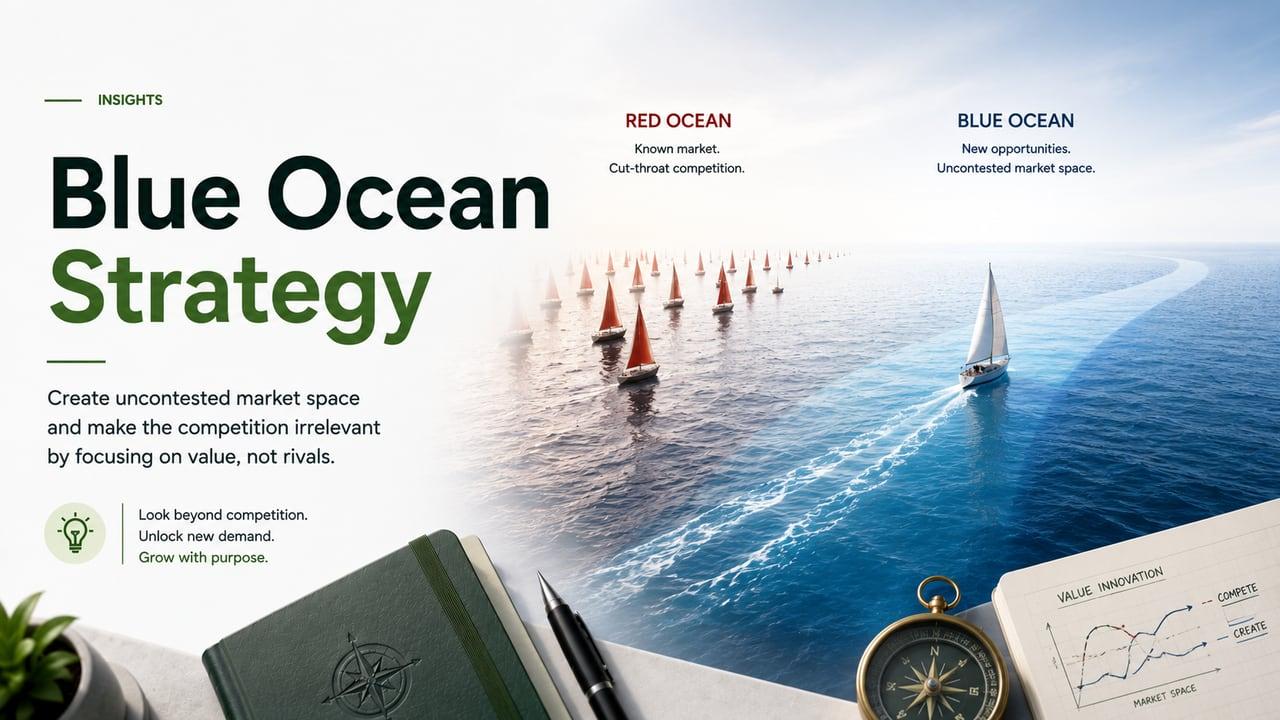
The book (W. Chan Kim and Renée Mauborgne, Harvard Business School Press, February 2005) argues that most industries are red oceans (crowded, price-competing, margin-bleeding) and that the winning move is to create uncontested space where the competition becomes irrelevant. The ideas had been running in Harvard Business Review since 1997 under a different name, value innovation; the "blue ocean" label itself arrived in an HBR article in October 2004, a year before the book.
Its central claim is the interesting one, and it isn't "be different." It's that differentiation and low cost are not a trade-off — that you can have both at once.
Sit with that, because it's an arithmetic claim, not a strategic one. If you're going to be more valuable and cheaper than the incumbents, the money has to come from somewhere. It can't come from your customer, and it can't come from your margin. It can only come out of something you stopped doing.
The book knows this. That's what the grid is for.
One thing worth knowing about what you're holding, though. The headline statistic (108 companies' launches, of which 86% were line extensions producing 62% of revenue and 39% of profit, while the 14% aimed at blue oceans produced 38% of revenue and 61% of profit) has no endnote. The book never names the companies, the sampling frame, or how a launch was classified. And it concedes the hole itself: "Although we don't have data on the hit rate of success of red and blue ocean initiatives, the global performance differences between them are marked." Phil Rosenzweig's review asked the obvious question — if the differences are marked, they have the data; if they don't, there's no basis for "marked." "The authors can't play both sides of the argument."
We're not telling you to throw the tool away; we use it. We're telling you which half holds. The evidence is thin. The arithmetic isn't — and the arithmetic runs entirely through the half of the grid you skipped.
The framework: the subtraction half
Every strategy tool tells you what to decide. None of them tell you whether your organization can do it. Blue Ocean's version of that silence is unusually precise, because its grid is exactly half made of the thing organizations cannot do:
The subtraction half — Eliminate and Reduce. The two boxes that fund the other two, and the only two that name people.
Look at the four honestly. Raise and Create are addition: more of a thing, or a new thing. Both feel like strategy. Both can be resourced by asking for budget. Neither costs anyone in the room anything today.
Eliminate and Reduce are subtraction. They are where the money for Raise and Create comes from — that is the entire mechanism by which "differentiation and low cost" stops being a slogan and starts being a P&L. And filled in honestly, they are the only boxes in the grid that name a person:
- Eliminate names the job that ends. A factor your industry competes on isn't an abstraction. It's a function, with a head, a budget, and a floor of people whose working identity is that factor.
- Reduce names the budget that shrinks, and the manager who'll spend the next planning cycle explaining why it shouldn't.
- Raise names the team that has to become dramatically better at something they're currently average at, which sounds like a compliment and is actually a capability gap.
- Create names a capability you don't employ yet. Which means hiring, or buying, or admitting you can't.
So the ERRC grid isn't a marketing exercise. It's a restructuring plan in marketing clothing — and it's being filled in by the people it restructures.
That's the whole of the sticky-note asymmetry. Create is easy because nothing in it costs anyone anything this quarter. Eliminate is empty because the person who'd have to write the note is in the room, and the note has their name on it.
Why is Eliminate always empty?
Here's where "courage" usually gets offered as the explanation. Courage isn't a mechanism. You can't schedule it, budget it, or hire for it, and telling a team they lacked it explains nothing they can act on. Three things are actually happening, and none of them require anyone in that room to be a coward.
Every incentive in a company points at addition. Budgets grow, headcount grows, scope grows, and promotion follows all three. Nobody has ever been promoted for removing their own function. The organization pays for adding with money and status, and pays for removing with a smaller team and a quieter seat at the table. A grid filled in by people inside that system will lean the way the system leans.
Subtraction is said out loud, in front of the person. "Create an onboarding concierge" costs nothing today and can be proposed cheerfully. "Eliminate the showroom" is a sentence about specific colleagues, spoken while they're sitting there. The first is a strategy note. The second is a personnel announcement wearing a sticky note's clothes, and everyone in the room hears it that way.
Nobody owns removal. Every factor your industry competes on has a champion — someone whose job is to defend and improve it. No factor has an opposite number whose job is to ask whether it should exist at all. So factors accumulate, and after long enough the accumulation stops looking like a pile of decisions nobody revisited and starts looking like the definition of the industry. It's the same mechanism as the Ceremony Trap: the standup that outlived its purpose doesn't survive because someone defends it. It survives because ending it is nobody's job.
None of this is fixed by running a better session. You cannot brainstorm your way out of an incentive structure.
Did Cirque du Soleil escape competition?
For about fifteen years. Then it was beaten by a man who used to work there, and then it went bankrupt.
Cirque is the canonical case, and it deserves to be, because it actually did the subtraction. Its ERRC grid is the most lopsided in the book — in the opposite direction from every grid we've watched a team produce. Eliminate is its largest cell: star performers, animal shows, aisle concession sales, multiple show arenas. Reduce: fun and humor, thrill and danger. Only then does the addition arrive: theme, refined environment, artistic music and dance.
Read that list as an organization rather than a strategy. It's the end of the animal operation and everyone attached to it. It's dropping the star system the industry's economics ran on. It's removing the three-ring format — which the book files under Eliminate, not Reduce, a detail worth getting right if you're teaching the grid. Years of demolition, and the blue ocean is what was left standing afterward. The result was real: in twenty years Cirque reached a level of revenue it had taken Ringling Bros. and Barnum & Bailey, the world's leading circus, more than a century to attain.
Now the part the case study leaves out.
The book says companies that create blue oceans "reap the benefits without credible challenges for ten to 15 years, as was the case with Cirque du Soleil." Cirque was founded in 1984. The book was published in 2005. On the book's own arithmetic, the window had closed six years before it named Cirque as the proof.
And the challenge, when it came, walked out of the building. Franco Dragone was Cirque's own creative director — ten of its productions between 1985 and 1999, Mystère and O among them. He left, and built Le Rêve at Wynn Las Vegas, which opened in 2005: the same year the book held Cirque up as an uncontested market. The 7 Fingers was founded by seven ex-Cirque artists. Cirque's moat was not cognitive or economic, which is what the book claims protects a blue ocean. Cirque's moat was Dragone, and Dragone had legs.
The ending is harder and more useful. On 29 June 2020 Cirque filed for creditor protection in Québec, with a US filing two days later: roughly a billion dollars of debt, some 3,480 people terminated, the equity wiped out entirely.
Be careful with the lesson, because the easy one is wrong. Cirque wasn't killed by the pandemic and it wasn't a bad business — going in, it was steadily if modestly profitable. It was killed by a balance sheet. A 2015 leveraged buyout put roughly $900 million of debt on it, on top of a diversification spree that bought complexity without margin. A company with no debt survives a shutdown. A company with $900 million of it and no revenue does not.
So: the blue ocean was real, it lasted a generation, it was closed by its own alumni, and the company was ended by a capital structure the strategy canvas has no axis for. A blue ocean isn't a place you find. It's an organization you become — and organizations leak, and organizations carry debt, and neither of those appears anywhere on the grid.
Cirque is still here, for the record: roughly a billion in revenue, more tickets sold than before the pandemic, owned now by the creditors who bought it out of bankruptcy — and retrenching toward about the scale it started at.
How do you fill in the subtraction half?
- Fill Eliminate first, and let nobody write in another box until it has three real entries. The order is the entire intervention. Create-first grids never come back to subtraction, because by then the money has already been spent on paper.
- Ban abstractions. "Legacy processes" is not an entry. "The showroom," "the customization desk," "the outbound team" are entries. If it doesn't have a budget line, it isn't a factor: it's a feeling.
- Put a name next to every entry, in all four boxes. Whose job ends, whose budget shrinks, who has to get dramatically better, who you'd have to hire. If nobody can name them, you haven't made a decision. You've had a conversation.
- Ask who champions each factor, then ask who's paid to question it. The second list is always empty, and that asymmetry is the reason your industry's list of competing factors has only ever grown.
- Do the arithmetic out loud. Total what Eliminate and Reduce free up. Total what Raise and Create cost. If the second number is bigger, you don't have a blue ocean strategy: you have a more expensive red one, and you want to know that in the room rather than in year two.
- Ask what happens if the person who is the ocean leaves. Cirque's answer was Le Rêve. If your differentiation lives in one team, or one name, your moat has a notice period.
- Date it and re-run it. A blue ocean is a moment, not a condition. Set against Porter's Five Forces, the pair is neat: Porter describes the shelter you're standing in, Blue Ocean tells you to go build a new one. Neither promises it'll still be standing in ten years.
Ask yourself
- Pull up your last ERRC grid. How many entries are in Eliminate, and how many in Create? What does that ratio tell you that the session didn't?
- Name one thing your organization has genuinely stopped doing in the last two years — stopped, not "deprioritized." How long did it take, and who paid for it?
- Every factor you compete on has someone who owns making it better. Who owns asking whether it should exist?
- If your differentiation is real, name the people it lives in. What's their notice period?
- If you did the arithmetic on your last strategy (everything you'd add, minus everything you'd remove), would the number come out negative? Did anyone check?
The takeaway
Blue Ocean Strategy's real promise is arithmetic: differentiation and low cost at the same time, which is only possible if something large comes out. The canvas, the curves, the four questions are scaffolding around that single trade.
And the trade lives in the half of the grid your organization is structurally unable to fill in — because every incentive you have points at addition, and the subtraction boxes have your colleagues' names in them.
So the question at the end of a blue ocean session isn't what could we create? Your team answered that in the first twenty minutes, enthusiastically, and none of it was free. The question is what you're willing to stop doing to pay for it, and whether that answer survives contact with the people who'd have to stop. Set this beside what the 5Cs can and can't tell you and the pattern holds across the whole shelf: the tool draws the map. It has nothing to say about the organization that has to walk it.
Frequently asked questions
- What is blue ocean strategy?
- An approach that competes by creating new, uncontested market space rather than fighting for share in an existing one, usually by changing what an industry competes on.
- What is the four actions framework?
- Eliminate, reduce, raise, and create: the four moves that reshape an industry's factors of competition. Value innovation comes from doing all four, not from raising and creating alone.
- Why do most blue ocean attempts fail?
- Because teams fill in raise and create and skip eliminate and reduce. Adding without subtracting produces a more expensive version of the red ocean, not an exit from it.
- What is the difference between a red ocean and a blue ocean?
- A red ocean is an existing, crowded market where firms compete on the same factors and bleed margin on price. A blue ocean is uncontested space you create by changing what the industry competes on, so rivals become irrelevant.
- Why should you fill in the Eliminate box first?
- Because Eliminate and Reduce are what fund Raise and Create, and grids that start with addition never come back to subtraction once the money is spent on paper. Filling Eliminate first, with real named entries, is the whole intervention.
Related articles
 StrategyWorkforce Planning for Next Year's Strategy — Start From the Bets, Not the Headcount7 min read
 StrategyOKRs — The Target Is Not the Capability14 min read
 StrategyThe Business Model Canvas — A Coherent Canvas Is Not a Company12 min read
 StrategyThe BCG Matrix — You Can Move the Cash, Not the Company14 min read