Building a Culture That Scales (Without Slowing Down)
Culture is strongest when a company is small — and most fragile exactly when it grows. Our Values → Behaviors → Systems model turns culture from a feeling into something that survives scale.
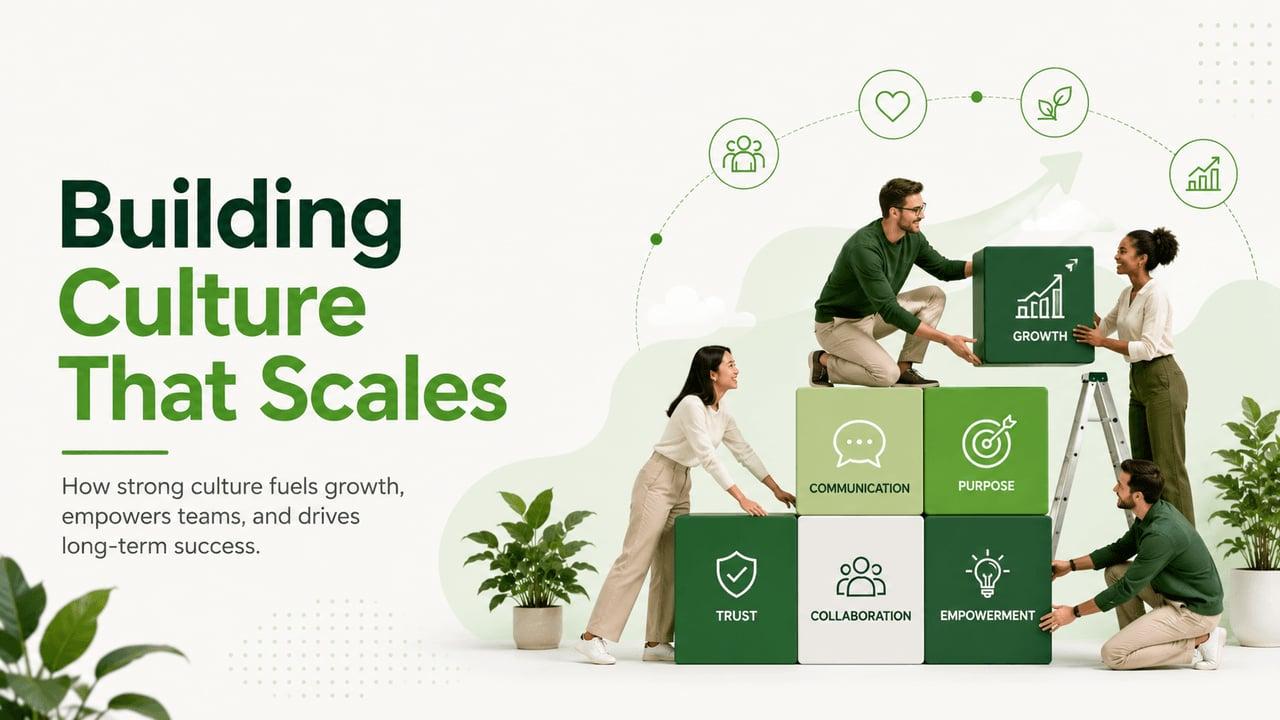
Culture is often strongest in a company's early days: when alignment is natural, communication is direct, and decisions are made quickly. But as organizations grow, that same culture is at risk of breaking under the weight of new people, new layers, and new complexity.
Scaling culture is not about preserving the past. It is about translating what made the company successful into systems that can survive growth.
When culture quietly slips
A founder we worked with was certain his culture was bulletproof — until he ran an engagement survey at around ninety people. "The scores from anyone who'd joined in the last year looked like a different company," he told us. "Not worse people. They'd just learned our culture secondhand, from people who'd learned it secondhand." Nobody had abandoned the values. They'd simply gotten fainter with each layer, like a photocopy of a photocopy.
That's how culture usually erodes at scale: not in a dramatic collapse, but quietly, one well-meaning hire at a time.
The Values → Behaviors → Systems model
To scale, culture has to be understood as three connected layers, what we call the Values → Behaviors → Systems model:
- Values — what we believe.
- Behaviors — how those values show up in action.
- Systems — how the organization reinforces those behaviors.
The layers depend on each other. Without behaviors, values are just statements on a wall. Without systems, behaviors depend on whoever happens to be in the room. Most companies write down values and stop there, which is exactly why their culture doesn't survive contact with growth. The work is to push each value all the way through to a system.
Where does culture break as companies grow?
Most companies don't lose culture suddenly — they dilute it gradually. The most common breaking points:
- Inconsistent leadership behavior
- Unclear decision-making frameworks
- Managers interpreting culture differently
- Hiring that prioritizes skills over values alignment
Among these, managers are the most critical layer. This isn't a hunch. It's one of the most consistent findings in engagement research: employees experience "the company" largely through their direct manager. A manager who lives the values transmits them; one who doesn't quietly overwrites them for an entire team, no matter what the values poster says.
How do you scale culture as a company grows?
A practical sequence:
- Make values behavioral, not theoretical. Define what each value looks like in real work situations, not just words on a wall.
- Build consistency into hiring. Use structured interviews and clear criteria to assess values-based behaviors, not personality fit.
- Equip managers as culture carriers. Train, align, and measure managers on how they reinforce culture, not just on the results they deliver.
- Embed culture into systems. Performance reviews, onboarding, promotions, and recognition must all reflect the same cultural principles.
- Measure culture health. Track signals like engagement, retention by cohort, and manager effectiveness to see where culture is strengthening or weakening.
The contrarian part
Strong culture is not the same as comfortable culture. The companies that scale culture well don't optimize for everyone feeling at home — they optimize for everyone sharing a how. That sometimes means hiring people who'll disagree, and turning away a brilliant candidate whose working style would quietly degrade the team. "Protect the culture" doesn't mean "hire people like us." It means hold the line on behaviors, and stay genuinely open on everything else.
Ask yourself
- Could each of your values be turned into a behavior you'd actually score in an interview?
- Do your managers reinforce the culture consistently, or does it change team to team?
- Does anything in your systems (reviews, promotions, recognition) reward people who live the values, or only people who hit the numbers?
- If you surveyed your newest cohort tomorrow, would they describe the same culture as your first ten employees?
The takeaway
Culture does not scale automatically. It either becomes stronger through design, or weaker through neglect. The companies that scale successfully are not those with the strongest culture at the start, but those that build the systems to sustain it at every stage of growth. Push every value through to a behavior, and every behavior through to a system, and culture stops being a fragile feeling and becomes something that holds.
Frequently asked questions
- What does it mean for a culture to scale?
- That the behaviours you want survive without the founder in the room. Early culture runs on proximity; scaled culture runs on things written down and reinforced by how people are hired, promoted, and corrected.
- At what size does culture start to break?
- Usually somewhere past twenty-five to forty people, when the founder stops being present for every decision. The culture does not degrade so much as stop transmitting.
- Does writing values down actually help?
- Only if they change a decision someone would otherwise have made differently. Values that no one has ever been turned down over are decoration.
- What is the Values, Behaviors, Systems model?
- A way to make culture survive growth by pushing each value all the way through. Values are what you believe, behaviors are how they show up in action, and systems are how the organization reinforces those behaviors. Most companies write down values and stop there.
- Why do managers matter most for scaling culture?
- Employees experience the company largely through their direct manager. A manager who lives the values transmits them; one who does not quietly overwrites them for an entire team, no matter what the values poster says.
Related articles
 CultureOrganizational Culture: How It Actually Drives Performance5 min read
 CulturePeople Strategy Isn't an HR Document. It's a Business Model.12 min read
 CultureStop Treating Culture Like a First Date. It's Built for the Long Haul5 min read
 CultureI Thought They Were Slogans on the Wall — Until I Saw People Living Them6 min read