Is Your Daily Huddle for Alignment — or Control?
Most leaders start a daily huddle to create alignment. Watch one for a week and you'll usually see something else: status flowing upward to reassure the person at the top. We call it the Direction of Flow — and it quietly decides whether your meeting cascades your strategy or just monitors your people. Here's how to tell which one you're running, and how strategy actually travels down an organization.
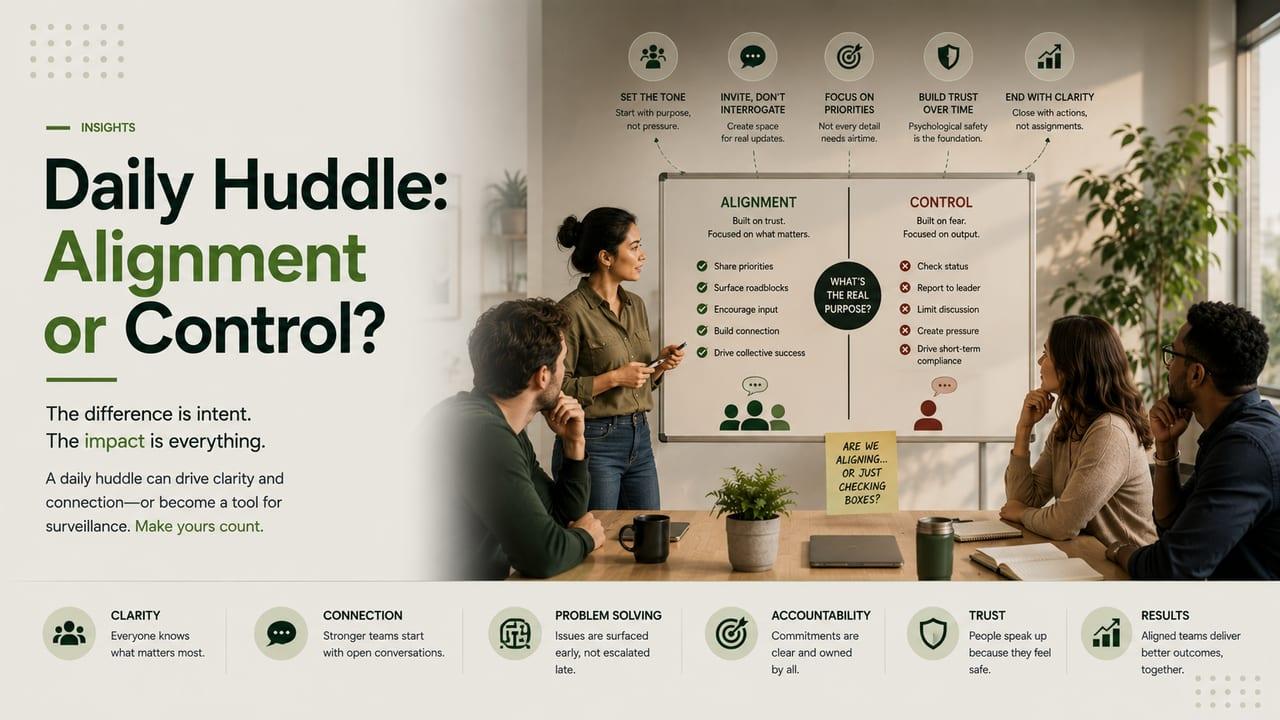
Almost every leader we work with starts the daily huddle for the same honorable reason: alignment. Get everyone in a room for fifteen minutes, share what matters, point the team the same way. It sounds like the most natural management instinct in the world. And then, somewhere in the first few weeks, the meeting quietly becomes something else — and most leaders never notice the switch.
Sit in the back of a huddle that's been running for a month and listen to where the words are going. One by one, people report up: what I did yesterday, what I'm doing today, what's blocking me. The leader nods, unblocks, occasionally course-corrects. Everyone leaves. It feels productive. But notice the shape of it — almost all the information moved in one direction: upward, toward the person who called the meeting. That meeting is no longer creating alignment. It's performing control. And the two look almost identical from the inside, which is exactly why the drift goes unseen.
The huddle that slowly changed jobs
A founder we worked with (second-time, thoughtful, genuinely allergic to micromanaging) ran a 9 a.m. standup he was proud of. "It keeps us aligned," he told us. We asked if we could just watch one. For eleven minutes, six people took turns telling him what they were working on. He asked two sharp questions, removed one blocker, and the meeting ended on time. Crisp. Disciplined. Useless for the thing he thought it was doing.
"I realized I hadn't said a single word about why any of it mattered," he admitted afterwards. "I was collecting status and calling it alignment. If you'd asked anyone in that room how their task connected to our strategy this quarter, they couldn't have told you — and neither, honestly, could I in that moment."
That's the trap in one sentence. He hadn't built a bad meeting. He'd built a control meeting and labeled it an alignment meeting — and the label was the problem, because it stopped him from noticing that the strategy never actually left his own head.
The framework: the Direction of Flow
Here's the lens we give leaders. Every recurring meeting moves information in a dominant direction, and that direction (not the agenda, not the cadence) tells you what the meeting is really for.
- Upward flow is control. Status, progress, "are we on track?", "what's blocked?" The value accrues to the person at the top: it relieves their anxiety, feeds their dashboard, lets them intervene. Useful — but it equips the leader, not the team.
- Downward flow is alignment. Context, priority, the why behind the what, and above all the criteria people should decide with when no one is watching. The value accrues to the people at the edge: they leave able to make better calls without asking up.
Now the uncomfortable part. A daily huddle defaults to upward flow — not because leaders are controlling, but because upward flow is what relieves the felt pressure in the room. The leader is anxious to know things are moving; the team is anxious to show they are. Status is the path of least resistance for both. Left undesigned, every huddle slides toward control, because control is the emotionally easier meeting to have. Alignment has to be engineered against the current.
So the first question isn't "is my huddle good?" It's: which way does it flow? Stand at the back and count. If most sentences end at you, you have a control meeting — and whatever you believe you're cascading is still sitting with you.
Does having a daily huddle mean your strategy is cascading?
Here's the belief we most often have to dismantle: that strategy cascades through frequency. The logic feels airtight: we meet every day, I mention priorities, therefore the strategy must be reaching the edge. It isn't. Frequency moves status efficiently. It does almost nothing for strategy, because strategy doesn't travel as information. It travels as translation.
This is the second half of the framework, and the more important one: a cascade is a chain of translations, not a relay of the same sentence. When a company priority is simply repeated verbatim at each level (leadership says it, the manager says it, the team hears it) nothing has cascaded. An announcement has echoed. A real cascade happens only when each layer rewrites the strategy in the currency of the layer below it:
- Leadership sets the strategy: where we play and how we win.
- The manager translates it into this quarter's priorities for this team: given that, here's what we're saying yes and no to.
- The huddle translates that into this week's decisions: so when X and Y conflict today, we choose X.
- The person carries it into the call no one will review: I know which way to lean without asking.
Strategy has cascaded only when it survives all four translations. If any layer just forwards the sentence above it without converting it into the next layer's decisions, the cascade breaks there — and everything below that break is improvising. Most organizations break at rung 2 or 3: the strategy is known, even recited, but never translated into the criteria a team decides with this week. (We've written about that missing rung at length in Decision Drift: the huddle is simply the place it most visibly succeeds or fails.)
Why this happens — it isn't a discipline problem
It's tempting to read a control-shaped huddle as a leader being a control freak. It almost never is. Two well-understood forces bend the meeting toward control on their own.
The first is information asymmetry and anxiety. The leader carries accountability for outcomes but sits furthest from the daily work, so they feel a structural pull to pull information up — it's how they reduce the uncertainty their role generates. The huddle becomes the instrument for that relief. Nothing malicious; it's the org chart expressing itself through the agenda.
The second is what behavioral researchers call the streetlight effect: we search where the light is, not where the answer is. Status is legible: it fits in a sentence, shows up green or red, can be reported in a round-robin. Strategic context is illegible in those same fifteen minutes: it's ambiguous, situational, hard to compress. So the meeting fills with the legible thing and crowds out the illegible one. The team learns, fast, that the huddle rewards having something tidy to report — and once that's the incentive, people optimize for a clean status update rather than a hard question, and the control loop reinforces itself daily. This is also why "just add a strategy slide to the standup" never works: you can't defeat a structural current with an agenda item.
How do you turn a control huddle into an alignment one?
You don't fix this by cancelling the huddle — status flow is genuinely useful. You fix it by deliberately adding downward flow until the meeting earns the word "alignment." In rough order of leverage:
- Reverse the first two minutes. Before anyone reports up, the leader says why this week matters: which priority we're serving and what we're willing to trade for it. Set the criteria before you collect the status, or the status has nothing to align to.
- Replace "what did you do?" with "what did you decide?" Status reports the past; decisions reveal the criteria people are actually using. The moment you hear a call you'd have made differently, you've found a broken translation — fix the criteria, not the task.
- Make someone translate, out loud. Once a week, ask a team member to connect their current work to the strategy in one sentence. If they can't (and at first many can't) the cascade is broken above them, and you've just learned exactly where.
- Run the "decide without me" test. Pick a real trade-off the team will hit this week. Would they reach your call without escalating? Where the answer is no, the huddle hasn't cascaded enough criteria to that decision — yet.
- Audit the direction of flow monthly. Literally tally: what share of airtime went up (status) vs. down (context, criteria, why)? A healthy alignment huddle is not 100% downward — but if it's 95% upward, you're running a control meeting wearing alignment's name tag.
- Resist more frequency as the fix. When alignment feels off, the instinct is to meet more. That almost always deepens control. Better one weekly huddle that genuinely translates strategy than five daily ones that efficiently extract status.
Ask yourself
Sit in your own huddle this week as an observer, not the chair, and ask:
- If you tallied the airtime, what share flowed up to you versus down to the team, and which number did you assume it was?
- Could each person connect today's task to the strategy in one sentence — or only describe the task?
- When was the last time someone left your huddle able to make a hard call they couldn't have made before it?
- Is your strategy being translated at each level, or just forwarded unchanged until it reaches people who can't decide with it?
- If you skipped the huddle for two weeks, would alignment actually decay, or would only your visibility decay? (The honest answer tells you which meeting you really have.)
The takeaway
A daily huddle doesn't cascade your strategy by happening. It cascades whatever it makes people decide with — and if it only collects status, it's giving you control and letting you call it alignment. The fix isn't a better agenda or a higher cadence; it's changing the direction of flow so context and criteria travel down as deliberately as status travels up. Strategy reaches the edge of your organization only as fast as each layer is willing to translate it into the next layer's decisions. Alignment isn't measured by whether everyone showed up to the meeting. It's measured by whether, the moment they leave it, they can make your call without you in the room.
Frequently asked questions
- What is a daily huddle?
- A short recurring meeting where a team syncs on priorities and blockers. Done well it takes ten minutes and removes obstacles.
- How do you tell alignment from control?
- Watch the direction of information. In an alignment huddle, people raise blockers and leave with help. In a control huddle, people report status upward and leave with nothing.
- Should every team run one?
- No. A daily huddle earns its place when work is genuinely interdependent day to day. For teams whose work interlocks weekly, a daily meeting is a tax collected in everyone's most productive hour.
- How do you turn a control huddle into an alignment one?
- Add downward flow deliberately: open by naming why this week matters, ask what people decided rather than what they did, and have someone connect their work to the strategy out loud. Meeting more often deepens control, it does not create alignment.
- Does meeting daily mean your strategy is cascading?
- No. Frequency moves status efficiently but does almost nothing for strategy, which travels as translation rather than repetition. The cascade breaks wherever a layer forwards the sentence above it instead of rewriting it into the next layer's decisions.
Related articles
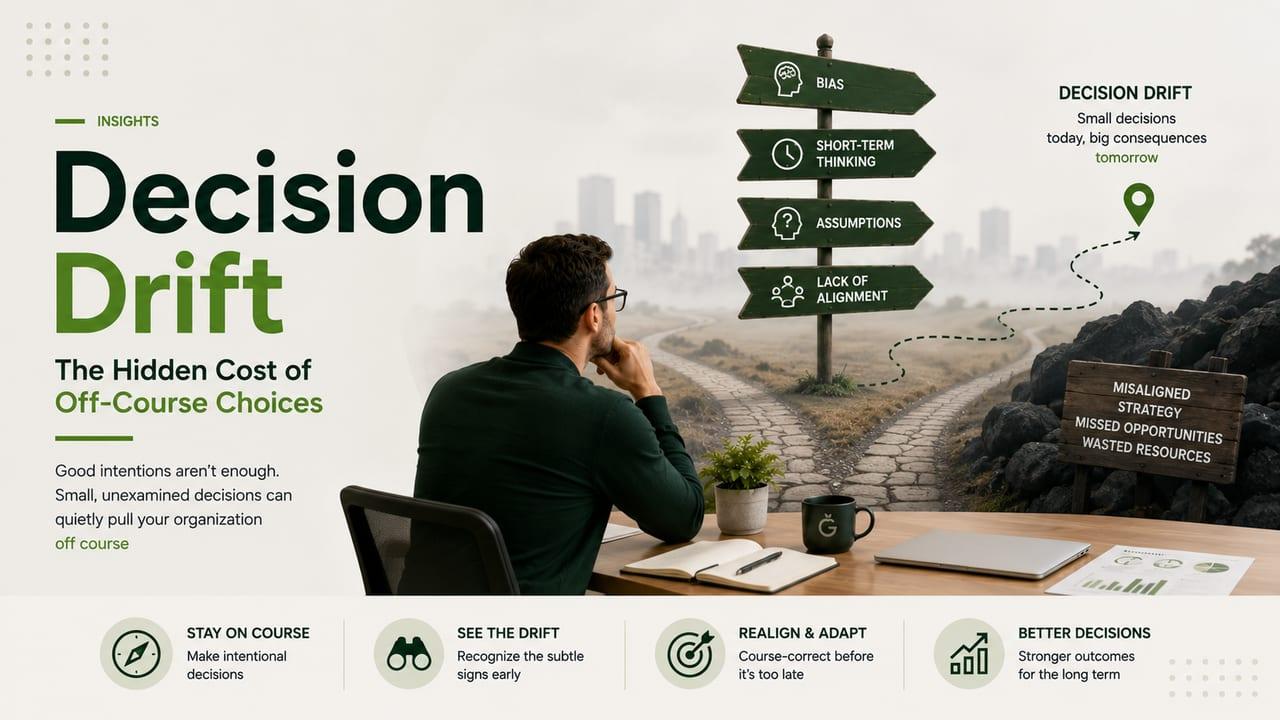 Organization DevelopmentDecision Drift: Are Your People's Decisions Actually Aligned With Your Strategy?7 min read
 Organization DevelopmentWhen Agile Stops Working7 min read
 Organization DevelopmentThe Real Challenges of Scaling a Startup (And How to Get Ahead of Them)5 min read
 Organization DevelopmentCulture Metrics for the Board — Stop Reporting the Weather8 min read