Decision Drift: Are Your People's Decisions Actually Aligned With Your Strategy?
Every leader eventually asks it: are my team's daily decisions aligned with our strategy — or my vision? The honest answer is usually neither. We call the gap Decision Drift, and it isn't lost where most leaders look for it. It's lost at the one layer nobody owns — the criteria people actually decide with.
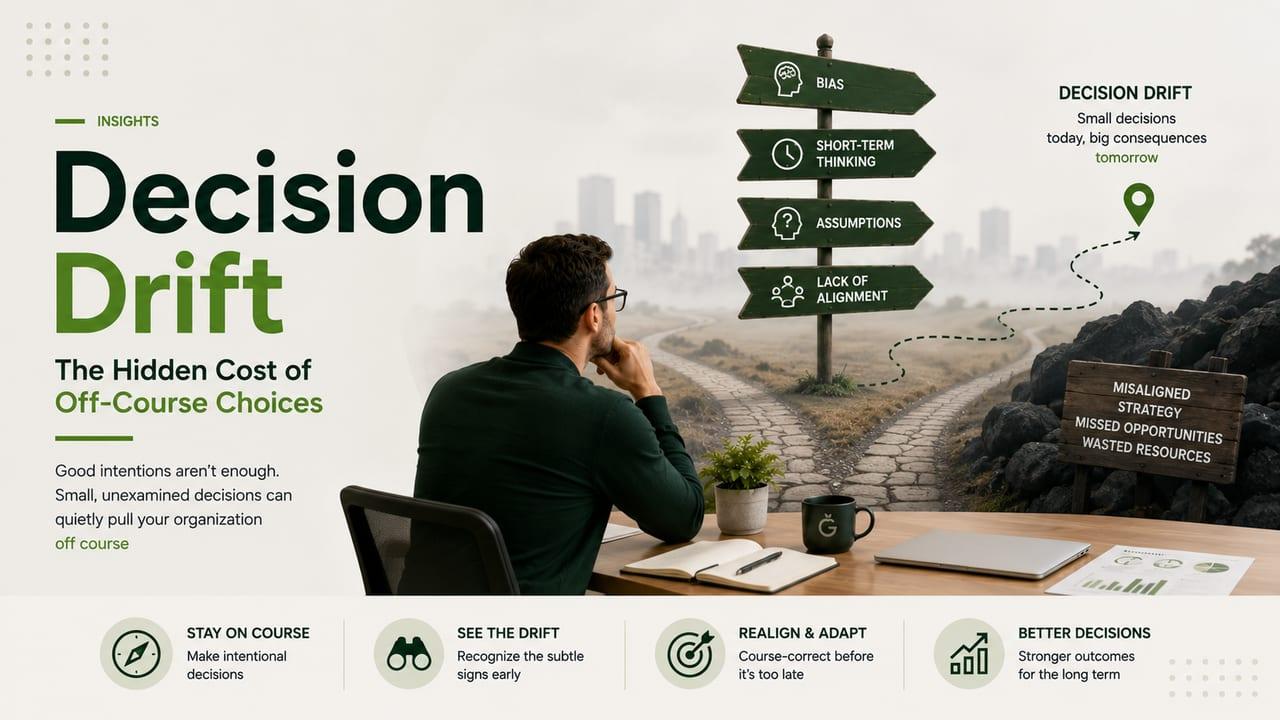
Sooner or later, almost every leader we work with asks a version of the same question: "Are my people's decisions aligned with our strategy — or with my vision?" It sounds like a question about communication. It's closer to a confession.
Listen to the word in the middle: or. The moment a leader experiences "strategy" and "vision" as two different things a decision could line up with, they've already named the problem. Because three levels down, a person facing a real trade-off (which customer to say no to, which corner to cut, which candidate to hire) has to align to something. And when the guidance from the top is fuzzy, they don't reach for the strategy and they don't reach for the vision. They reach for whatever is loudest in the room at the moment they decide: the nearest metric, their manager's mood, last quarter's number, their own downside risk.
So the honest answer is uncomfortable: your people's decisions probably aren't aligned to your strategy or your vision. They're aligned to whatever was most legible at the moment they decided. We call that gap Decision Drift — and it almost never lives where leaders go looking for it.
The decision you never heard about
A CEO we worked with had spent a quarter making his enterprise strategy unmissable: town halls, a one-line mantra, a strategy deck every team could quote. Months later he found out his support team had quietly turned away a major enterprise account's renewal, because an internal policy, built years earlier to close tickets fast, treated the account like any other overdue case. The decision was made cleanly, by competent people, against a green dashboard. It just happened to be the opposite of the strategy he'd repeated forty times.
"Everyone in that room could recite our strategy back to me word for word," he told us. "Not one of them used it to make the call."
That sentence is Decision Drift in miniature. The strategy wasn't misunderstood — it was known by heart. It simply wasn't the thing anyone decided with. And notice how he found out: by accident, after the fact, when a decision came back wrong. That's the quiet danger. Drift is invisible until it's expensive, because the choices that reveal it are exactly the ones a leader never hears about.
The framework: four rungs, and the one nobody owns
When we trace how a leader's intent becomes a frontline decision, it passes down four rungs:
- Vision — why we exist, where we're going.
- Strategy — where we play and how we win.
- Criteria — what we therefore say yes and no to.
- Decisions — the thousand daily calls no one escalates.
Here's the pattern we see in nearly every organization: leaders invest enormously in rungs 1 and 2 (the offsite, the deck, the all-hands) and almost nothing in rung 3. They broadcast the destination and the plan, then expect rung 4 to follow. But a vision and a strategy don't tell a support agent whether this refund, this exception, this account is a yes. The translation from "what we're trying to win" into "what I should choose right now" is a separate piece of work — and it's the rung almost no one explicitly owns.
That missing rung is where drift enters. Alignment isn't lost at the vision layer. It's lost at the criteria layer. People align their words to the strategy within a week. They can recite it. They align their judgment far more slowly, and only if someone does the unglamorous work of turning the strategy into the criteria they decide with.
Here's the contrarian part, and it catches good leaders off guard: over-communicating the vision can make drift worse, not better. Repeating the mission louder produces word-alignment (everyone nods, everyone can quote it) which masks the judgment-drift underneath. The greenest dashboards and the most fluent town halls are often where drift hides most comfortably, because fluency feels like alignment. It isn't.
Why does decision drift happen?
It's tempting to read drift as carelessness. It isn't. Two well-established ideas explain why even committed people drift.
Decades ago, Chris Argyris and Donald Schön drew the line between an organization's espoused theory (what it says it values) and its theory-in-use (what its behavior actually optimizes for). Every organization has both, and the gap between them is invisible from inside. Your strategy deck is the espoused theory. The criteria your people actually use under pressure are the theory-in-use. Drift is simply the distance between the two, and it widens silently because no one is measuring the second one.
The second idea comes from Herbert Simon's work on how decisions really get made: not by whoever holds the best view of the whole, but by whoever is closest to the local information, using whatever signal is immediately legible to them. People are not lazy decision-makers — they are local decision-makers. They optimize what they can see. If the only thing legible at the moment of choice is a ticket-closing metric, that metric wins, no matter how inspiring the mission on the wall. This is also why drift is a design problem, not a character problem: you don't fix it by hiring more aligned people. You fix it by making the strategy legible at the exact moment and place people decide.
How do you fix decision drift?
You don't get alignment by saying the vision again. You get it by doing the translation work on rung 3 — and putting it where decisions happen. In order of leverage:
- Translate strategy into decision criteria. For each priority, write the yes/no it implies in concrete terms: "When X and Y conflict, we choose X." A strategy your people can recite but can't decide with is decoration.
- Run the "would they decide the same?" test. Take a real trade-off your frontline faces. Would three different people, none of them in the room with you, reach the call you'd make — without asking up? Where the answer is no, you've found live drift.
- Make the criteria legible at the point of decision, not just at the offsite. The signal has to reach the support queue, the hiring panel, the roadmap meeting (wherever the choice is actually made) or the nearest metric will win by default.
- Audit your theory-in-use, not your slide. Pull ten recent decisions nobody escalated. What did they actually optimize for? That, not the deck, is your real strategy.
- Fix the loudest wrong signal first. Drift usually traces to one legible metric pulling against the strategy (tickets-closed vs. accounts-kept). Find it and reframe it before you write one more principle.
- Let people decide — don't route it back to you. A leader who answers every decision has perfect alignment and zero scale. The goal isn't everyone deciding like you; it's giving them enough to decide as you would, without you in the room.
Ask yourself
A quick diagnostic. Wherever the answer turns fuzzy, that's where Decision Drift is already forming:
- If you pulled the last ten decisions nobody escalated to you, would they reveal your strategy — or something else you've been quietly rewarding?
- Can your strategy resolve a real trade-off your frontline hit last week, or only describe the destination?
- When you say "aligned to our strategy," would three people three levels down translate that into the same concrete yes/no?
- Which single metric, legible at the moment of decision, is pulling hardest against what you say you want?
- The last time a decision came back wrong — did you fix that decision, or the criteria that produced it?
The takeaway
When a leader has to ask whether their people's decisions are aligned, the asking is the answer: there's no instrument, so the drift is already invisible. And it won't be closed by repeating the vision — that only buys you alignment of words. It's closed one rung lower, by translating strategy into the criteria people actually decide with, and putting those criteria where the decisions happen. Alignment isn't whether your team can recite your strategy. It's whether, three levels down and with you nowhere in the room, they'd still make your call.
Frequently asked questions
- What is decision drift?
- The gap between the strategy leadership believes is being executed and the choices people actually make day to day. No one defects; the decisions simply optimise for what is legible locally.
- Why is drift hard to see?
- Because it shows up in decisions that were never escalated. Leadership reviews the exceptions and sees alignment, while the ninety percent that never surfaced is where the drift lives.
- How do you correct it?
- Make the strategy decidable: state the trade-offs it implies, not just the ambitions. People cannot apply "grow responsibly" — they can apply "reject deals under this margin".
- Why can over-communicating your vision make decision drift worse?
- Repeating the mission louder produces word-alignment — everyone nods and can recite it — which masks the judgment-drift underneath. Fluency feels like alignment, so the greenest dashboards and most polished town halls are often where drift hides most comfortably.
- What are the four rungs between strategy and a frontline decision?
- Vision, strategy, criteria, and decisions. Leaders invest heavily in vision and strategy and almost nothing in criteria — the yes and no that strategy implies — which is the unowned rung where drift enters.
Related articles
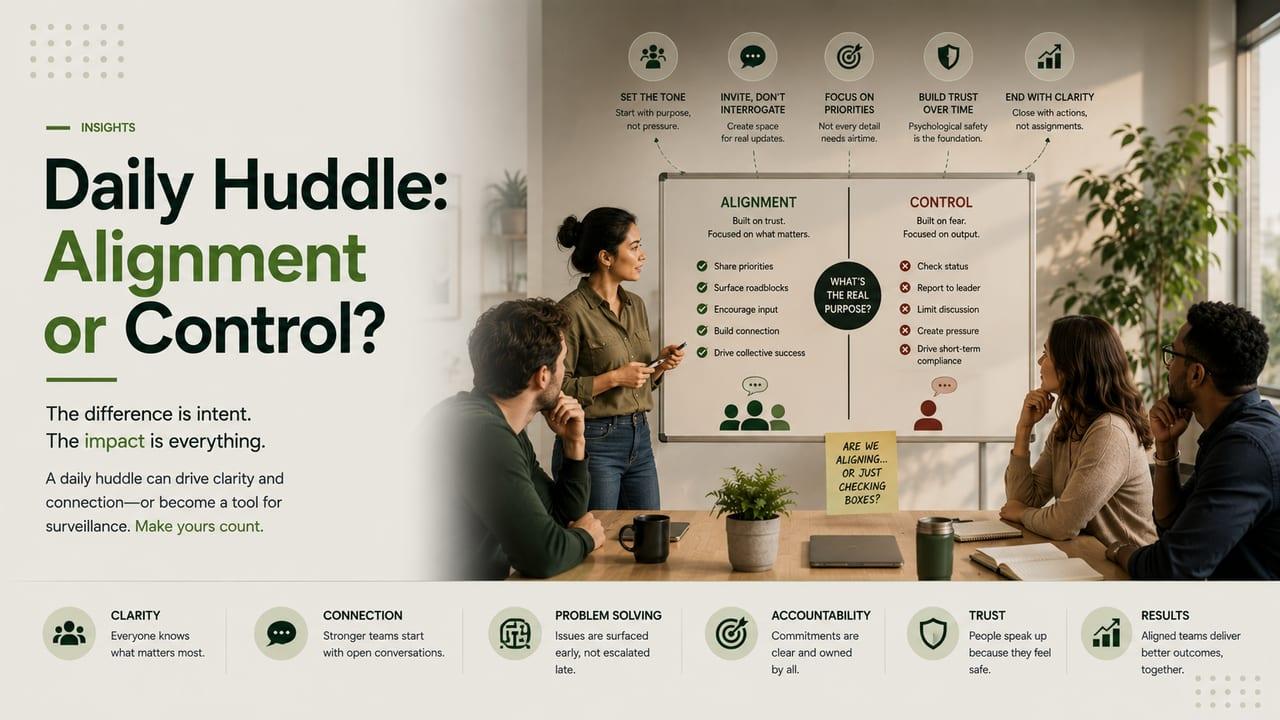 Organization DevelopmentIs Your Daily Huddle for Alignment — or Control?8 min read
 Organization DevelopmentWhen Agile Stops Working7 min read
 Organization DevelopmentThe Real Challenges of Scaling a Startup (And How to Get Ahead of Them)5 min read
 Organization DevelopmentCulture Metrics for the Board — Stop Reporting the Weather8 min read