The Ping Pong Culture Nobody Talks About — And the One That's Quietly Killing Your Strategy
How departments learned to bat accountability back and forth — and why that's always a leadership problem in disguise.
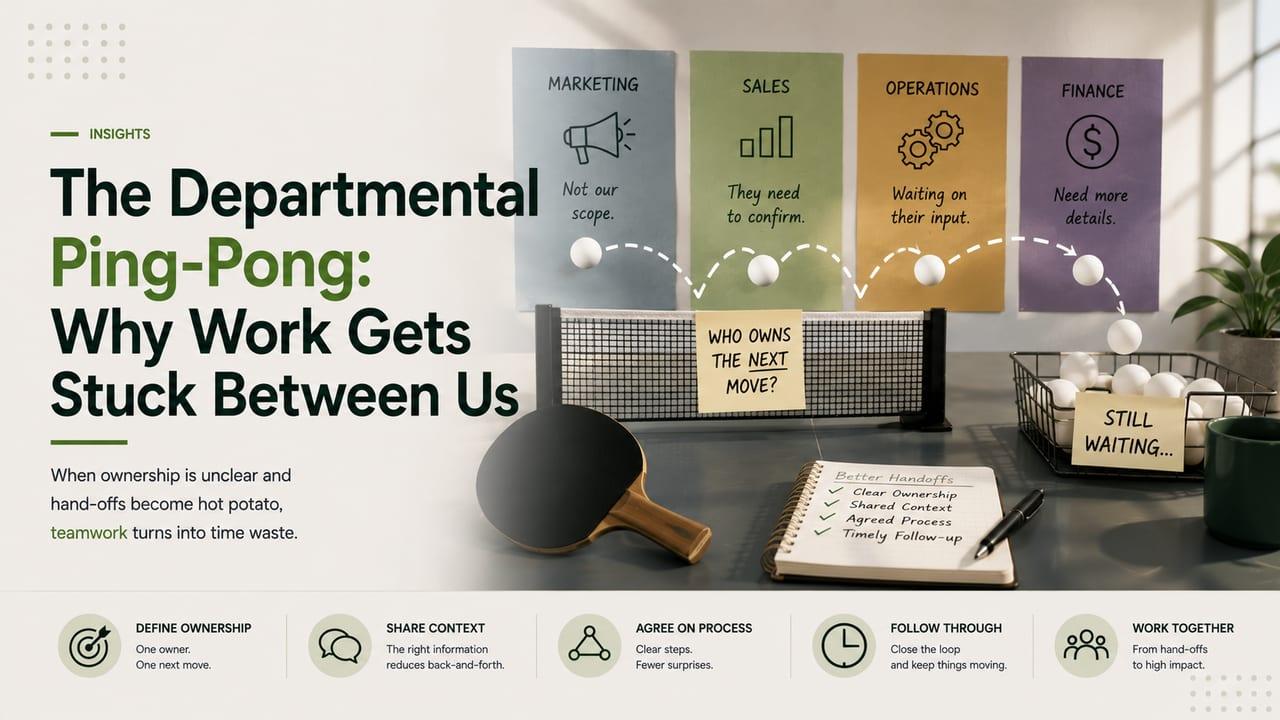
Picture a ping pong match.
Two players. One table. A ball moving fast — back and forth, back and forth. Neither side willing to let it land on their side. The rally goes on. Points are never scored. Nobody wins. But nobody loses either, because the game never actually ends.
Now replace the players with departments. Replace the ball with a business problem, a strategic initiative, an unresolved decision. Replace the table with every cross-functional meeting that ends without a clear owner.
You've just watched the most expensive game in tech.
We call it Departmental Ping Pong — and we've all seen it, participated in it, and if we're honest, enabled it. It's not a communication problem. It's not a process problem. It's not even a team problem. It's a leadership failure with a very convincing disguise.
What does departmental ping pong look like?
The scene is familiar. A SaaS company is six months into executing its annual strategy. Product wants to launch a new feature. Tech says the infrastructure isn't ready. Operations says nobody told them about the infrastructure gap. Tech says it was in the roadmap. Operations says the roadmap wasn't shared with them. Product says they're blocked until someone makes a decision.
Leadership calls a meeting. The meeting produces a follow-up meeting. The follow-up meeting produces an action item assigned to "all parties." Six weeks pass. The feature is delayed. A key client churns. The post-mortem asks: what went wrong?
Every department has an answer. Every answer points somewhere else.
The ball never landed. It never had to. Because no one in that organization ever decided who was supposed to catch it.
When organizational goals, strategies, and values aren't clear, groups will sometimes work toward different objectives. A group that values customer service over cost will conflict with a group that is trying to lower expenditures, and blame becomes a fix that actually diverts attention away from long-term structural solutions.
That's the trap. And it's set at the top, not the bottom.
The Three Engines That Keep the Ball in the Air
Departmental ping pong doesn't happen by accident. It is a predictable output of three systemic failures that compound each other.
Engine 1: Goals built in silos. When Tech sets its OKRs without Operations in the room, and Operations sets its KPIs without visibility into Tech's roadmap, you haven't created alignment — you've created parallel tracks that will eventually collide. When funding decisions are made based on department-level justifications without an enterprise lens, and financial KPIs don't reconcile across siloed systems, resources are poorly utilized and planning becomes a bureaucratic bottleneck rather than a driver of strategic clarity. Each team is optimizing for its own scoreboard. Nobody is optimizing for the company's.
Engine 2: Unclear ownership between departments. Organizational silos restrict information and resources, and stymie progress and innovation. But the more dangerous consequence isn't the information gap — it's the ownership gap. When a decision lives between two departments, it effectively belongs to neither. Both teams can point to their deliverables, demonstrate they've done their part, and pass the ball. The decision dies somewhere in the middle. And because nobody dropped it, nobody is accountable for it.
Engine 3: Leadership that avoids taking sides. This is the engine nobody wants to talk about. Toxic blame-shifting ultimately undermines team performance, employee engagement, trust in leadership, and organizational progress. But that blame culture doesn't start with teams. It starts when leaders consistently refuse to name a clear owner, consistently validate both sides of a conflict without resolution, and consistently mistake neutrality for wisdom. When the leader won't catch the ball, the departments learn (rationally, sensibly) to keep returning it.
What does departmental ping pong cost your company?
The delayed product launch is visible. The churned client is measurable. But the real cost of departmental ping pong runs much deeper and much quieter.
It erodes your best people first. High performers have options. When they spend months watching decisions circle the organization without landing, they don't file a complaint — they file a resignation. When team members seem disconnected and not invested in their work, they've likely lost the sense of purpose that comes from aligning daily work with organizational goals. Trust is lost when people don't deliver as promised, and a lack of accountability is to blame. The people who care most about outcomes are precisely the ones most exhausted by a culture where outcomes never have an owner.
It turns your strategy into theater. A company can have beautifully designed OKRs, a compelling annual strategy deck, and a leadership team that speaks fluently about execution, and still produce nothing, because every initiative stalls at a departmental boundary. Siloed departments inhibit the transfer of information and contribute to problems in organizations by negatively affecting transparency, accountability, and risk management. Strategy without accountability architecture is just an expensive document.
It teaches departments that surviving matters more than delivering. This is the cultural damage that persists longest. When teams learn that the goal is to return the ball, not catch it, they start building organizations optimized for self-protection. Meetings get documented not to drive action, but to create evidence. Emails get CC'd not to inform, but to establish a paper trail. Blame provides some immediate relief and a sense of having solved a problem, but it also erodes communication and shifts the focus even further from accountability. Over time, the whole organization gets better at defending itself and worse at moving forward.
Why is departmental ping pong a leadership problem?
We need to say this clearly, because organizations love to diagnose it elsewhere: departmental ping pong is not a team failure. It is a leadership failure.
Silos are often considered a leadership problem: it requires a shift from managing silos to managing systems. And Patrick Lencioni, whose organizational health work remains the most practically useful in this space, identified the solution clearly: establish a thematic goal, define objectives for it, set standard operating objectives, and, critically, select shared metrics that cut across departmental lines.
Shared metrics change the game entirely. When Tech and Operations are both measured against time-to-deployment and client satisfaction (not just their individual KPIs) the incentive to bat the ball changes. Suddenly, catching it is in everyone's interest.
When people from various departments are involved in cross-functional teams with shared ownership for results, it becomes less feasible to attribute failures to any one person or group. Teams focus on understanding root causes holistically rather than defensive blaming.
But that structure doesn't build itself. A leader has to decide to build it, and more importantly, has to be willing to name owners, make calls, and stop rewarding the teams that return the ball most gracefully.
Is Your Company Playing Departmental Ping Pong? A Checklist
Run through this honestly. Five or more signals means the game is already running — and leadership is the net.
- Cross-functional meetings end with "we'll follow up" more often than with a named decision-owner
- The same problem has appeared in three or more leadership meetings without resolution
- Tech and Operations have separate OKRs with no shared success metric between them
- When a project fails, every department can demonstrate it completed its portion
- Escalations to leadership result in more meetings, not decisions
- High performers are leaving and citing "lack of clarity" or "politics" in exit interviews
- Teams invest more energy in documenting what they did than in deciding what to do next
- "That's not our responsibility" is a complete sentence in your organization
- Strategic initiatives stall at departmental handoff points, not at the idea stage
- Leadership describes itself as "facilitating alignment", but never names who owns what
The ping pong table in your breakroom is innocent. The one in your strategy meetings is costing you more than you think.
The fix is not a new process, a better RACI matrix, or a cross-functional task force with no authority. The fix is leaders who are willing to end the rally: to name an owner, hold the accountability, and stop mistaking the absence of conflict for the presence of alignment.
Catch the ball. The game ends when you do.
Frequently asked questions
- What is departmental ping-pong?
- The pattern where a request bounces between teams, each genuinely believing it belongs to someone else. Nobody is refusing to work; the ownership was never actually assigned.
- What causes it?
- Structure, not attitude. When two functions share a responsibility and neither holds the decision, the handoff becomes the safest place to leave the work.
- How do you fix it?
- Name a single owner for the outcome, not the activity. Most leaders respond by adding a coordination meeting, which makes the bouncing visible without making it stop.
- Why is departmental ping-pong a leadership problem and not a team problem?
- Because leaders set the conditions that keep the ball moving: goals built in silos, undefined decision rights, and a habit of validating both sides without naming an owner. Teams return the ball rationally when no one above them is willing to catch it.
- How do shared metrics stop work from bouncing between departments?
- When two functions are measured against the same cross-cutting outcome, such as time-to-deployment or client satisfaction, catching the work becomes in everyone's interest. Separate scoreboards reward returning the ball; a shared one rewards landing it.
Related articles
 LeadershipFrom Founder to CEO: Growing Into the Job as Your Company Grows4 min read
 LeadershipBuilding an Executive Leadership Team — Hiring Senior People Is the Easy Half7 min read
 LeadershipHigh-Performance Teams: What Separates Them From Merely Busy Ones6 min read
 Organization DevelopmentDecision Drift: Are Your People's Decisions Actually Aligned With Your Strategy?7 min read