OKRs — The Target Is Not the Capability
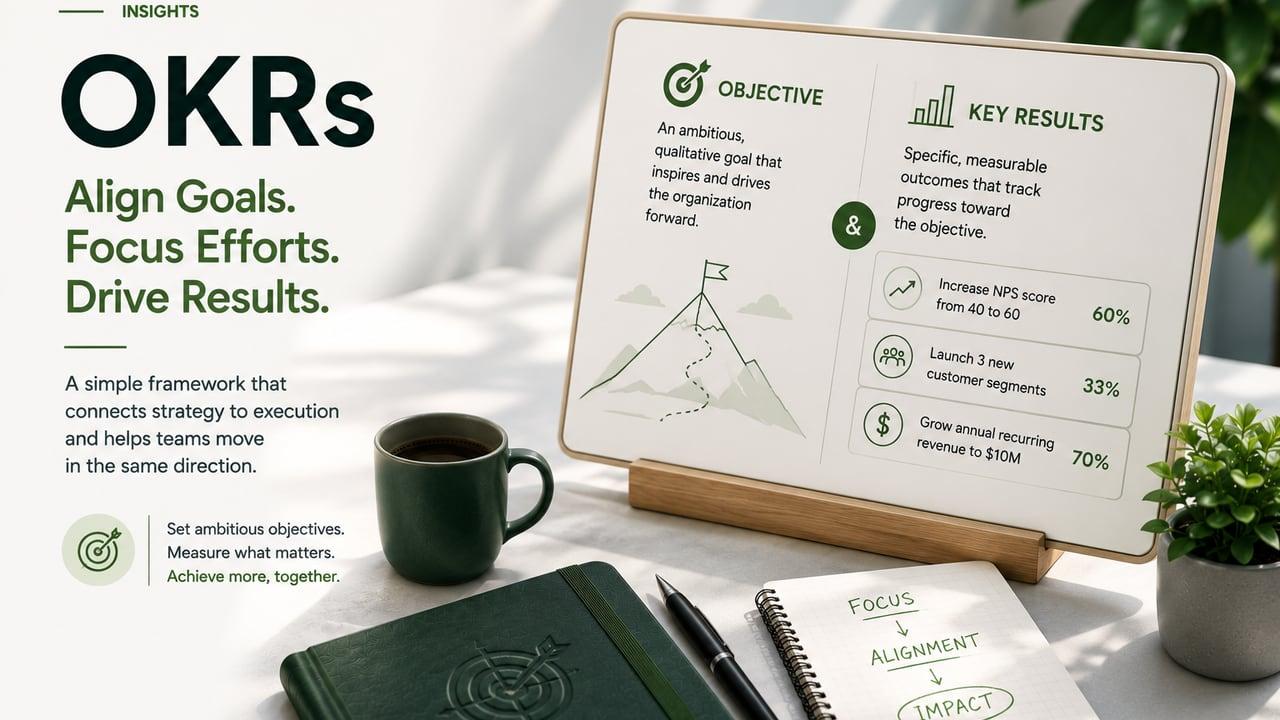
OKRs make your goals visible and force you to measure them — the honest, transparent accountability most organizations never build. But a Key Result is a number you commit to, not a capability you have. Score a 0.6 and the sheet tells you that you missed — never whether you aimed too high or your organization simply couldn't reach it.
A CEO we know opened every quarterly review with the same sentence: "We had a strong quarter." Pressed for specifics — what moved, by how much, against what target — the answers dissolved. Customer satisfaction had improved. The team felt more aligned. They were heading in the right direction. After the third consecutive quarter of exactly this language, a board member asked the only question that mattered: heading toward what, exactly?
That organization had strategy. It had initiatives, energy, and a genuine sense of momentum. What it did not have was a system for turning any of that into outcomes that a person could name, own, and check. OKRs are the system built to close precisely that gap, and for this company they would have been a real upgrade — the difference between "we're aligned" and "here are the four numbers we agreed to move, and here is where each of them stands today."
But sit with the board member's question a moment longer, because it has a second half most people never hear. "Heading toward what" is one question. "And can we actually get there" is a different one. OKRs answer the first with a rigor almost nothing else on the shelf can match. The second one they cannot answer at all — and the trouble starts the day a full, well-measured scorecard makes it feel as though they have.
What the missing system actually buys
Let us be clear about the value first, because it is real and this company was right to want it. OKRs do three things that most organizations struggle to do at all.
They force alignment into the open. In most companies there is strategic intent at the top and busy activity at the bottom, with a fog of disconnection in between. OKRs cascade: a company objective informs team objectives, which inform individual ones, so a person can trace a line from the thing they did on Tuesday to the direction the whole organization claims to be going. When that line can't be drawn, the tool exposes it — which is itself the finding.
They turn ambition into something you can check. Ordinary goal-setting quietly rewards the achievable; you hit your number, you look good, so you set a number you know you'll hit. OKRs push the other way. A Key Result is not a to-do — it is a measurement, and "improve customer satisfaction" is not one until it becomes "raise NPS from 31 to 45." The discipline of attaching a number is where most of the honesty lives.
And they make performance visible without a surveillance culture. Because well-run OKRs are transparent — everyone can see everyone's — accountability comes from the light rather than from a manager standing over a shoulder. People track progress because the whole organization can see whether they did. That is a genuinely good property, and most strategy tools cannot produce it.
None of this is in dispute. The argument of this piece is not that OKRs are weak. It is that they are strong at one thing and silent about another, and the silence is easy to mistake for a green light.
What OKRs actually are
The lineage runs back further than most decks admit. Peter Drucker named Management by Objectives in 1954, in The Practice of Management: set clear objectives, measure against them, let people own their piece. Andy Grove took that and sharpened it at Intel in the 1970s into what he called iMBOs — Intel Management by Objectives — the version that added the crisp pairing of a qualitative objective with quantitative key results and a short, repeating cadence. He documented the practice years later in High Output Management. The name "OKR" came afterward; the machinery was Grove's.
John Doerr sat in Grove's Intel course in 1975, carried the method through his career, and in 1999 walked it into a roughly forty-person startup called Google. The founders did not need convincing. Sergey Brin's reaction, by Doerr's account, was essentially "we need some organizing principle, and this might as well be it"; Larry Page later credited OKRs as a great impedance match for the company and part of how it grew tenfold, repeatedly. Google has run on OKRs every quarter since, scaling from those forty people to well over 180,000 without losing the thread — which is the real case for the tool, and a strong one.
Two details from Google's own practice matter for everything that follows, because they are usually flattened into a single slogan. Google distinguishes committed OKRs from aspirational ones. A committed OKR is a promise: you are expected to hit 1.0, and missing it is treated as an execution failure worth a post-mortem. An aspirational OKR is a stretch: the famous "0.7 is a good score, and consistently scoring 1.0 means you aimed too low" applies here, to the moonshots, not to everything. The two kinds are graded by different rules on purpose. Hold on to that distinction — it is where the whole problem lives.
The rest is well-trodden: LinkedIn ran on OKRs under Jeff Weiner, the Gates Foundation adopted them for philanthropic goals, and the framework spread far enough to become the default operating layer of a generation of companies. (It spread unevenly, too. Spotify publicly walked back individual OKRs in 2016 as too rigid for how its teams actually worked — a useful reminder that adoption is not the same as fit.)
The framework: the target is not the capability
Every strategy tool tells you what to decide. Almost none of them tell you whether your organization can actually do it. OKRs look, at first, like the exception — the one tool that finally closes the loop, because it makes you measure. But measuring a gap is not the same as being able to cross it, and that is the seam this whole series keeps pulling at:
A Key Result is a number you have committed to, not a capability you have proved. Score a 0.6 and the scorecard tells you that you missed — it never tells you whether you aimed too high or your organization simply couldn't reach it. OKRs make the gap visible and measurable. They cannot tell you which side of it you are standing on.
That is the difference between accountability for a result and honesty about a capacity. OKRs deliver the first with real rigor. The second — can the team that owns this number actually produce the number — sits entirely outside the frame, and the more disciplined your OKR process looks, the more completely that question hides behind it. A scorecard full of red at quarter's end feels like information. Often it is only a symptom, and the diagnosis it points to is the one thing the scorecard was never built to read.
The gap the score can't see
Here is the failure in miniature. A team commits to a Key Result: "reduce onboarding time from 14 days to 3." The quarter ends at day 9. The score is a 0.4, and everyone in the room now believes they know something. They don't — not the thing that matters. A 0.4 is consistent with two completely different stories. In the first, the target was a genuine stretch, the team executed superbly, and day 9 is a triumph badly mislabeled by an arbitrary anchor. In the second, day 3 was entirely reachable and the team lacked the process design, the engineering capacity, or the authority to change the handoffs — and day 9 is a capability problem wearing the costume of a near miss. The number is identical. The meaning is opposite. The scorecard cannot tell you which one you are looking at, and it will present both in the same shade of amber.
This is why the committed-versus-aspirational split, useful as it is, papers over the deeper issue. It tells you how to grade the miss. It does not tell you the cause. And the cause is almost always some form of the question this series was built around: does the organization you actually have possess the capability the target assumes? Every Key Result is written in a confident present tense — "reduce," "raise," "ship," "grow" — that quietly asserts the capacity to do the reducing and the shipping already exists. Frequently it doesn't. The target is a statement about the future you are betting on; the organization is a fact about the present you have to work with; and the OKR notation renders both in the same clean line, so the eye reads a plan where there is only a wager.
This is the same translation failure we describe in Decision Drift — the intent at the top of the house is clear, shared, and measured, and it still tells you nothing about whether the people downstream can execute it. An OKR is drift made quantitative: it does not fix the gap between intent and capability, it just gives the gap a number and a due date.
The maker knew
The strongest evidence that OKRs measure ambition rather than manufacture capability is that the man who brought them to Google said so, in the book that sold everyone on them. Doerr's line in Measure What Matters is unambiguous: OKRs "are not a silver bullet. They won't substitute for good judgment and a strong culture. But when those fundamentals are in place, OKRs can take you to the mountaintop." Read that carefully. The fundamentals — judgment, culture, the capability to execute — are the precondition. OKRs are the amplifier you attach once the engine exists. Point the amplifier at an organization that can't yet do the work and you get a louder, better-measured version of not doing it.
His own committed-versus-aspirational framing admits the same thing from the other direction. An aspirational OKR, Doerr grants, is set "even though we have no clear idea how to get there, or the resources necessary." That is a plain acknowledgment that the target can legitimately outrun the capability — that is the point of a stretch goal. But the tool offers no notation for the size of that overrun, no field for "how far past our current capacity is this," which is exactly the number a leader most needs and never gets. Google itself is careful about one more thing the folklore drops: its own guidance urges you to decouple OKR scores from performance reviews and compensation, precisely because the moment a miss becomes a punishment, people stop setting honest targets and the whole instrument inverts. The makers built the tool and then spent chapters warning you what it does not do. That warning is the tell.
Two companies, one framework
Put two OKR stories side by side and the blind spot stops being abstract.
Google is the case everyone cites, and rightly. But look at why it worked, because the usual reading gets the causation backwards. OKRs did not make Google capable. Google arrived at OKRs already holding a genuinely differentiated product and a concentration of engineering talent that could, in fact, ship a tenfold improvement when pointed at one. OKRs took an organization that could do extraordinary things and made sure the whole of it pushed on the same extraordinary thing at once. The tool was a multiplier on a capability that was already there. That is OKRs at their best — and it is not a story about measurement creating performance. It is a story about measurement organizing performance that already existed.
Now the other one. Twitter ran OKRs — it is a named case study in Doerr's own book, adopted under CEO Dick Costolo in the early 2010s. The company set exactly the kind of ambitious, measurable user-growth targets the framework is famous for, tracked them rigorously, and reported them to the market. And it could not hit them, quarter after quarter. Monthly-active-user growth decelerated to the low single digits — around four percent quarter-over-quarter by late 2014 — the stock cratered, and Costolo was out by June 2015. The measurement was impeccable; everyone could see, in real time, precisely how far short the product was falling. What the OKRs could not supply was the missing ingredient — the product-and-execution capability to actually move the number they so clearly displayed. The scoreboard worked perfectly. The team just couldn't score. That is the entire thesis in one company: rigorous, transparent, ambitious measurement, laid over a capability gap it could name to two decimal places and do absolutely nothing to close.
Same framework, two outcomes, and the framework did not decide either. The capability underneath it did. OKRs told both companies the truth about the number. Only one of them had the organization to make the number come true.
Using them for what they're actually good at
The tool earns its place. The failures come from treating a measured target as a delivered one. So:
- Split every OKR into committed or aspirational, out loud. A committed KR is a promise you owe at 1.0; an aspirational one is a stretch where 0.7 is a win. Grading them by the same rule is how you get either sandbagging or despair. Naming which is which is half the honesty.
- For every Key Result, name the team and the capability it assumes. Write the second sentence the canvas never has room for: "this target assumes we can do X — can we, today, or is X itself the real work?" Where the assumed capability doesn't exist yet, you haven't set a goal, you've discovered a build. That is the same present-tense-you-can-defend discipline the Business Model Canvas needs in its Key Resources block.
- Treat every miss as a diagnosis, not a verdict. When a KR comes in red, the only useful question is which red it is: did we aim past the horizon, or past our own capacity? Those demand opposite responses — recalibrate the target versus build the capability — and the score alone can't tell them apart. Someone has to ask.
- Don't put OKRs on business-as-usual. Repetitive operations, compliance, keep-the-lights-on work — quarterly stretch goals add ceremony without strategy there. Reserve OKRs for the growth and transformation work where the capability question is live.
- Keep scores away from pay and reviews. The moment a 0.6 costs someone a bonus, every target in the building quietly becomes a 1.0 you were always going to hit, and the instrument stops measuring anything. This is the discipline that separates real OKRs from the daily theater of a ritual everyone performs and no one believes.
Ask yourself
- Take your reddest Key Result from last quarter. Was it red because the target was heroic, or because your organization couldn't do the thing? Did anyone in the room actually distinguish the two — or did you just write down the number and move on?
- For each of this quarter's OKRs, can the team that owns it name the capability the target assumes, and say plainly whether that capability exists today? How many of your goals are secretly builds you haven't scheduled?
- Are your OKR scores connected, formally or informally, to how people are paid and rated? If so, how honest do you really think next quarter's targets are?
- If a target and your team's actual capacity disagree, which one does your process treat as fixed — and which one does it try to change?
The takeaway
OKRs are one of the best tools ever built for making a strategy honest about whether you hit the number. Every part of that sentence is earned: the objective names the intent, the key results force the measurement, the transparency makes the whole thing accountable in the open. The CEO who kept saying "we had a strong quarter" genuinely needed this, and it would genuinely have helped.
But making a strategy honest about whether you hit the number is not the same as making it honest about whether you could — and that second honesty is the one that decides whether an organization actually grows or just measures itself failing with admirable precision. A Key Result tells you the target. It does not tell you that the team can reach it, that the capability the target assumes is real, or that the confident present tense on the scorecard describes the company you have rather than the one you are hoping to become. Doerr knew; he said outright that OKRs need judgment and culture already in place to work. Grove knew; he built the method for an Intel that could already execute. Set the number — the discipline of setting it is worth everything the CEO's board was asking for. Then go find out whether the organization holding the scorecard is one that can make the number true. OKRs don't make strategy easier. They make it measured. Whether they make it happen is still up to the company you actually have.
Frequently asked questions
- What are OKRs?
- A goal-setting method pairing a qualitative Objective with a small set of measurable Key Results. The Objective says where you are going; the Key Results say how you will know you arrived.
- Why do OKRs fail in most companies?
- Because the target gets set without touching the capability that produces it. A number written on a slide does not change what the organization can actually do, so the quarter ends with the same result and a worse mood.
- How many OKRs should a team have?
- Few enough that dropping one hurts. Most teams are better served by one objective with three key results than by five objectives nobody can recite.
- What is the difference between committed and aspirational OKRs?
- A committed OKR is a promise you are expected to hit at 1.0, and missing it warrants a post-mortem. An aspirational OKR is a stretch where 0.7 is a good score. Grading both by the same rule produces either sandbagging or despair.
- Should OKR scores be tied to pay and performance reviews?
- No. Google's own guidance decouples them, because the moment a 0.6 costs someone a bonus, every target in the building quietly becomes a number people were always going to hit, and the instrument stops measuring anything honest.
Related articles
 StrategyWorkforce Planning for Next Year's Strategy — Start From the Bets, Not the Headcount7 min read
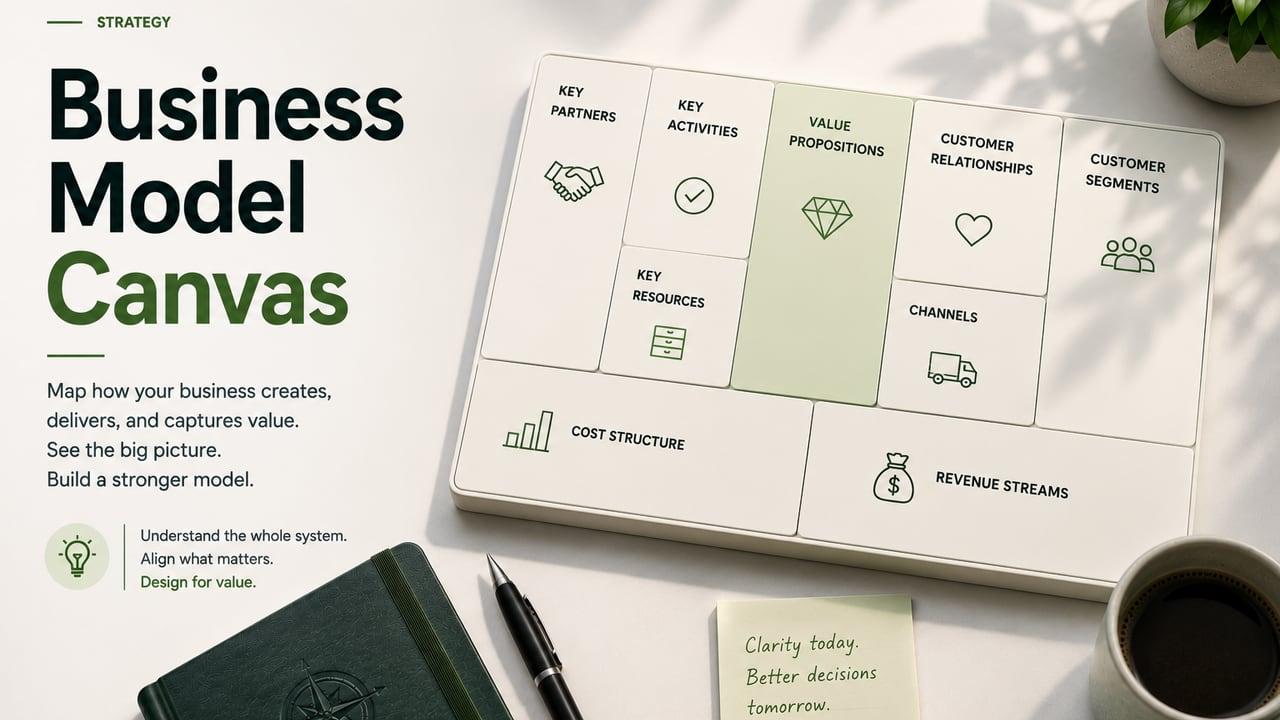 StrategyThe Business Model Canvas — A Coherent Canvas Is Not a Company12 min read
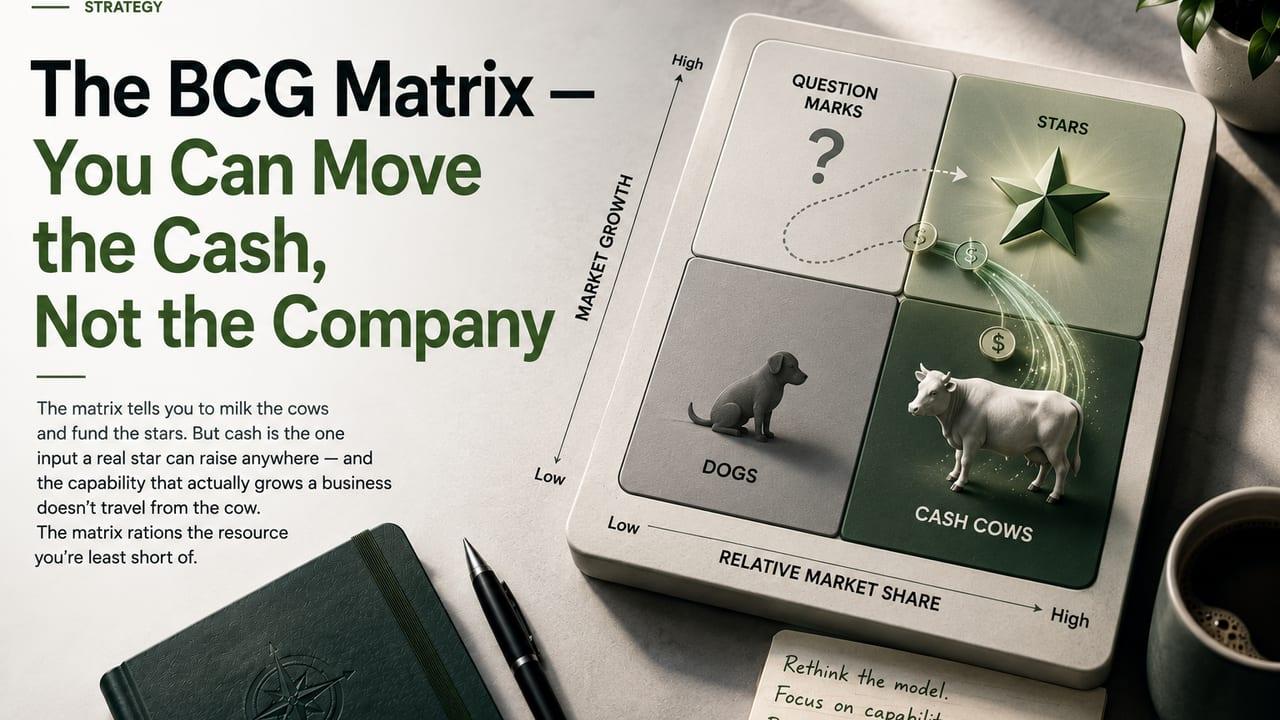 StrategyThe BCG Matrix — You Can Move the Cash, Not the Company14 min read
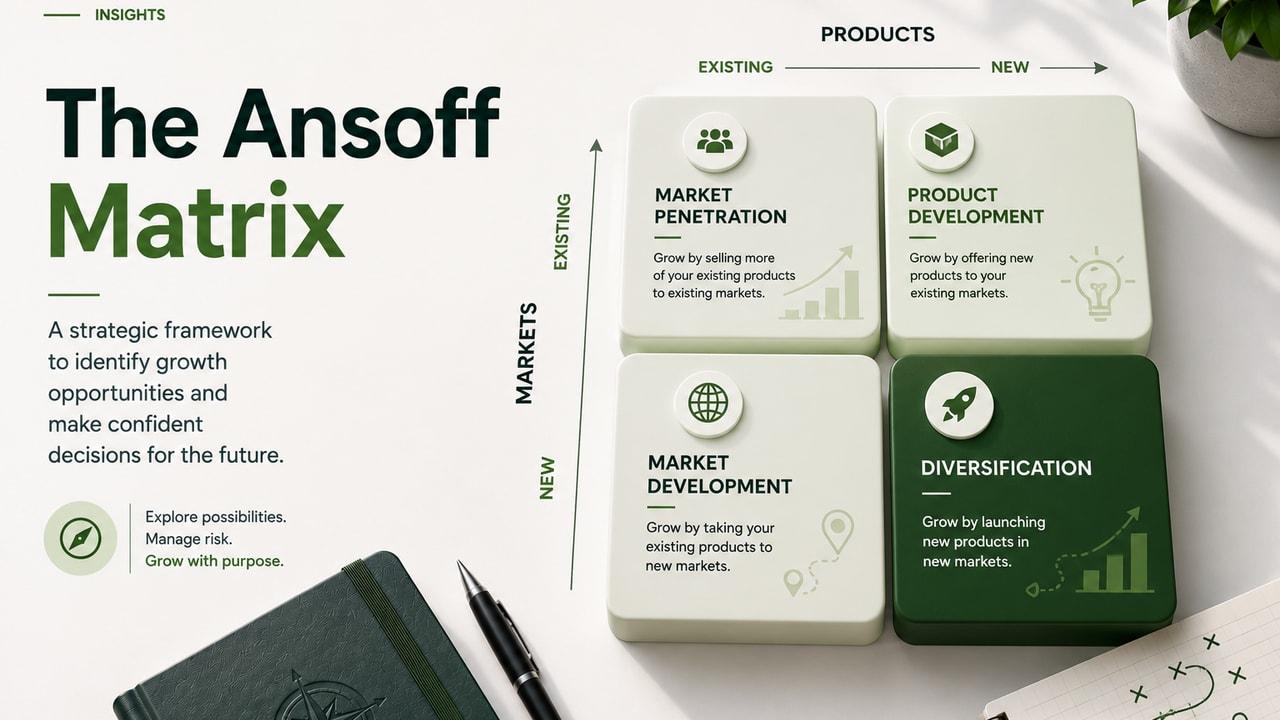 StrategyAnsoff's Matrix — Every Box Is a Different Company14 min read