People Strategy Isn't an HR Document. It's a Business Model.
Most 'people strategies' aren't strategies — they're activity calendars in a strategy costume. A step-by-step model for building one backward from the business bet, the way you'd build any business-critical system: name the bet, pick the 2-3 capabilities that actually win, decide build-buy-borrow-or-bot, and instrument it like a product instead of an annual survey.
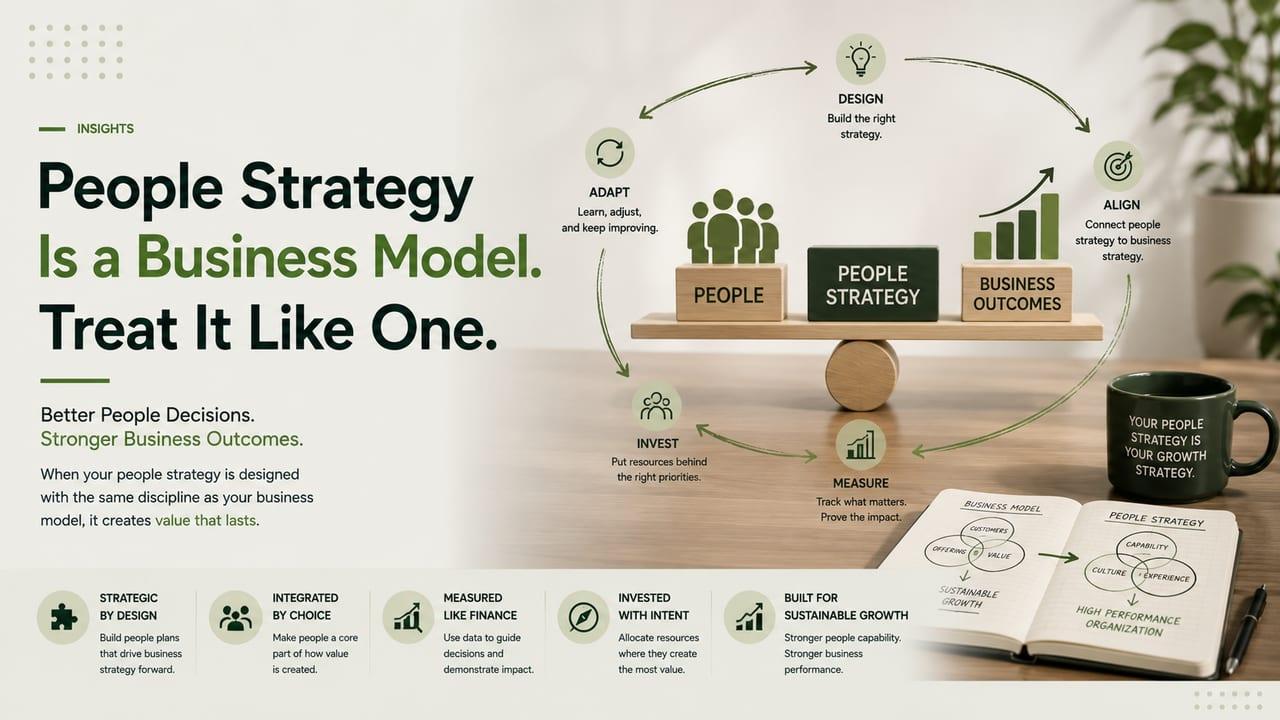
Most "people strategies" aren't strategies. They're activity calendars wearing a strategy costume: a slide with hiring plans, an engagement survey cadence, a learning catalog, and a values poster, all stapled together and presented to the board once a year.
That's not a strategy. A strategy is a set of choices about how you will win, and what you will deliberately not do to win it. By that definition, most companies don't have a people strategy. They have an HR plan.
This matters more than it sounds like it does. LSA Global's organizational alignment research found that how well people are aligned to strategy accounts for 60% of the performance gap between high- and low-performing companies — yet LSA's culture-assessment data shows nearly 70% of employees say their company's strategy is itself unclear or unknown. That gap isn't an HR problem. It's a business problem that happens to live in the HR function.
This article is a step-by-step model for building a people strategy the way we'd build any other business-critical system: starting from the business problem, not from the HR org chart.
The Tell: When People Strategy Is the Business Strategy
Microsoft had long been known internally for stack ranking: a system that forced managers to label a fixed share of their team as underperformers every cycle, regardless of how the team actually did. The result was a culture where people protected their own scores instead of helping the person next to them, in a company whose next bet (cloud, at scale) depended on the opposite.
The curve was scrapped in November 2013, under then-CEO Steve Ballmer, just months before Satya Nadella took over in February 2014. But ending stack ranking was the easy part; what made it strategy was what Nadella built on top of it. He didn't open with an engagement survey or a values refresh. He started with the business bet: Microsoft was moving to a mobile-first, cloud-first world, which meant the work would increasingly be cross-team, fast-moving, and collaborative by necessity. So the people system had to change to match. Performance conversations shifted to impact, potential, and mobility instead of relative ranking. The org moved from product-line silos toward teams built around shared capabilities. None of it was a culture initiative bolted onto the business strategy — it was the business strategy, expressed in how people were hired, ranked, and rewarded.
The result, a decade later: Microsoft's market value grew from roughly $300 billion in early 2014 to nearly $3 trillion, with Azure becoming a genuine challenger to AWS in cloud, a bet that required exactly the collaborative behavior the old ranking system had been quietly punishing. That's the pattern worth noticing: the company didn't fix culture and then get the strategy right. The people changes were how the strategy got executed.
This is the standard worth holding every people strategy to: could you trace a straight line from "this is how we hire, rank, and promote" to "this is the specific business bet we're trying to win"? Most companies can't. That gap is what the rest of this article is built to close.
Why do most people strategies fail?
The conventional way people strategy gets built looks like this: HR looks at its own functions (recruiting, L&D, comp, engagement, culture) and asks "what should we improve this year?" Then it builds a plan function by function and calls the sum of those plans a "strategy." We've all sat through that deck. It's competent. It's also not a strategy.
The problem is that this process never asks the one question that makes something a strategy instead of a to-do list: what does the business actually need from its people that it doesn't have today?
A people strategy built bottom-up from HR functions will always converge on the same generic answers (better engagement, better retention, better leadership development, better DEI metrics) regardless of what the business actually does. You could swap the "people strategy" deck between a fintech startup and a logistics company and barely notice the difference. That's the tell. If your people strategy would look the same at a different company, it isn't a strategy — it's a list of HR best practices.
A real people strategy reads like it could only belong to your company, because it's derived from your competitive bet, not from a generic HR playbook.
The Business-Back Model: 6 Steps to Build a Real People Strategy
Step 1 — Reverse the Direction: Start From the Business Strategy, Not the HR Calendar
Before you write a single people initiative, answer one question in plain business language: how does this company intend to win, and what would have to be true about our people for that bet to pay off?
If the company's bet is speed-to-market in a new category, the people implication is tolerance for ambiguity and decision rights pushed down, not up. If the bet is operational excellence at scale, the implication is standardization, deep bench strength, and low tolerance for variance. These produce opposite people strategies. Hiring profiles, performance systems, even how meetings are run, all of it should look different depending on the bet.
The out-of-the-box move: sit in the room where business strategy gets decided, not the room where it gets explained to you afterward. If People & Culture is briefed on strategy rather than present at its formation, you are always going to be building support systems for a decision you didn't shape — and that's the structural reason people strategy keeps getting treated as execution, not strategy.
Step 2 — Pick Your Battles: Define the 3 Capabilities That Actually Win
Most people strategies try to be good at everything: hiring, retention, engagement, culture, learning, DEI, succession, all rated "priority." A strategy that prioritizes everything prioritizes nothing.
Instead, identify the 2-3 organizational capabilities that are actually load-bearing for your specific competitive bet — the ones that, if they're weak, the strategy fails regardless of how good everything else is. Everything else gets a "good enough" standard, deliberately. This is the same logic as product strategy: you don't build every feature to best-in-class; you pick what differentiates and you build that ruthlessly well.
The out-of-the-box move: explicitly name what you are choosing to be mediocre at. A people strategy that doesn't say "we are intentionally not optimizing for X" isn't making real trade-offs — and a document with no trade-offs isn't a strategy.
Step 3 — Make the Build, Buy, Borrow, or Bot Decision Explicit
For each capability identified in Step 2, decide deliberately: do you build it internally through development, buy it through hiring, borrow it through contractors/partners, or (increasingly relevant) automate it through AI and tooling. Most companies default to "hire for it" without ever testing the other three options, which quietly makes time-to-hire and headcount budget the real constraint on strategy execution, even though nobody decided that on purpose.
This is also where AI-powered talent platforms (skills-intelligence and internal-mobility tools, for example) are starting to change the calculus: surfacing capability that already exists inside the company before you reflexively go external. Worth a deliberate look as part of this decision, not a side project bolted on afterward.
The out-of-the-box move: run this decision capability-by-capability, not as a single company-wide hiring philosophy. The right answer for your core differentiating capability ("build") will often be the wrong answer for a supporting one ("borrow" or "bot").
Step 4 — Design the Operating System, Not Just the Org Chart
An org chart shows who reports to whom. It says nothing about how decisions actually get made, how fast information moves, or who has the authority to say no. Most "people strategies" stop at structure and never get to the operating mechanics — which is exactly why a beautifully designed org chart can still produce a slow, political, frustrating company.
Define explicitly: where do decisions get made (and at what level)? What's the cadence of the rhythm that keeps the strategy alive (weekly, monthly, quarterly) and who's in the room? What gets escalated automatically versus resolved locally? This is the unglamorous infrastructure layer that determines whether the rest of the strategy can actually move.
The out-of-the-box move: treat decision rights as a deliverable of the people strategy, with the same rigor as a hiring plan. Most companies can tell you their headcount plan in detail and cannot tell you, in one sentence, who has the authority to approve a $50K decision. That ambiguity is a people strategy failure, not an operations footnote.
Step 5 — Engineer Culture as an Operating Mechanism, Not a Poster
Culture is usually written as a list of aspirational words ("innovative," "collaborative," "customer-obsessed") printed on a wall and reinforced by nothing. Culture that isn't embedded into how people get hired, promoted, paid, and let go is just branding.
The fix is mechanical: take your 3-5 actual stated values and run each one through three filters: is it a hiring filter (do we screen for it)? Is it a promotion filter (do we reward it, even when it's inconvenient)? Is it an exit filter (do we act when someone violates it, regardless of performance)? A value that doesn't survive all three filters isn't a real value — it's a poster.
Quantum Workplace's 2025 Workplace Trends research backs this up directly: culture that's disconnected from how the business actually operates erodes under pressure (scaling, leadership turnover, shifting priorities) no matter how strong it once was. Culture isn't what's written down. It's what gets rewarded.
The out-of-the-box move: audit your last 10 promotions and your last 5 involuntary exits against your stated values. If the pattern doesn't match the poster, you don't have a culture problem — you have a people strategy problem, because culture is downstream of what the system actually incentivizes.
Step 6 — Instrument It Like a Product, Not a Once-a-Year Survey
Most people strategies get measured once a year through an engagement survey and a turnover number: two lagging indicators that tell you something already went wrong, long after you could have acted on it.
Treat the people strategy the way a product team treats a roadmap: define the 3-5 leading indicators that predict whether the strategy is working before the lagging metrics confirm it (e.g., internal mobility rate for the capabilities you said matter most, manager-to-direct-report ratio drift, time from open requisition to capability deployed, not just time to fill). Review them on a cadence, not annually. Kill what isn't working instead of running it again next year out of habit.
The out-of-the-box move: give the people strategy a quarterly business review, the same way revenue or product gets one — with the same scrutiny, the same "what changed and why," and the same authority to cut what isn't working.
The Checklist: Is This a People Strategy or an HR Plan?
Before this goes to the board, run the document against these six lines. Each one should be answerable in a sentence — if it takes a paragraph, it isn't decided yet.
- The business bet is named. Not "growth" — the specific bet (new category, operational scale, premium positioning) and what it requires from people.
- The 2-3 capabilities are named, and so is what we're deliberately not prioritizing.
- Every capability has a build, buy, borrow, or bot decision attached to it, not a default to "hire for it."
- Decision rights are written down, including who can approve what, at what dollar or risk threshold.
- Each stated value has survived the hiring, promotion, and exit test, not just the onboarding deck.
- There are 3-5 leading indicators reviewed on a cadence, not just an annual engagement score and a turnover number.
If more than two boxes are unchecked, what's being presented is an HR plan with a strategy cover page.
Three Clichés Worth Retiring
"Engagement scores are our people strategy." An engagement score is a symptom report, not a strategy. You can have high engagement and still be building the wrong capabilities for what the business needs next. Measure it — don't mistake it for the plan.
"Culture is about perks and events." Perks are visible and cheap to copy, which is exactly why they're not a differentiator. The companies with durable cultures built them into decision-making systems, not into the office snack selection.
"More headcount means we're executing the strategy." Headcount growth without a corresponding capability story is just cost growth. The question isn't "are we hiring," it's "are we building the 2-3 capabilities we said actually matter."
Questions Every Leader Should Ask Before Calling This a Strategy
- If we handed this document to a competitor, would it actually help them — or is it generic enough that it wouldn't matter?
- What are we choosing to be mediocre at, on purpose, and have we said so out loud?
- Who in this company can name our 2-3 priority capabilities without looking at the deck?
- When did we last change a hiring, promotion, or exit decision because of what's written here, not just reference it after the fact?
- If our top three competitors saw our people strategy, would they recognize it as a threat or shrug?
The Real Test
Here's a fast diagnostic for whether what you have is a people strategy or an HR plan: hand it to someone outside HR (a product lead, a finance lead) without the company name on it. Can they tell, from the document alone, what your company is actually betting on to win? If the answer is no, you've written an HR plan. If the answer is yes, you've written a people strategy.
People strategy isn't HR's plan for HR. It's the business's plan for how it wins through its people. Build it backward from the bet, not forward from the org chart — and the title on the document stops mattering, because the work itself will read like strategy.
Frequently asked questions
- What is a people strategy?
- The explicit account of what kind of workforce your business model requires: which capabilities have to be internal, how work is organised, and what the company must be good at employing.
- Why is it not an HR document?
- Because the answers are determined by the business model, not by the HR function. A model that competes on service depth and one that competes on cost need different organizations, and no policy reconciles that.
- What happens when the two are misaligned?
- The strategy quietly loses. The business model asks for one behaviour, the reward system pays for another, and people do the one they are paid for.
- How do you build a people strategy backward from the business bet?
- Start from how the company intends to win, name the two or three capabilities that are load-bearing for that bet, decide build, buy, borrow, or bot for each, then instrument leading indicators. The result should read like it could only belong to your company.
- What is the build, buy, borrow, or bot decision in a people strategy?
- For each load-bearing capability, decide deliberately whether to build it through development, buy it through hiring, borrow it through partners, or automate it with tooling. Most companies default to hiring, which quietly makes headcount the real limit on strategy.
Related articles
 CultureCulture at Pixar Was the True Guardian of Creativity4 min read
 CultureOrganizational Culture: How It Actually Drives Performance5 min read
 CultureStop Treating Culture Like a First Date. It's Built for the Long Haul5 min read
 CultureI Thought They Were Slogans on the Wall — Until I Saw People Living Them6 min read