PESTLE Analysis — The Tool That Reads the Room Before You Walk Into It
Almost every company runs a PESTLE analysis. Almost none can name a decision that changed because of one. The gap isn't the scan — it's the seventh column nobody draws: what you'd have to be able to do about what you found. A framework for turning environmental intelligence into decisions that actually have owners.
The Head of Strategy at a Saudi logistics company spent six months designing a cross-border expansion into a neighboring market. The financial model was solid. The operational plan was detailed. The team was energized. Three months after launch, a change to customs processing added roughly 40% to the cost of every shipment and quietly took the business case apart.
The way that story usually gets told, it ends there, with a tidy lesson about looking outside before you step outside. But that isn't what happened. They had seen it coming. A regulatory analyst had flagged the pending change eight months earlier, in a PESTLE review, on a slide, under Legal. Nobody disagreed with her. Nobody acted on her either. The finding belonged to a document rather than to a person, and documents don't make decisions.
This is the pattern we run into far more often than the one PESTLE is usually sold to fix. In our experience organizations are not especially bad at scanning. They are bad at owning what the scan comes back with.
The PESTLE that was right about everything
We asked to see the original review. It was good work — genuinely. Six columns, forty-odd factors, sources cited, the customs risk sitting there in plain language with a note that the consultation period had already closed.
"I keep coming back to the fact that we weren't wrong," the Head of Strategy told us. "If you'd handed that document to a competitor, they'd have had everything we had. We didn't miss it. It's just that nobody's job was to do anything about it. It was research. It went in the appendix."
It was research. That phrase is worth sitting with. The analysis was accurate, current, and completely inert — and its accuracy is exactly what made it feel like the work was finished.
Here's the uncomfortable version: the PESTLE that changes nothing is usually correct. Being right is not the same as being actionable, and a framework that only asks you to be right will let you stop at precisely the point where the hard part starts.
Where did PESTLE actually come from?
The lineage is usually traced to Francis Aguilar, whose 1967 book Scanning the Business Environment (written while he was on the faculty at Harvard Business School, four years before he made professor) grouped the forces outside a company into four categories: economic, technical, political, and social. Later writers reordered those into PEST, then expanded them into PESTLE, splitting out legal and environmental as regulatory and climate stakes rose.
That's the standard account, and it's worth knowing it's shakier than the confidence with which it gets repeated. Aguilar did not coin PESTLE. The "ETPS" label routinely attributed to him is oddly hard to locate: we couldn't find a source that cites a page in his book where it appears, and the practitioner histories that trace the lineage most carefully openly concede the intermediate steps are undocumented.
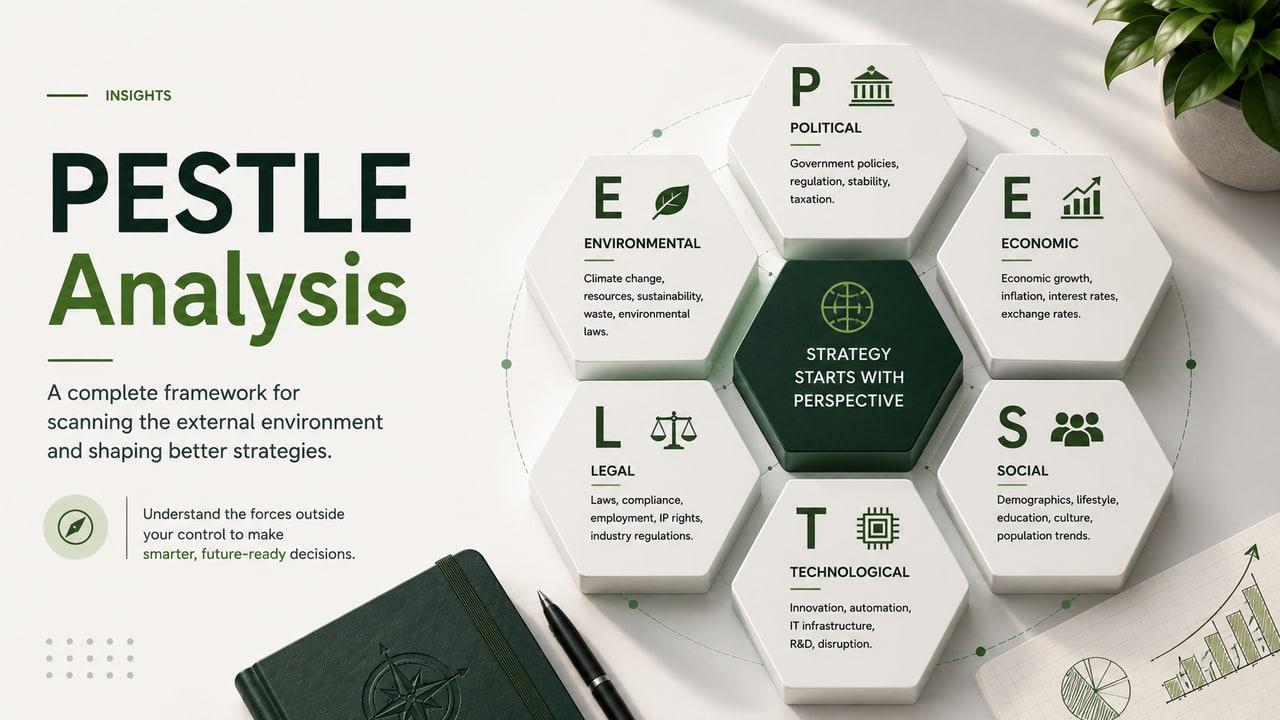
We raise this not to be pedantic, but because it explains the tool. PESTLE was never designed. It accumulated. Nobody sat down and specified what it was supposed to produce, which is exactly why it has no opinion about what you should do once you've filled it in. It is a taxonomy, not a method. It sorts the world into six boxes and stops. Every organization we've met that felt let down by a PESTLE was expecting a method and received a taxonomy.
The framework: the seventh column
A PESTLE grid has six columns: Political, Economic, Social, Technological, Legal, Environmental. Teams fill in all six, present them, and file them. The column nobody draws is the seventh:
What would we have to be able to do to act on this?
For every factor that survives onto the page, three questions:
- Which decision does this change? Not "which part of the business does this touch" but which specific decision, made by someone, on a date. A factor that changes no decision is trivia with a citation. Delete it.
- Who owns that decision? A name, not a function. "Operations" is not an owner; Operations has never once walked into a room and decided something. If no name fits, you've found the real finding: the decision is unowned, and the external factor is merely how you discovered that. (We've written about that at length in Decision Drift; a PESTLE is one of the most reliable ways to find out you have one.)
- What would we need to be able to do? The capability question, the one that turns a scan into strategy. Reading the customs change is free. Re-routing a supply chain, re-pricing a contract book, or standing up a regulatory affairs function is not. This is where the analysis stops being about the world and starts being about you.
A factor that answers all three is intelligence. A factor that answers none is a slide. Most grids are ninety percent slides, and the six columns give you no way to tell which is which, because the six columns were never asked to.
Notice what the seventh column does to the grid: it collapses it. Forty factors go in; three or four come out with a decision, an owner, and a capability attached. That collapse is the prioritization mechanism PESTLE has always been missing. You don't rank factors by importance — an argument nobody has ever won. You rank them by whether anyone can do anything about them.
Why do good PESTLE analyses change nothing?
It's tempting to read the story we opened with as a discipline failure. It almost never is. Three forces push a scan toward inertia on their own.
The artifact is born orphaned. A PESTLE is almost always commissioned by a function that owns no decisions: strategy, planning, an analyst, a consultant. The people who could act on it, the ones holding capital, headcount, pricing, or legal posture, were not in the room where it was built. So it reaches them as somebody else's homework, and homework has a well-known fate.
Everything is weighted equally, so nothing is. Six columns, forty rows, and no mechanism for saying this one matters and those thirty-seven don't. A grid with no prioritization built into it isn't neutral — it's an invitation to skim.
Completing the scan feels like managing the risk. This is the quiet one. Finishing a PESTLE produces a real and legible sense of having dealt with the environment, and from the inside that feeling is almost indistinguishable from having actually dealt with it. The document discharges the discomfort that would otherwise have forced a decision. Which is why "we did do a PESTLE" turns up so often in the same sentence as a surprise nobody responded to.
None of this is fixed by scanning harder. You cannot out-analyze an ownership problem.
Did Aramco and Netflix just scan better than everyone else?
No. And that's the whole point.
Saudi Aramco read a macro environment that was in no sense private. Vision 2030, launched in April 2016, set the national direction toward diversification in public. Oil price volatility was on every screen in the industry. The energy transition was the sector's most-discussed trend. 63% of Saudi nationals are under 30 (GASTAT, 2022 census), a demographic fact available to anyone who cared to look it up. Every one of Aramco's peers could read those same six columns, and most of them did.
What Aramco had was the seventh. When the scan said diversify downstream into chemicals and petrochemicals, there was capital to commit at that scale, a shareholder aligned with the direction, and the structural authority to reorganize around it. The signal was commodity. The capacity to act on it was not.
Which makes Aramco a genuinely useful case and a terrible model. If your takeaway is "read the environment carefully," you've learned the wrong lesson — everyone read it. What separated Aramco was its answer to the third question, and that answer had been built over years, long before the scan was run.
Netflix is the same story at a different scale. Its expansion into over 190 countries gets told as a market-intelligence achievement: local content quotas here, purchasing-power gaps there, bandwidth constraints somewhere else. But its competitors knew about the quotas too. Regulations are published.
What Netflix built was the capability the scan implied: the ability to commission Korean, Indian, Spanish, and Arabic originals rather than export one catalogue, and to price against local purchasing power rather than a single global tier. Reading "this market needs local content" takes an afternoon. Becoming an organization that can produce local content in dozens of languages takes a decade and reshapes the company. The result: revenue from outside the US and Canada reached $18.8 billion in 2023, 56% of Netflix's $33.7 billion total (FY2023 10-K). Not a supplement to the business. The majority of it. That figure is the seventh column compounding, not the scan.
How do you fill in the seventh column?
Run this against your most recent PESTLE, the actual document, not your memory of it.
- Delete every factor that changes no decision. Go row by row and name the specific decision that moves. Most grids lose half their rows here and lose nothing.
- Put a name next to every survivor. A person, not a department. Where you can't, stop: you've found an unowned decision, which matters more than the factor did.
- Ask the capability question out loud. "If this happens, what would we need to be able to do?" Write the answer next to the factor. The distance between that answer and what you can do today is your actual strategic agenda, and it's the same question as the build, buy, borrow, or bot choice in any real people strategy.
- Date the review. A PESTLE ages badly and invisibly. A two-year-old grid is more dangerous than no grid, because it carries the authority of analysis and the content of history.
- Send the survivors to the people who can act, not to the appendix. If the only artifact is a document, the document is the outcome.
- Resist scanning wider when it feels thin. Adding a seventh factor to a column nobody acts on is the most common response to this problem and the least useful one.
Ask yourself
- Can you name one decision (one, with a date) that changed because of your last PESTLE? If not, what exactly did it change?
- For the external factor that worries you most: whose name is next to it? If the honest answer is "the strategy team's," it's unowned.
- What would you have to be able to do to respond to the biggest threat on your grid, and how far is that from what you can do today?
- Is your PESTLE describing the environment you're in, the one you were in when it was written, or the one you'd prefer?
- When something external surprised you recently, was it genuinely missing from your analysis — or was it in there, correctly, changing nothing?
The takeaway
PESTLE is a good taxonomy and it was never a strategy. It sorts the outside world into six boxes, and every one of those boxes describes something you cannot control. The only column that has ever changed an outcome is the one the framework doesn't have: what you would have to be able to do about any of it.
So the question at the end of an environmental scan isn't did we see it? Most organizations, most of the time, saw it. The question is whether the seeing landed on someone who could act, and whether they could. Reading the room is table stakes — your competitors are reading the same room, from the same public data, at the same time. What separates you is whether anything happens after somebody says "this is going to be a problem."
Frequently asked questions
- What is PESTLE analysis?
- A scan of the external forces acting on an organization: political, economic, social, technological, legal, and environmental. It maps the conditions you do not control.
- When is PESTLE most useful?
- Before entering a market, before a major investment, and during planning cycles where the assumptions from last year have quietly expired.
- What makes a PESTLE useless?
- Listing forces without saying what each one changes about the decision in front of you. A PESTLE that produces no "so we should" is a research exercise, not analysis.
- What is the seventh column in a PESTLE analysis?
- The column the standard six-box grid leaves out: what you would have to be able to do to act on each factor. For every surviving factor, name the decision it changes, the person who owns that decision, and the capability required.
- How do you make a PESTLE analysis actionable?
- Delete every factor that changes no specific decision, put a named owner beside each survivor, and ask out loud what capability acting would require. Most grids collapse from forty rows to three or four, and those few are the intelligence.
Related articles
 StrategyWorkforce Planning for Next Year's Strategy — Start From the Bets, Not the Headcount7 min read
 StrategyOKRs — The Target Is Not the Capability14 min read
 StrategyThe Business Model Canvas — A Coherent Canvas Is Not a Company12 min read
 StrategyThe BCG Matrix — You Can Move the Cash, Not the Company14 min read