Culture at Pixar Was the True Guardian of Creativity
When a company chose to trust human creativity over the system. The story of Pixar — born a pure technology company, then discovering its real competitive edge wasn't its system but its people — and how Ed Catmull guarded its culture after the merger, through the BrainTrust.
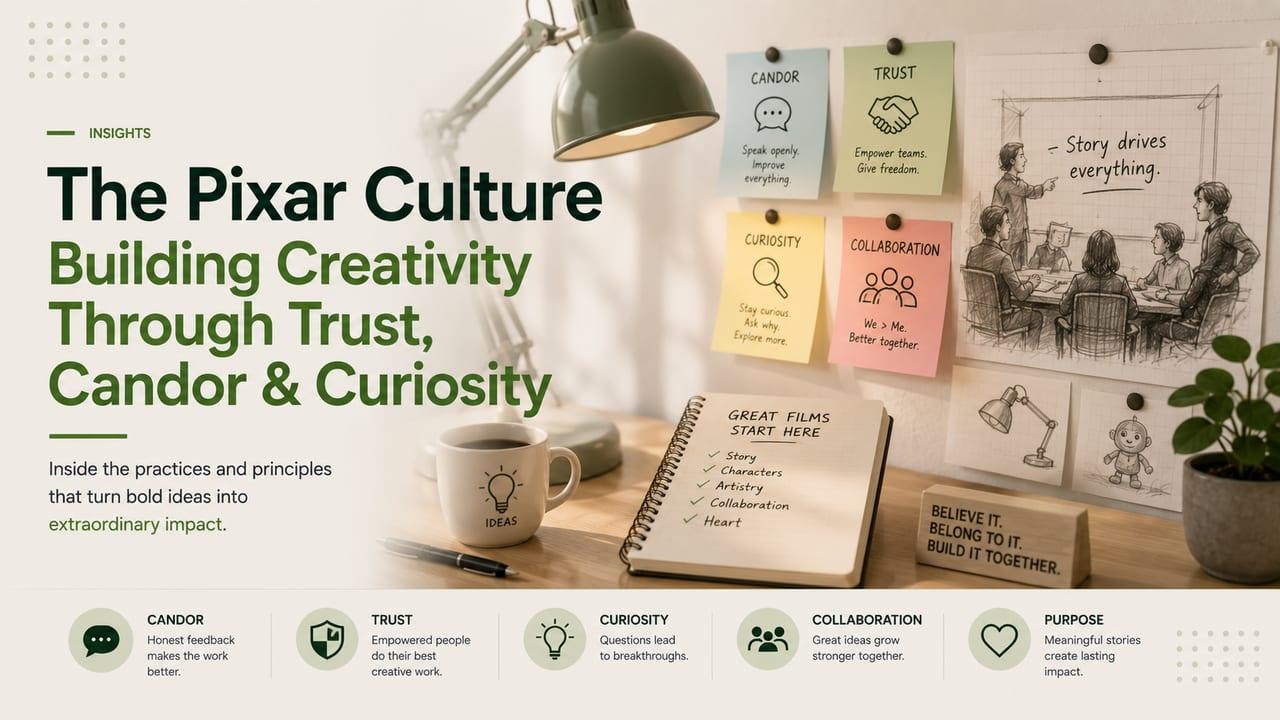
In the business world, we're used to tying the success of great companies to familiar factors.
Strong strategies… advanced operating models… vast financial resources… and management systems engineered to guarantee the highest levels of efficiency.
But among all these models, one company chose to build its success in a completely different way. A company that believed the real competitive advantage doesn't begin with the system… but with the human being. That is what Pixar Animation Studios did.
What's striking is that Pixar wasn't originally born as an idea centered on people, or even on creativity in the way we know it today. Contrary to the image later attached to it, this company's first nucleus was built on pure technology: advanced computing, digital processing systems, and tools designed in the first place to serve large entities that relied on complex computational engineering.
And although that technology ultimately served people, the human element was never the center of the idea.
The story began when one of those programmers and thinkers whose true worth the world had not yet recognized walked away — a man who was still an ordinary name back then, compared to the exceptional stature he would come to represent later: Ed Catmull.
At almost the same moment, there was an investor in his own early days who had also left his company, one who saw what others could not. He decided to invest in a small division that had been cast off from inside Lucasfilm, a division led by that same Ed; one that looked, at the time, like little more than a side unit that had lost its place inside a larger institution. Our investor here was Steve Jobs.
This is exactly where something entirely different began to take shape. After long years of work, the team spent its time developing a high-performance computer known as the Pixar Image Computer, a machine designed with advanced engineering capabilities, ahead of its time technologically…
Yet they discovered a fundamental problem: its cost was so high that even large companies hesitated to invest in it. Despite the quality of the product and its engineering sophistication, the market wasn't ready yet to absorb what Pixar was trying to sell. The crisis began.
The years kept passing… the investments kept draining… and the company was edging, little by little, toward the brink of financial collapse.
The two men sat down and made a strategic decision, each seeing the world in a different way: Steve Jobs, arriving with the mind of a businessman who knew the language of the market and of survival, and Ed Catmull, who still saw in technology and creativity an engineering project worth continuing.
Technology was no longer the only story. And creativity was no longer merely an isolated artistic talent. Instead, a rare model began to form — one made of the precision of technology and the freedom of human imagination.
It became an experience. And the first real test of that decision went out into the world: in 1995, the company released Toy Story, the first feature-length film in history produced entirely with computer animation.
A film with a budget of nearly $30 million… became a global success whose revenues surpassed $360 million worldwide. A string of successes followed in the same vein, until an acquisition offer came from one of the largest entertainment entities in the world: Walt Disney. The acquisition went through, a step that seemed, at the time, a natural extension of the exceptional success Pixar had achieved over the years.
But what raised the real question wasn't the deal itself. It was what always happens after any great merger.
Which culture would win in the end?
The culture of the smaller entity that had built its success in a different way… or the culture of the larger entity, governed by the calculations of growth and commercial return? The answer didn't take long.
In 2011, Cars 2 marked the first clear stumble in the company's history, measured against the standard audiences had grown used to from Pixar.
And here Ed Catmull realized the problem wasn't the film itself, but something far deeper. The culture that had built Pixar's success from the very beginning had melted, little by little, into the new entity. So Catmull decided to return, steadily and firmly, to the heart of the philosophy he had believed in from day one: that the best a company can offer isn't imposing the answers, but creating an environment that lets minds arrive at them on their own. And so he re-established one of the most important methodologies that had distinguished Pixar for years: the BrainTrust.
A methodology built on giving creators an honest space for critique, dialogue, and intellectual challenge, with no authority to constrain them and no fear to keep them from speaking. Pixar believed that respecting creativity doesn't only mean respecting the mind that makes the work, but also respecting the mind that will ultimately receive it.
And perhaps that was the most important lesson in the company's entire journey: knowing how to build a culture that gives people the freedom to think — and to receive.
My question: does your company today have someone who dares to build an organizational culture and protect it, the way Ed Catmull did?
Frequently asked questions
- What made Pixar's culture distinctive?
- Mechanisms that made honest criticism safe and routine — most famously the Braintrust, a group with no authority over the director, which removed the power dynamic that usually makes feedback useless.
- Was it about hiring exceptional talent?
- Partly, but Pixar's own account is the opposite emphasis: give a good team a mediocre idea and they will fix it; give a mediocre team a brilliant idea and they will ruin it.
- What transfers to non-creative companies?
- The separation of feedback from authority. Any organization can convene people who have no power over a decision and a real stake in it being good.
- Why did Pixar's culture weaken after the Disney acquisition?
- Its distinctive way of working gradually dissolved into the larger entity's growth-and-return calculus. Catmull read the 2011 stumble of Cars 2 not as a bad film but as a cultural signal, and re-established the Braintrust to restore what had faded.
- Did Pixar begin as a technology company?
- Yes. Its first nucleus was pure technology — advanced computing and digital processing, including the high-end Pixar Image Computer. The human and creative element became the center only later, after the market proved unready for the hardware.
Related articles
 CultureI Thought They Were Slogans on the Wall — Until I Saw People Living Them6 min read
 CulturePeople Strategy Isn't an HR Document. It's a Business Model.12 min read
 CultureOrganizational Culture: How It Actually Drives Performance5 min read
 CultureStop Treating Culture Like a First Date. It's Built for the Long Haul5 min read