Porter's Five Forces — You're Not as Safe as You Think
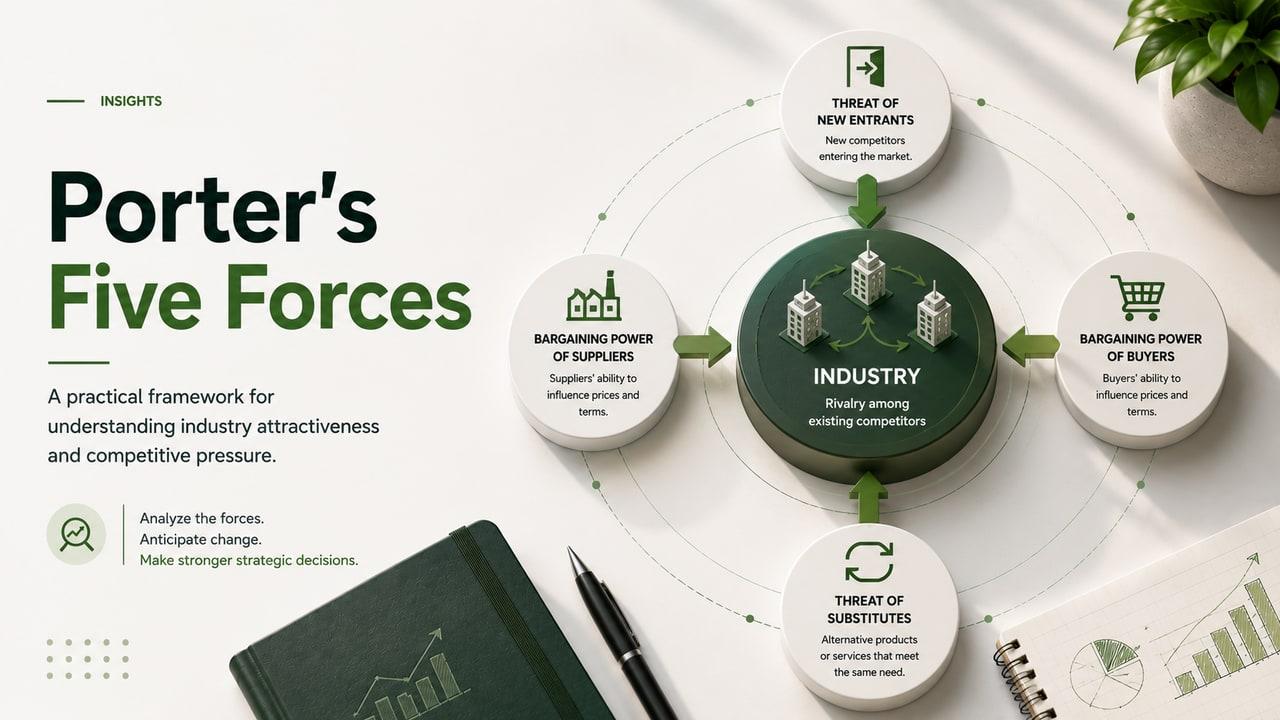
Porter's Five Forces measures how attractive your industry is. It says nothing about how good you are — and on a P&L, profit the structure lends you looks identical to profit you earned. A framework for telling borrowed profit from the real thing, before the barriers fall and you find out the hard way.
A regional bank we worked with had dominated its market for eleven years. Same products, same margins, same customers. Leadership called it stability, and they were proud of it. Then two fintech startups took 22% of their retail deposit customers in eighteen months.
The post-mortem inside the bank focused on the obvious thing: they hadn't seen the fintechs coming. That's true, and it's the least interesting part of the story.
Here's the harder reading. The eleven good years were never evidence that the bank was good. Retail banking had for decades been protected by barriers that had nothing to do with any individual bank's competence — capital requirements, a licence, a branch network, the sheer cost of owning a payments relationship. Those barriers produced margin. The margin landed in the bank's accounts. And everyone in the building read it as a scorecard.
It wasn't a scorecard. It was a loan. When digital infrastructure knocked the barriers down, the loan got called.
The eleven good years
We sat with the CEO some months after the deposit numbers came in.
"I keep thinking about how confident we were. We had eleven years of numbers — you can't argue with eleven years. Except it turns out you can. When I finally asked the room what we actually did that the bank across the street didn't do, nobody had an answer. Not a bad answer. No answer. We'd been reading our margin as a verdict on us. It was a verdict on banking."
That last line is the whole article. The bank had spent eleven years accumulating evidence about its industry and filing it under evidence about itself.
What is Porter's Five Forces actually measuring?
Michael Porter introduced the five forces in a March 1979 Harvard Business Review article, "How Competitive Forces Shape Strategy." He was an associate professor at the time; it was his first HBR piece, and it won that year's McKinsey Award. Nearly five decades on it remains the most-used lens in competitive strategy, and deservedly — the forces it names are structural, and they operate whether or not anyone in your company is thinking about them.
But read the framework's own claim closely, because most people read straight past it. Five Forces explains industry profitability. It tells you how much profit is available in an arena and how much of it the players get to keep. It is a statement about the arena. It is not a statement about you.
That isn't a criticism — it's the design. The framework answers "how attractive is this industry?" It was never built to answer "how will we do in it?" The trouble starts when a leadership team receives an answer to the first question and hears an answer to the second.
The framework: borrowed profit
Every company's margin comes from two sources, and your accounts cannot tell them apart.
Borrowed profit is margin the industry's structure hands you. High barriers to entry, weak buyers, no credible substitutes, few rivals — these generate profit for whoever happens to be standing inside the walls when the music is playing. You didn't earn it. You qualified for it.
Earned profit is the margin you would still have if the structure changed tomorrow, because you are genuinely better at something customers will pay for.
Five Forces is an excellent instrument for measuring the first. It is entirely silent on the second. And here is the trap: on a P&L they are the same colour. No line item says "this margin came from the licence."
So the question the framework cannot ask you is the one that decides your future:
If the barriers protecting you fell tomorrow, how much of your margin would survive?
Most incumbents have never asked it, and there's a reason that's rational rather than lazy: while the barriers hold, there is no way to tell the two apart. The experiment never runs. Worse, every year the barriers hold is another year of evidence that you're good.
That's the real mechanism, and it's nastier than complacency. Borrowed profit doesn't merely flatter you — it accumulates as proof. Eleven years of it is very hard to argue with. The longer the shelter lasts, the more confident you become, and the less able anyone in the building is to distinguish the shelter from themselves.
How much of your profit is the industry actually lending you?
The satisfying part of this question is that Porter's own research answers it.
In 1997, Anita McGahan and Michael Porter published "How Much Does Industry Matter, Really?" in the Strategic Management Journal — a direct response to Richard Rumelt, who in 1991 had found that industry structure explained strikingly little of why firms differ in profitability. McGahan and Porter used a deliberately broader dataset, all sectors rather than manufacturing alone, and roughly doubled Rumelt's estimate of how much industry matters.
Their answer, with the thumb pressed firmly on the scale in industry's favour: industry membership explained about 19% of the variance in business profitability. Business-specific effects explained about 32% — nearly twice as much.
Sit with that for a second. The man who taught the world to analyze industry structure went looking for how much industry structure matters, using the sample most likely to flatter the answer, and found that you matter roughly twice as much as your industry does.
Two honest caveats, because this literature is genuinely contested and anyone quoting one clean number is selling something. Estimates of industry effects across the field range from roughly 3% to over 40% depending on sample, country, how narrowly "industry" is defined, and estimation method — and a serious minority of researchers, using value-based measures, argue industry dominates for the average firm. Meanwhile something like 40% of the variance isn't explained by industry, corporate parent, or business unit at all. Nobody can fully account for why two companies facing identical forces end up in different places.
But the direction isn't seriously in dispute: the arena explains less than the player. Which means the tool that measures the arena is, by construction, measuring the smaller half of your problem.
Why do incumbents mistake shelter for skill?
It's tempting to file this under complacency. It's structural, and it happens to careful people.
Profit is the same colour whatever its source. Accounting cannot separate borrowed from earned, so the distinction has to be drawn by judgment — and there is rarely an occasion to draw it while the numbers are good. Nobody calls a strategy offsite to ask why things are going well.
Stability reads as a track record, and track records read as competence. Eleven years of stable margin looks exactly like eleven years of good management. It might be. It might equally be eleven years of a moat that nobody currently employed there dug.
A protected industry stops needing the muscle, so it stops building it. This is the one that matters most and gets noticed least. If competition has been structurally suppressed for a decade, the organization has spent that decade hiring operators rather than competitors, rewarding administration rather than aggression, and building processes for a world where customers don't leave. None of that is wrong — it's a rational response to the environment. But it means that on the day the barrier falls, the capability to fight isn't merely low. It's absent, and it takes years to grow. The shelter doesn't just hide your weakness. Over time, it creates it.
How do you tell borrowed profit from earned profit?
- Run the barrier-collapse test. Take your single largest structural protection (the licence, the switching cost, the distribution lock, the regulation) and assume it's gone in 24 months. Now forecast. The margin that survives is yours. The rest was borrowed. Most teams have never run this and find it genuinely unpleasant, which is the point.
- Ask what you do that the company across the street doesn't. Ask it out loud, in the room, and make people answer specifically. If every answer is something your rival also does, your margin isn't coming from you.
- Check whether your best years were your best decisions. Line your margin history up against the decisions you're proud of. Where margin was high and flat through years in which you did nothing remarkable, that's the structure paying you, not the strategy.
- Name the capability you'd need if the shelter went, and be honest about the distance from where you stand today. It's the same build, buy, borrow, or bot question that any real people strategy has to answer, asked under time pressure instead of at leisure.
- Watch adjacency, not rivals. Five Forces asks who is in your industry. Substitution is the force teams underweight, because taking it seriously means imagining a competitor that doesn't exist yet and doesn't look like you.
- Pair it with a macro scan. Five Forces reads the industry; PESTLE reads the world the industry sits inside. Barriers rarely fall because a rival pushed them. They fall because regulation, technology, or capital changed. And neither tool will tell you whether you can respond.
Ask yourself
- If your single biggest barrier to entry vanished inside 24 months, how much of your margin survives?
- What do you do that your closest competitor doesn't, and would three people on your leadership team give the same answer?
- Are you reading years of stable margin as evidence about your company, or about your industry?
- When did you last win a customer who had a genuine, easy alternative? How long ago was that?
- Which capability would you need on the day the shelter goes, and how many years away from it are you, honestly?
The takeaway
Porter's Five Forces is the finest instrument ever built for reading the arena, and it will tell you nothing about whether you can fight in it. That isn't a flaw. It's the scope. The forces describe the industry — and the industry, on the most generous estimate the framework's own author was able to produce, explains less about your profit than you do.
So the question Five Forces can't ask is the only one that finally matters: of the margin you have today, how much is actually yours? Eleven good years feel like the answer. They aren't. They're the shelter holding. You find out what you built the day the walls come down — and by then it isn't an analysis exercise. It's a fight you have either trained for or haven't.
Frequently asked questions
- What are Porter's Five Forces?
- Competitive rivalry, supplier power, buyer power, threat of substitutes, and threat of new entrants: the five pressures that determine how much profit an industry can sustain.
- What are the Five Forces used for?
- Assessing structural attractiveness before committing capital, and finding which force to defend against. A profitable industry with one weak force is a temporary condition.
- Why do comfortable companies misread the model?
- Because they score the forces from the position they hold today. Substitutes and new entrants are the two forces that look weakest right up until they are not, and both are usually assessed by the people with most to lose from taking them seriously.
- What is the difference between borrowed profit and earned profit?
- Borrowed profit is margin the industry's structure hands you through high barriers and weak rivals; you qualified for it rather than earned it. Earned profit is what would survive if those barriers fell tomorrow. A P&L cannot tell the two apart.
- How much does industry structure actually affect profitability?
- In McGahan and Porter's own 1997 study, industry membership explained about 19% of the variance in business profitability, while business-specific effects explained roughly 32%, nearly twice as much. Estimates vary widely, but the player tends to explain more than the arena.
Related articles
 StrategyWorkforce Planning for Next Year's Strategy — Start From the Bets, Not the Headcount7 min read
 StrategyOKRs — The Target Is Not the Capability14 min read
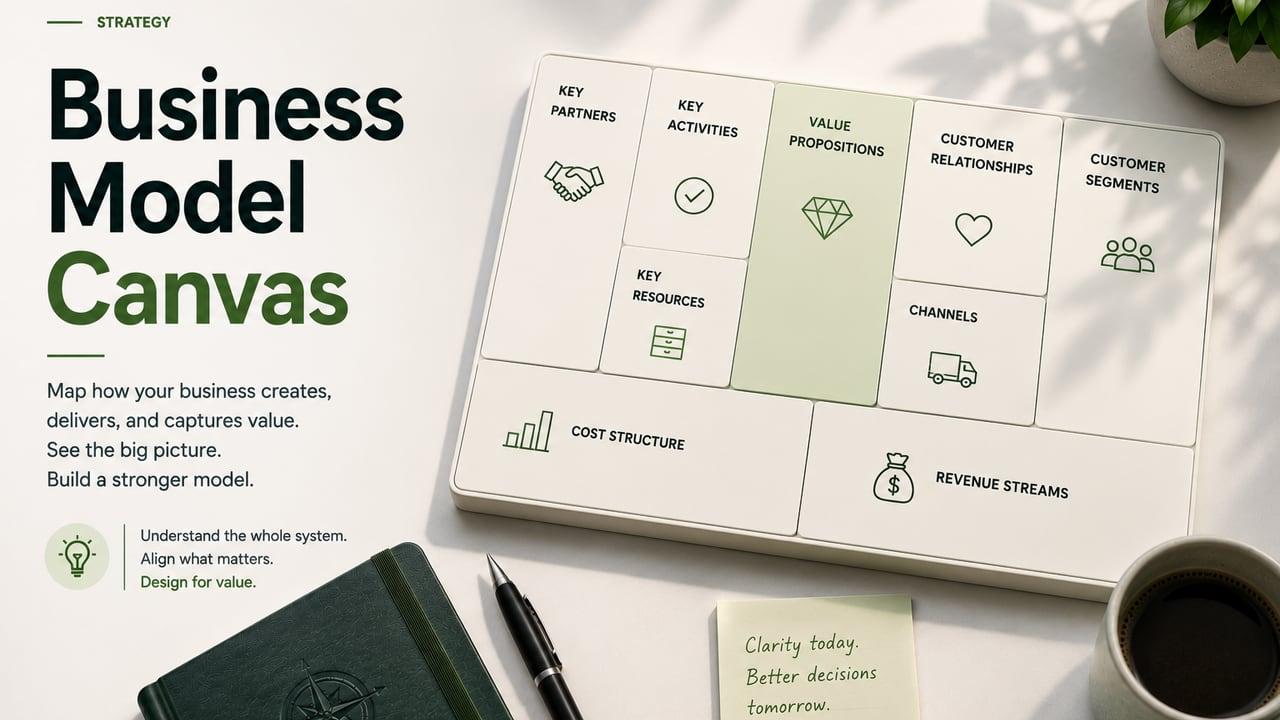 StrategyThe Business Model Canvas — A Coherent Canvas Is Not a Company12 min read
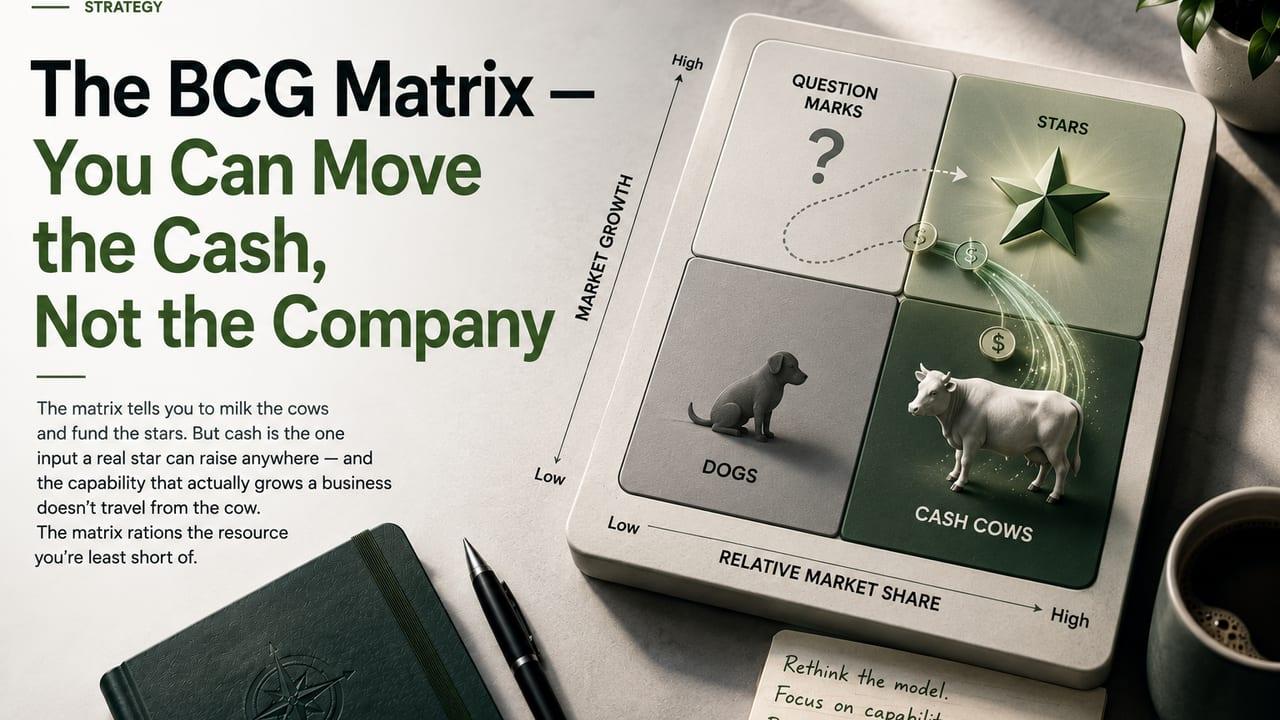 StrategyThe BCG Matrix — You Can Move the Cash, Not the Company14 min read