Talent Management in 2026: From Pipeline to Loop
We still run talent management like a pipeline — hire, develop, retain, in that order. But the pipeline broke. Our Skills Intelligence Loop reframes talent as something continuous: sensing the skills the business needs, building them, deploying by skill rather than title, and retaining people by making growth visible before they go looking for it elsewhere.
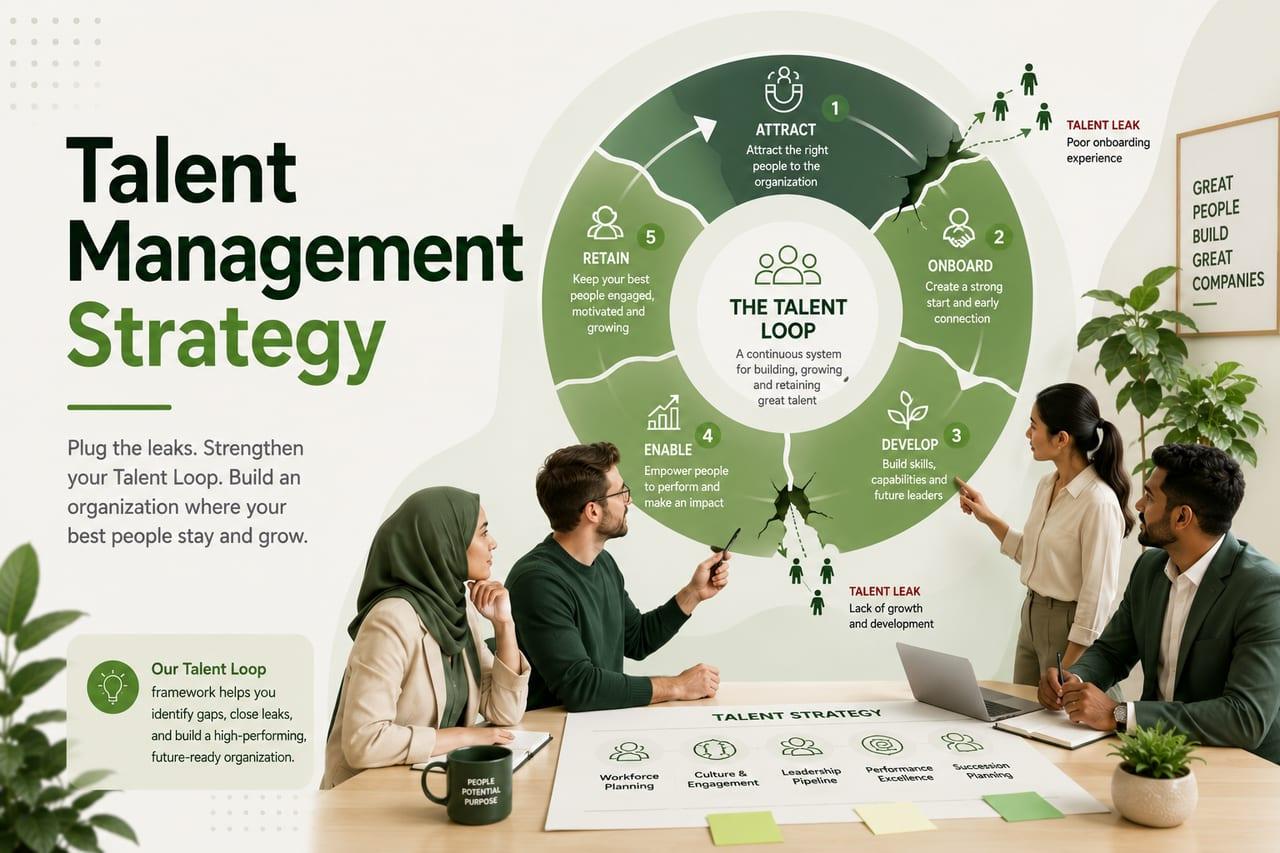
We keep treating talent management as a pipeline: hire, onboard, develop, retain, in that order, in that direction. But the pipeline broke. Roles change faster than job descriptions. Skills expire before careers peak. And the people you most need to keep are the ones with the most options to leave.
Most talent-management failures we see aren't execution problems — they're design problems. Companies built their systems for a stable world and are now running them at speed. The issue isn't that people have become harder to keep. It's that we're offering growth at the wrong pace, in the wrong shape, through the wrong signals.
The career mapped as a ladder
A founder we worked with lost his best data scientist, not to more money, but to a competitor who offered her a sideways move into a new product area. "There was nowhere for her to go here," he admitted. The only growth his company could offer was a management track she didn't want; the lateral move she did want never surfaced, because nobody was tracking who could do what — only who reported to whom.
"We'd mapped her whole career as a ladder," he said. "She wanted a lattice."
That's the pipeline breaking in a single sentence. His talent system could see titles, not skills. So it couldn't see the move that would have kept her. The process ran perfectly and still leaked.
The Skills Intelligence Loop
The fix isn't a better pipeline; it's a different shape. We use a framework called the Skills Intelligence Loop to help organizations design talent systems that are continuous rather than cyclical, adaptive rather than scheduled. Unlike a pipeline, the Loop has no fixed starting point: in 2026 you might enter the system as a new hire, an internal candidate, or a reskilled employee moving into a new function. Its four stages feed each other in real time, not once a year.
- Sense — continuously map what capabilities exist across the company, where they're thinning, and which new ones the work now demands. Not a once-a-year skills audit: a live signal.
- Build — develop in the flow of work, not in scheduled batches. Targeted growth at the moment of need, reaching frontline and remote people, not only those in the room.
- Deploy — match people to opportunity by skill, not by org chart, tenure, or a manager's hunch. Surface the right person for the work before the role is ever posted externally.
- Retain — treat retention as an output of the first three stages, not a separate program.
The order isn't a sequence so much as a circuit, and it closes on itself. Retention data tells you which earlier stage is underperforming: high attrition right after a Deploy decision usually means the skills you're Building don't match the roles actually opening up, a mismatch you can see and fix before it hardens into a culture problem.
The most important shift is that last stage. Retention isn't something you bolt on at the end — it's what a working Loop produces. When people can see where they're headed and feel the company investing in getting them there, they stay. When they can't, they leave, regardless of compensation.
Why is talent management harder in 2026?
Two things make the broken pipeline urgent right now, and the data on both is sobering. Mercer's Global Talent Trends 2026 (built on nearly 12,000 voices) found that only 44% of employees feel they're thriving at work, down from 66% two years earlier. Over the same period, the share who fear becoming obsolete because of AI climbed from 28% to 40%. A depleted, anxious workforce can't sustain performance no matter how good the strategy looks on a slide, and most strategy documents still don't address this human dimension head-on.
But the same research points straight at the antidote. In that survey, 63% of employees said they would trade a 10% pay raise for the chance to build AI and digital skills. People aren't asking for more money so much as for a future, and they're telling you, plainly, what would make them stay. That is the Loop's whole thesis: growth, made visible, is the retention strategy.
What has changed about talent management in 2026?
The mechanics of the Loop are timeless; what's changed in 2026 is where the pressure falls.
- Skills have replaced titles as the unit of talent decisions. Companies like IBM and Google dropped degree filters years ago; skills-first is now the organizing layer underneath hiring, development, and mobility. A job description is too blunt an instrument to run a Loop on.
- AI moved from doing the admin to informing the decisions — surfacing flight risk, suggesting matches, spotting emerging skill gaps. The useful question is no longer should we use AI in talent. It's where must a human stay in the loop, because decisions about who to hire, promote, or let go carry too much weight, and too much bias risk, to hand to an algorithm.
- Human skills became the scarce complement, not a soft extra. As AI absorbs routine cognitive work, judgment and adaptability are where people stay irreplaceable. McKinsey projects demand for social and emotional skills to rise 26% in the US and 22% in Europe by 2030. A strategy that doesn't deliberately build these is quietly engineering its own obsolescence.
- Internal mobility is becoming the primary lever, not the fallback. The economics are settled: Wharton research found external hires are paid 18–20% more than internal promotions for the same role, and underperform in their first two years. LinkedIn finds employees at high-internal- mobility companies stay roughly 53% longer. Building the Deploy stage well is both the cheaper and the stickier path.
How do you design a talent management strategy?
You don't rebuild everything at once. You design deliberately and fix in order of cost:
- Start from the business, not from HR. Every talent priority should trace to a named business priority. A strategy organized around HR's own goals loses leadership backing within a year.
- Map your skills before you build anything. What capabilities do you have, where are they concentrated, where are they thinning? Without that map, every downstream call is a guess.
- Find where your best people leave, not just your turnover rate. Most companies know the headline number; few know which stage their most valuable people exit, and why. That's where the design work starts.
- Run an internal search before every external hire. With the cost gap above, visible internal opportunity is one of the highest-leverage retention tools you have, at no added headcount.
- Hold managers accountable for the Loop, not just for output. Gallup's analysis of 2.7 million employees found managers account for at least 70% of the variance in team engagement, and SHRM puts the cost of replacing someone at six to nine months of their salary. Developing managers as managers isn't a soft nicety; it's your retention budget.
- Review on the business's rhythm, not the calendar's. A strategy that fit in January may need real adjustment by Q3. Tie the review to market and workforce signals, not the annual cycle.
Ask yourself
A quick diagnostic. Wherever the answer is fuzzy, you've probably found your next leak:
- If your three best people left tomorrow, would you have a ready internal alternative, and would you have seen it coming?
- Do you have a live, dynamic skills map, or a static list from the last job-description refresh?
- Before your last three external hires, did you run a structured internal search first?
- Can your highest performers point to a specific, visible path here, or are you relying on goodwill?
- Four in ten employees fear becoming obsolete because of AI. What's that number in your organization, and what are you doing about it?
- Where is AI making talent decisions right now, and was that designed, or did it happen by default?
The takeaway
The organizations that win on talent in 2026 won't be the ones with the best HR software. They'll be the ones that stopped managing talent as a pipeline and started running it as a loop: one that continuously senses the capabilities the business needs, builds them deliberately, deploys people by skill rather than title, and retains them by making growth visible before they go looking for it elsewhere. The data is clear and the tools exist. The real question is whether leadership is willing to own the strategy — not just approve it.
Frequently asked questions
- What is talent management?
- The full cycle of attracting, developing, deploying, and keeping people — not recruitment with extra steps. The distinction matters because most of the value sits after the hire.
- What is the shift from pipeline to loop?
- A pipeline treats talent as flowing in one direction and ending at the hire. A loop assumes people move between roles, leave and return, and develop in place — so the same investment serves retention and acquisition at once.
- What should companies measure?
- Whether capability is growing where the strategy needs it. Time-to-hire and attrition are easy to count and say almost nothing about that.
- What are the four stages of the Skills Intelligence Loop?
- Sense the capabilities the business needs, Build them in the flow of work, Deploy people by skill rather than title, and Retain them as an output of the first three. The stages feed each other continuously rather than running once a year.
- Is internal mobility cheaper than hiring externally?
- Usually. Wharton found external hires are paid 18 to 20 percent more than internal promotions for the same role and underperform in their first two years, while LinkedIn finds people at high-internal-mobility companies stay roughly 53 percent longer.
Related articles
 Talent ManagementThe PIP Trap: Why Most Underperformance Is Misdiagnosed3 min read
 Talent ManagementSuccession Planning When Every Critical Role Rests on One Person7 min read
 Talent ManagementHR Department Structure by Growth Stage — Add Capability, Not Just Administrators7 min read
 Talent ManagementPerformance Management That Doesn't Rot Into a Form6 min read