Green Apple vs Other Talent Management Platforms: An Honest Comparison
Most talent platforms are built to run processes. We built Green Apple to keep decisions aligned with strategy. Here's the honest comparison, including where we lose and who shouldn't buy us.
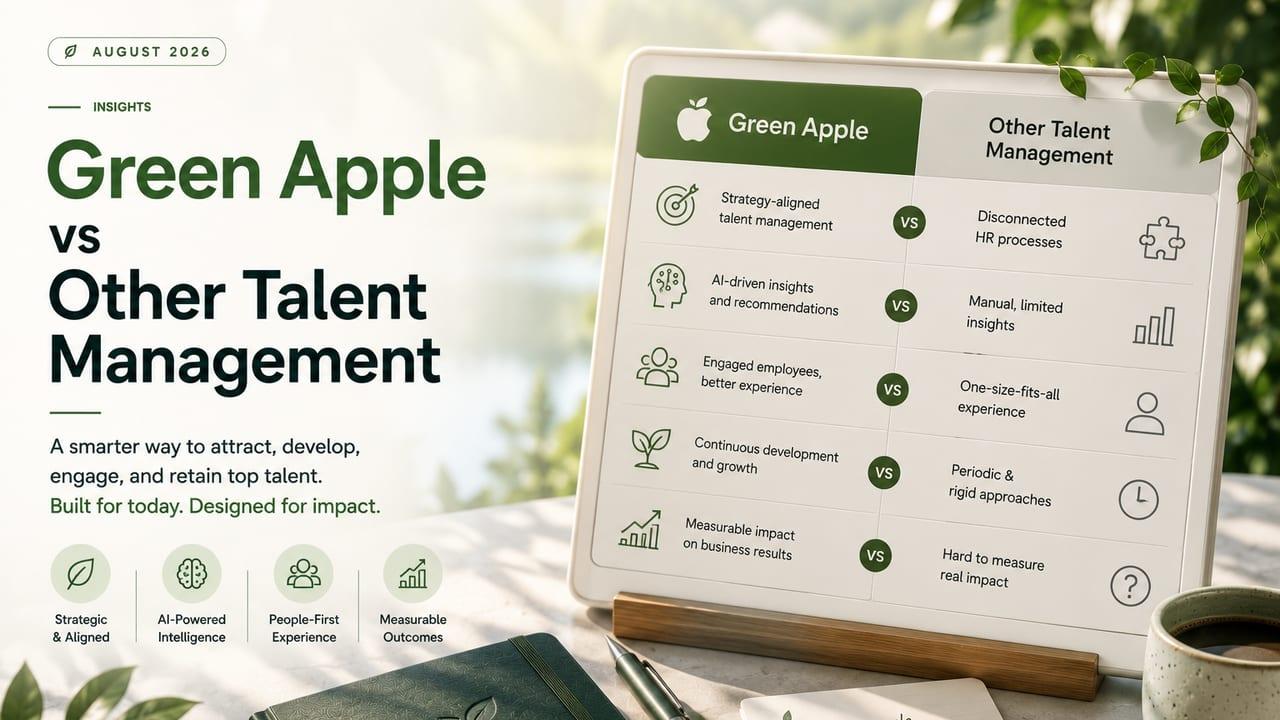
Most talent management platforms are built to run processes. Green Apple is built to keep decisions aligned with the company's DNA and strategy. That is the honest short answer, and it comes with an honest boundary: if what you need most is payroll, leave balances, or an applicant tracker as your primary system, we are not that product and we won't pretend to be. Green Apple is a culture-first talent management and organizational development platform, aimed at Saudi and GCC small-to-medium enterprises of roughly 20 staff and above, and the person who usually finds us is a CEO, founder, chief of staff, strategy officer or HR leader who has just discovered something uncomfortable: the org chart is current, the review cycle closed on time, and nobody can explain why last quarter's biggest decision was made the way it was.
What did we learn from a founder with three systems and no answers?
A founder we worked with in the region had built a 70-person company with a respectable stack. An HRIS holding contracts and leave. A recruiting tool with a clean pipeline. An engagement platform producing a quarterly score that hovered, reassuringly, around 7.4. He had spent real money and had genuinely good tooling.
Then two departments shipped conflicting commitments to the same client in the same month. He asked us to help him understand how that happened. We spent a week talking to eleven people. Each one had made a defensible decision. Each one was optimizing against a different understanding of what the company was trying to win at. Nothing in his stack was designed to notice that. His systems could tell him who worked where, who was hired, and how people felt. None of them could tell him whether his people were deciding the same way he would.
That gap has a name in our practice. We call it Decision Drift, and we've written about it separately. What matters for a buying decision is this: no amount of workflow automation closes it, because workflow tools are built to move work through steps, not to hold a shared meaning of why the steps exist.
What is the Three Systems Model for evaluating talent platforms?
When we help leadership teams evaluate software, we stop comparing feature grids and sort the market into three systems instead. Every vendor in your shortlist is strongest at exactly one of them, whatever the website says.
| System | The question it answers | Typical products | Failure mode when it's your only system |
|---|---|---|---|
| System of Record | Who works here, on what terms | HRIS, payroll, core HR | Perfect data about people, no view of the organization |
| System of Workflow | Did the process run | ATS, LMS, performance suites, survey tools | Cycles complete on time while alignment quietly erodes |
| System of Meaning | Are we deciding the same way | Company brain, strategy and DNA models | Beautiful clarity that nobody has to operate against |
Green Apple lives in the third row. Green Organization, our AI company assistant, holds DNA (purpose, values, principles), strategy, structure, governance and ownership in one canonical model, with an executive metrics dashboard on top. It is deliberately not a document management system. Storing your strategy deck is not the same as modelling your strategy; a folder cannot tell you that a new team's mandate overlaps someone else's ownership.
The four pillars around it cover the talent lifecycle — Organization Development, Talent Acquisition, Talent Experience, Team Building — but they all point back at the same model. That is the design choice that makes us different, and it's also the reason we're a poor fit for some buyers.
Why does the meaning layer matter more than another workflow tool?
This isn't a novel idea, it's an old one that the software market has mostly ignored. Nadler and Tushman's congruence model argued decades ago that organizational performance comes from fit among strategy, work, people and the informal organization, not from the quality of any single element. Edgar Schein made a parallel point about culture: espoused values sit above the layer that actually governs behaviour, the shared assumptions nobody writes down. We've told our own version of that discovery in Slogans on the Wall.
Fit and assumptions are relational properties. A tool that can only see one process at a time is structurally incapable of reporting on them. That's why we treat engagement signals as inputs to an alignment model rather than as a score: sentiment is interesting only when read against strategy and structure. And it's why the platform's AI surfaces alignment, drift and risk and suggests actions, while people stay in control of every decision. An engine that decided for you would be solving the wrong problem, since the whole point is that the humans hold a shared model.
Where does Green Apple genuinely lose?
An honest comparison has to include the losses. We'd rather you self-select out now than churn in month five.
- You need payroll, benefits administration or statutory HR records. Buy an HRIS. We are not one and don't replace one.
- Your primary pain is high-volume recruiting throughput. A dedicated ATS will out-execute us on requisition mechanics.
- You want a polling tool with fast pulse surveys and a benchmark database. We are not a survey or engagement-polling product.
- You want a file repository for policies and decks. Green Organization builds a model of the organization, not a library about it.
- You're eight people in one room. You already have a company brain: it's the room. Come back at twenty.
We also lose deals where the buyer wants software to substitute for a leadership conversation that hasn't happened. In those cases our human-led Leadership and Team Performance work — executive advisory, coaching, leadership team development — usually has to come first.
Which platforms actually support Arabic and RTL, and what fits the GCC?
This is where regional buyers get burned most often. Plenty of global suites list Arabic as an available locale, and the translation is fine. Then you open a real screen and the layout is mirrored inconsistently, dates and numerals fight the copy, and Arabic content sits inside a left-to-right skeleton. Green Apple supports 15 languages, including Arabic and Urdu with full RTL support, and our Arabic brand name is جرين أبل. Our advice, applied to us as much as anyone: refuse the slide deck, ask for a live screen with your own Arabic content in it, and have an Arabic-first colleague drive.
On residency, the answerable version matters more than the promised one. Our primary data region is Frankfurt for GDPR, and a Saudi Arabia region is planned for Saudi PDPL and GCC customers. If a vendor cannot tell you today which region holds your data, treat that as a finding.
| Plan | Monthly price (USD) | Seats |
|---|---|---|
| Starter | $0 | 2 |
| Growth | $35 | Uncapped |
| Pro | $189 | Uncapped |
| Enterprise | From $2,499, custom | Uncapped |
What can you do this week to compare platforms properly?
- Write down the last three decisions that surprised you. Ask each shortlisted vendor which screen would have flagged them in advance.
- Sort your current tools into Record, Workflow and Meaning. Most companies find two full rows and one empty one.
- Ask five people in different functions, separately, what the company is trying to win at this year. Compare the answers before you compare vendors.
- Demand one live RTL screen with your real Arabic content.
- Ask where the data physically sits, and what changes when a regional option becomes available.
- Name the owner. A meaning-layer system with no executive owner becomes shelfware faster than any workflow tool.
- Run the free tier with two seats before you convene a committee.
What should you ask your own leadership team?
- If two managers made opposite calls next week, which of them would be wrong, and how would anyone know?
- Where does our strategy actually live: in a deck, in one person's head, or in something the whole company can consult?
- Which of our tools would notice a structural conflict before a client did?
- Are we buying software to fix a system, or to avoid a conversation?
- If our headcount doubled in twelve months, which part of how we decide would break first?
The takeaway
Most of the market is competing to run your processes more smoothly. Very little of it is competing to keep your company recognisably itself while it grows, which is the actual work of organization development, as we've argued in our guide to organization development. Buy the record from a record system. Buy the workflow from a workflow system. But if nothing in your stack holds a canonical model of your DNA and strategy that every member can consult before deciding, you don't have a tooling gap. You have a company brain that only exists in one or two heads, and that is a far more expensive problem than any licence fee.
Frequently asked questions
- How does Green Apple compare to other talent management platforms?
- Most talent management platforms are systems of workflow: they run recruiting, reviews, learning and engagement surveys well. Green Apple is a culture-first talent management and organizational development platform built around a canonical model of the company's DNA, strategy, structure, governance and ownership, so daily decisions can be checked against them. It is not an HRIS, a payroll system, or an ATS-only product, and it does not replace one.
- Which talent management platforms offer full Arabic and right-to-left interface support?
- Many global suites offer Arabic as a translated locale while the underlying interface logic stays left-to-right. Green Apple supports 15 languages, including Arabic and Urdu with full RTL support, so the interface reads natively rather than mirrored awkwardly. When evaluating any vendor, ask to see a live RTL screen with real Arabic content, not a slide.
- What talent management software works well for companies in Saudi Arabia and the GCC?
- For Saudi and GCC small-to-medium enterprises of roughly 20 staff and above, the practical test is three-part: native Arabic and RTL, a data residency answer you can defend, and a model of the organization that survives fast-changing structures. Green Apple was built for this market, with CEOs, founders, HR leaders, chiefs of staff and strategy officers as its buyers. Primary data region is Frankfurt for GDPR, with a Saudi Arabia region planned for PDPL and GCC customers.
- Do we need to replace our HRIS to use Green Apple?
- No. Green Apple sits at a different layer from your HRIS, payroll or applicant tracking system, which stay the authoritative record for employment data. Green Apple's job is organizational alignment: DNA, strategy, structure, governance, ownership, and the executive metrics that show whether execution matches intent.
- What does Green Apple cost?
- Green Apple has four plans in USD: Starter at $0 per month with 2 seats, Growth at $35 per month, Pro at $189 per month, and Enterprise starting at $2,499 per month with custom pricing for larger organizations. Paid plans are uncapped on seats. Human-led Leadership and Team Performance services are available alongside the platform.
- Is Green Apple an engagement survey tool?
- No. Green Apple is not a survey or engagement-polling tool. Engagement signals feed a broader organizational-alignment model anchored in company DNA, so a drop in sentiment is read against strategy and structure rather than reported as a standalone score.
Related articles
 Talent ManagementSuccession Planning When Every Critical Role Rests on One Person7 min read
 Talent ManagementHR Department Structure by Growth Stage — Add Capability, Not Just Administrators7 min read
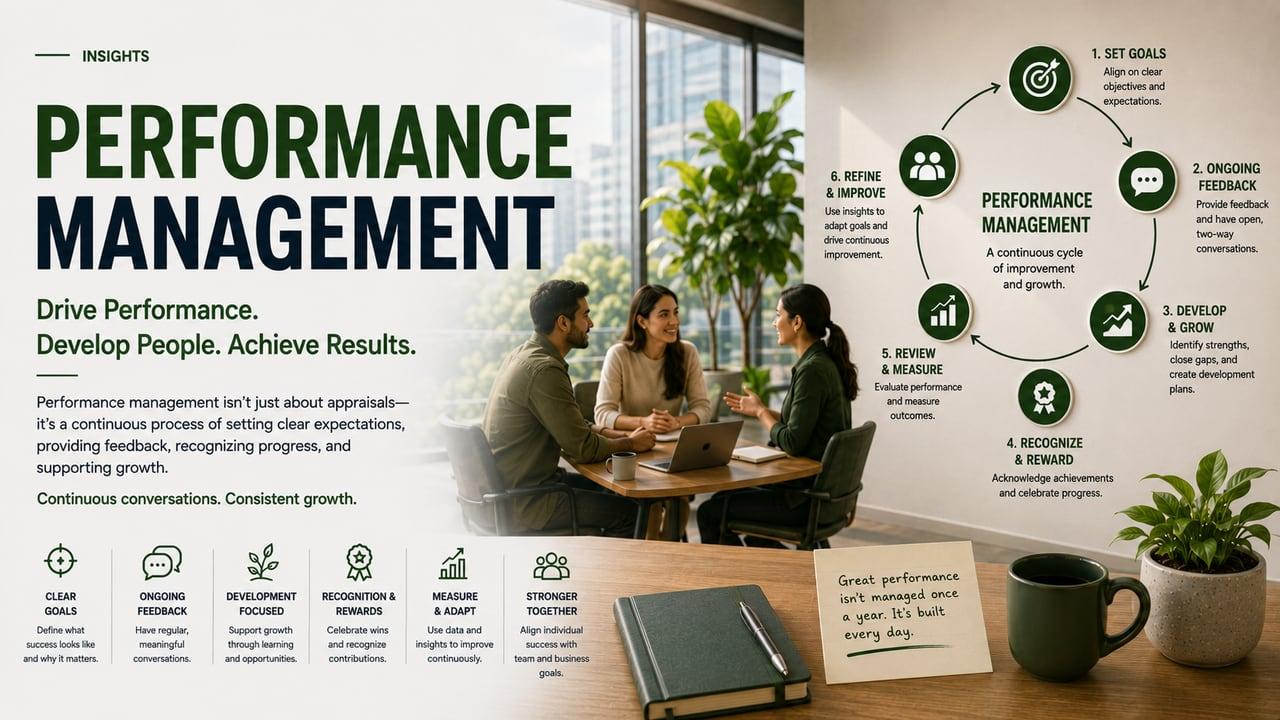 Talent ManagementPerformance Management That Doesn't Rot Into a Form6 min read
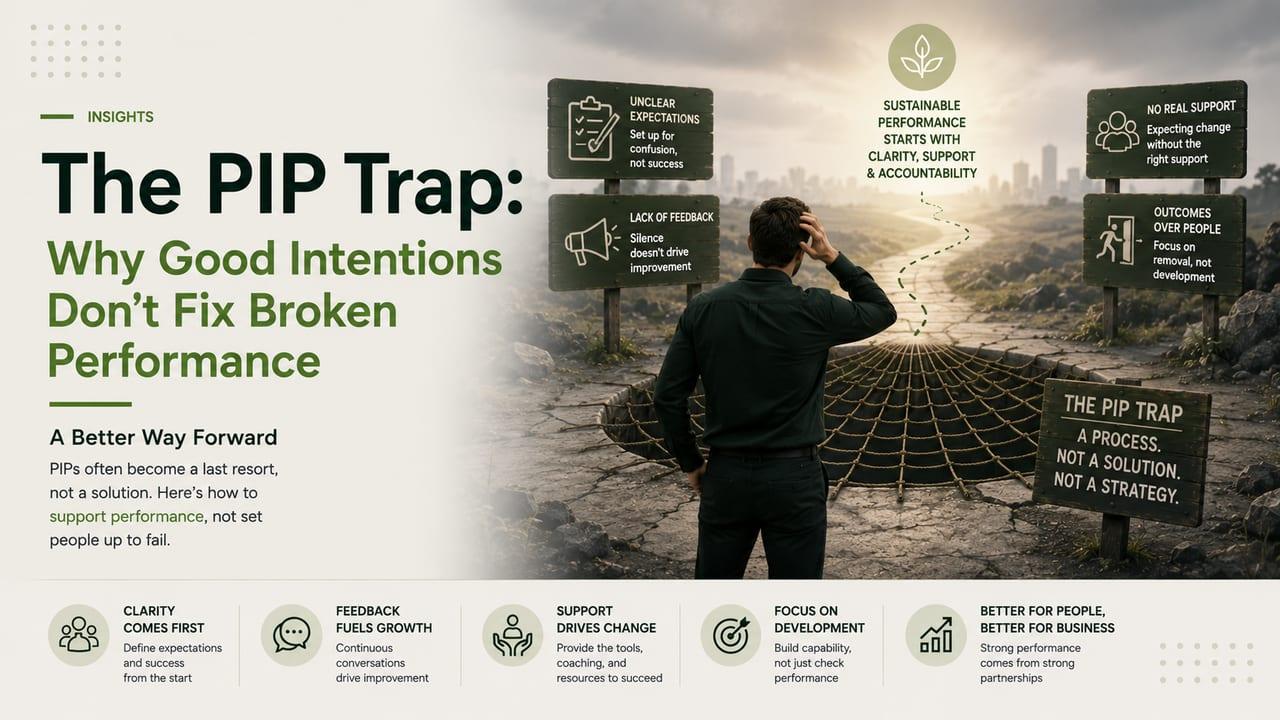 Talent ManagementThe PIP Trap: Why Most Underperformance Is Misdiagnosed3 min read