Performance Management That Doesn't Rot Into a Form
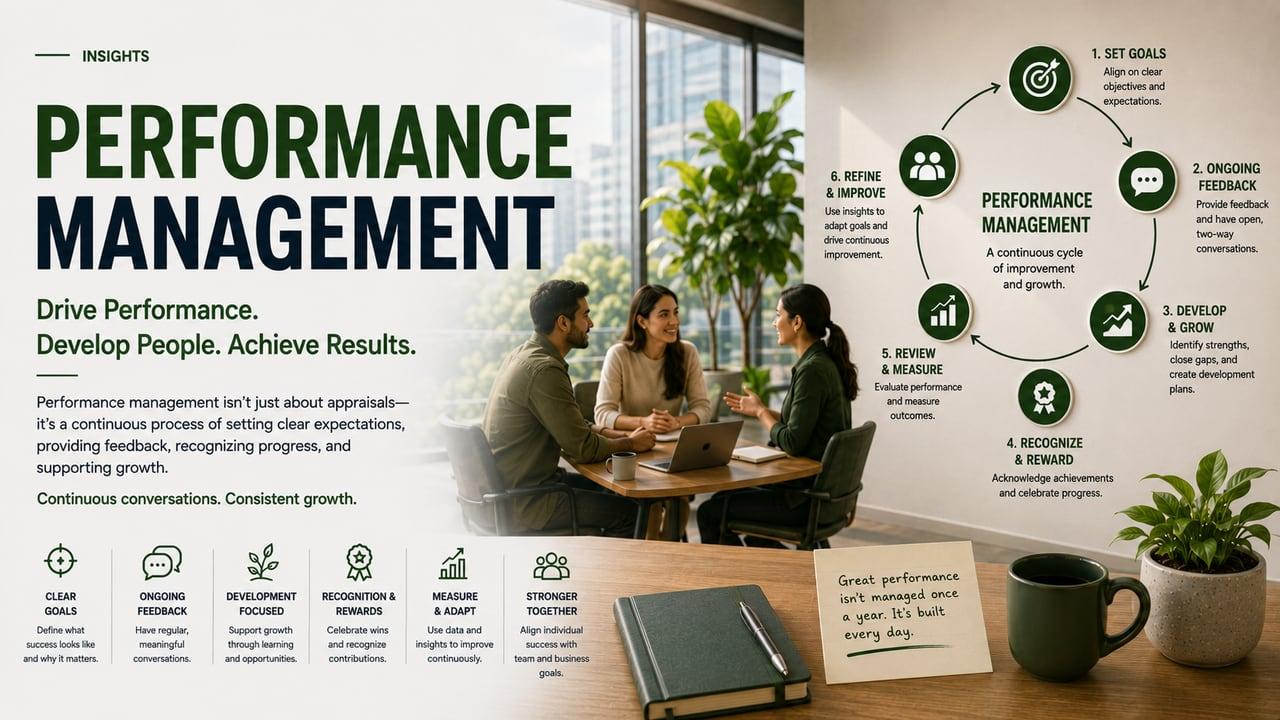
The annual review measures the wrong thing at the wrong time. The Living Performance Loop reframes performance management as a continuous cycle — goals, feedback, honest grading, and growth — that a team runs all year.
Ask a manager when they last gave someone real feedback, and watch the pause. Most can point to the annual review — a document, a rating, a slightly awkward hour. What they struggle to name is the last time they told someone, in the moment, exactly what worked and what didn't. We've sat with hundreds of these managers, and the pattern is always the same: feedback gets saved up for an occasion, and by the time the occasion arrives, it has gone cold.
That instinct to save it up is the whole problem. Performance isn't an annual event. It happens every week, in a hundred small moments — and the review that lands eleven months later is measuring something that no longer exists.
The review that told her nothing
A director we worked with described her worst review. Her manager opened a form, read out a "meets expectations," and cited a project from the previous spring — nine months earlier. She sat there doing the math: the thing he remembered had shipped before half the year's actual work even started. The launch she'd rescued in October, the two hires she'd coached from shaky to solid, the quarter she'd carried a vacant role on top of her own — none of it was in the room. Not because he'd judged it poorly. Because he'd never written it down, and by August it was gone.
"The number wasn't wrong," she told us. "It was just about a different year than the one I lived." She didn't argue it. She updated her résumé instead.
That is the annual review's quiet failure. It doesn't usually get the rating badly wrong. It gets the timing wrong — and stale feedback, however accurate, changes nothing, because the moment to act on it passed two seasons ago.
The framework: The Living Performance Loop
Here is what we've learned works instead. Performance management isn't a form you fill in; it's a loop you run — and the loop has four stages that feed each other all year.
1. Goals. It starts with clear objectives and a plain answer to what does success look like. Not "improve onboarding" but "cut time-to-first-value from fourteen days to five." If the goal is vague, everything downstream — the feedback, the grade — becomes an opinion. This is where the discipline of OKRs earns its place: they force the goal to be measurable before anyone tries to assess it.
2. Feedback. Frequent, specific, in the moment — never saved up. The manager who tells you on Tuesday that the deck buried its own headline is worth ten who mention it at year-end. Feedback has a shelf life measured in days, because that's how long the context stays alive.
3. Grading. Honest assessment against the goal — not against a forced curve that ranks people relative to each other. Did the work hit what it set out to hit? Say so plainly. The grade should be a summary of conversations that already happened, never a surprise.
4. Growth. The review points forward. Its most valuable output isn't the score; it's the answer to "what should this person build next." A loop that only grades the past is an audit. A loop that sets up the next goal is management.
Then it closes: growth reshapes the next set of goals, and the loop runs again. The review isn't the event — it's just the moment you write down what the loop already knew.
Which is the contrarian point worth sitting with: the fix for the annual review isn't a better form. It's shortening the loop until the review has nothing left to reveal. When feedback is continuous, the year-end conversation stops being a verdict and becomes a summary. Nobody negotiates a summary of things they already heard.
Why the timing matters more than the form
The research has been pointing this direction for years. Behavioral science is blunt about feedback: its effect decays fast, because behavior change depends on connecting the correction to the moment that produced it. Save feedback for eleven months and you've severed that link — you're describing a stranger's work to the person who did it.
Memory makes it worse. The recency effect means an annual rating over-weights the last few weeks and quietly forgets the ten months before — which is exactly what happened to our director. And when a single number carries a whole year's pay and standing, people stop treating it as information and start treating it as a bargain. The instrument meant to measure performance ends up measuring negotiating stamina.
This is also why performance ratings drift toward the middle over time — the decision drift that sets in when nobody can quite remember the reasoning behind a call made two seasons ago. Continuous grading resists that pull, because each assessment sits close to the work it describes.
None of this means reviews don't matter. It means the review should be the cheapest part of the loop, precisely because the expensive part — the honest, timely conversation — already happened.
The checklist: run the loop, don't file the form
- Write the goal as a measurable outcome, with success defined up front. If two people could disagree on whether it was met, it isn't a goal yet.
- Give feedback within the week, not the quarter. Tie it to the specific work while the context is still warm.
- Separate the honest conversation from the pay conversation. The moment a grade sets a bonus, honest self-assessment quietly dies — the same trap that ruins performance improvement plans.
- Grade against the goal, not against the team. A forced curve tells you who ranked highest; it never tells you whether the work was good.
- End every review facing forward. The last question is always "what next," never just "how did that go."
- Make sure the review contains no news. If the rating surprises anyone, the loop was broken long before the form came out.
Ask yourself
- When did each of your people last get specific feedback — this week, or last quarter?
- If you ran your reviews tomorrow, how much of the year would your managers actually remember versus reconstruct?
- Are your grades a summary of conversations that already happened, or the first time the person hears the verdict?
- Does your review point backward at a score, or forward at what to build next?
- What would you stop doing if feedback were continuous — and why are you still doing it?
The takeaway
The annual review isn't broken because the form is bad. It's broken because it measures the wrong thing at the wrong time — a whole year of work compressed into one stale number, arriving long after anyone could act on it. Performance is a loop, not an event: goals that define success, feedback that lands in the moment, grading that stays honest, growth that points forward. Run that loop all year and the review takes care of itself — because there's nothing left to reveal that the team didn't already know.
Frequently asked questions
- What is performance management?
- The ongoing work of setting clear goals, giving frequent feedback, assessing results honestly, and pointing people toward what to build next. Done well it is a continuous loop, not a once-a-year form.
- Why do annual reviews fail?
- Because they measure the wrong thing at the wrong time. By the time the review arrives the feedback is stale, the memory favors the last few weeks, and the score becomes a negotiation instead of an honest summary of the year.
- What are OKRs versus performance reviews?
- OKRs set the goals and measure whether you hit the number. A performance review assesses how a person contributed and what they should grow next. OKRs feed the review; they do not replace the human judgment it requires.
- How often should feedback happen?
- In the moment, not saved up. Specific feedback given within days of the work still changes behavior. Feedback banked for a quarterly or annual review has already lost the context that made it useful.
- How do you measure performance fairly?
- Assess each person against their actual goal and what success looked like, not against a forced curve that ranks them relative to peers. Grade the work honestly, and make sure the assessment contains no surprises.
Related articles
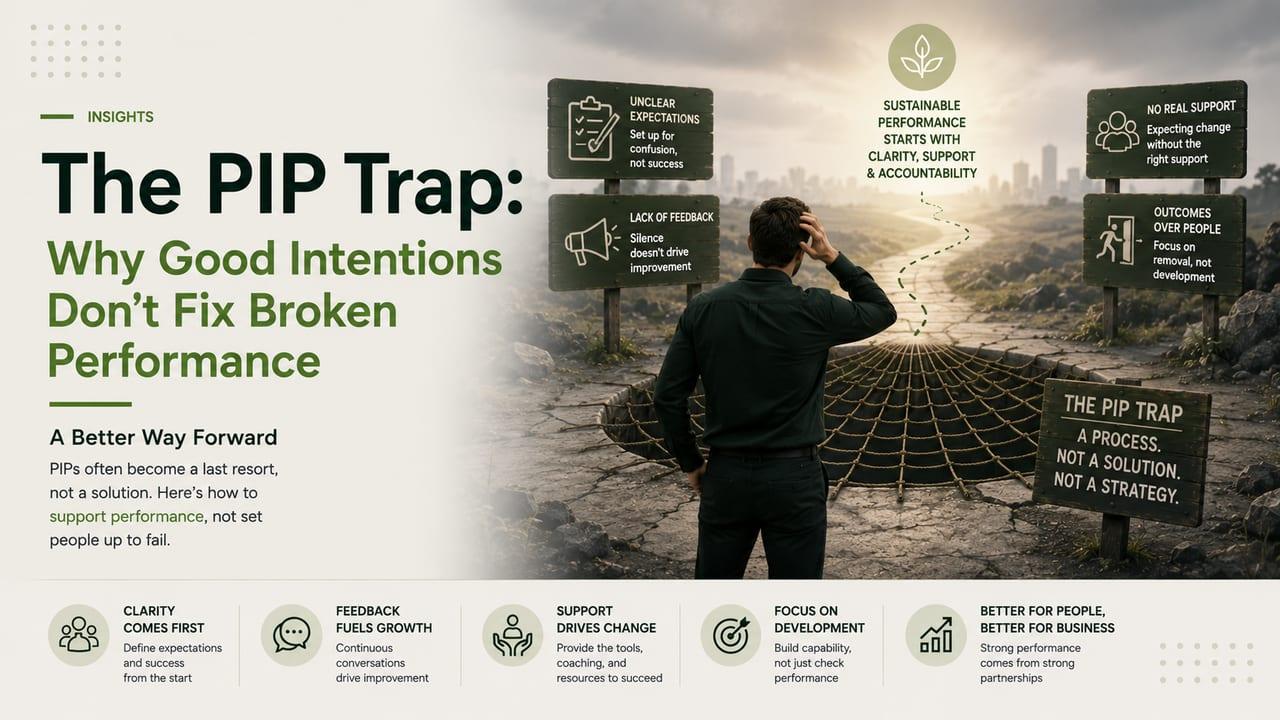 Talent ManagementThe PIP Trap: Why Most Underperformance Is Misdiagnosed3 min read
 Talent ManagementSuccession Planning When Every Critical Role Rests on One Person7 min read
 Talent ManagementHR Department Structure by Growth Stage — Add Capability, Not Just Administrators7 min read
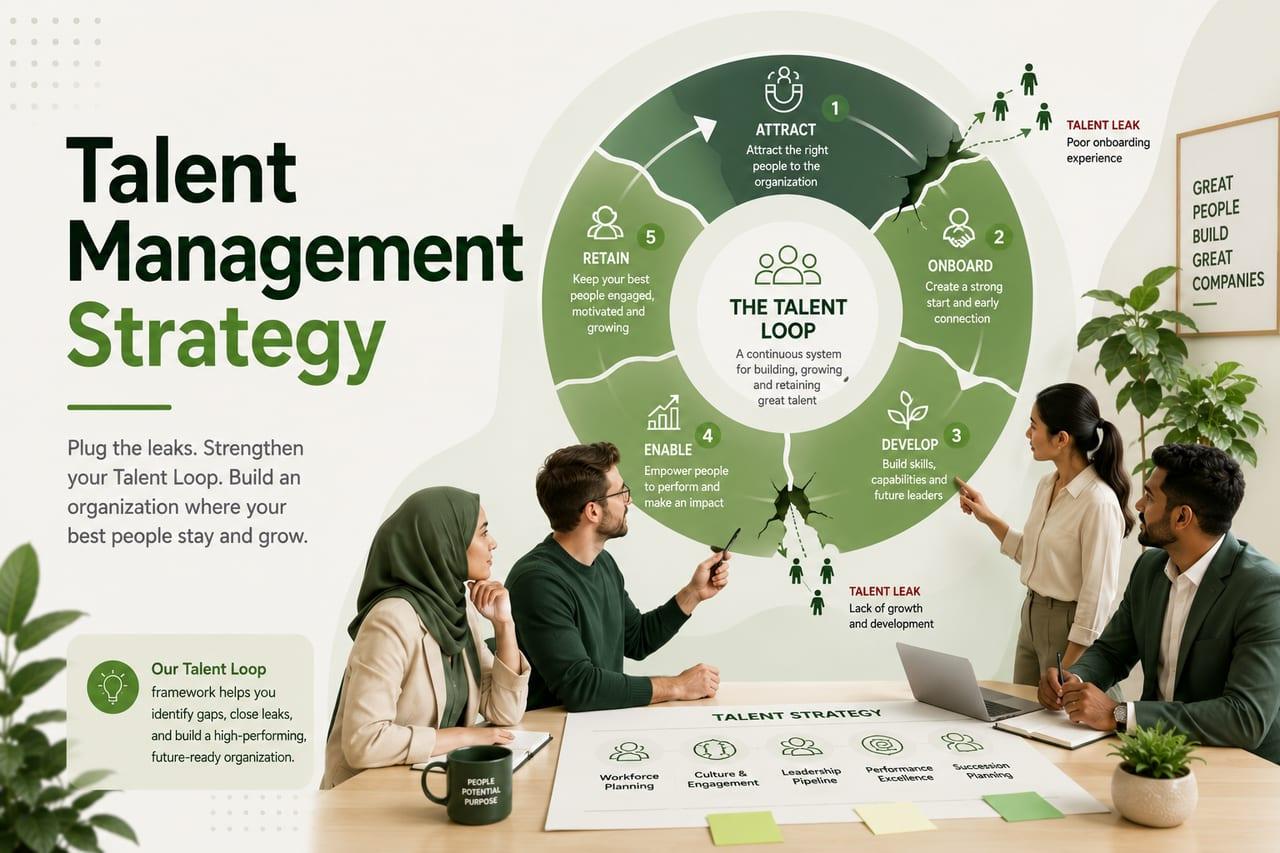 Talent ManagementTalent Management in 2026: From Pipeline to Loop7 min read