High-Performance Teams: What Separates Them From Merely Busy Ones
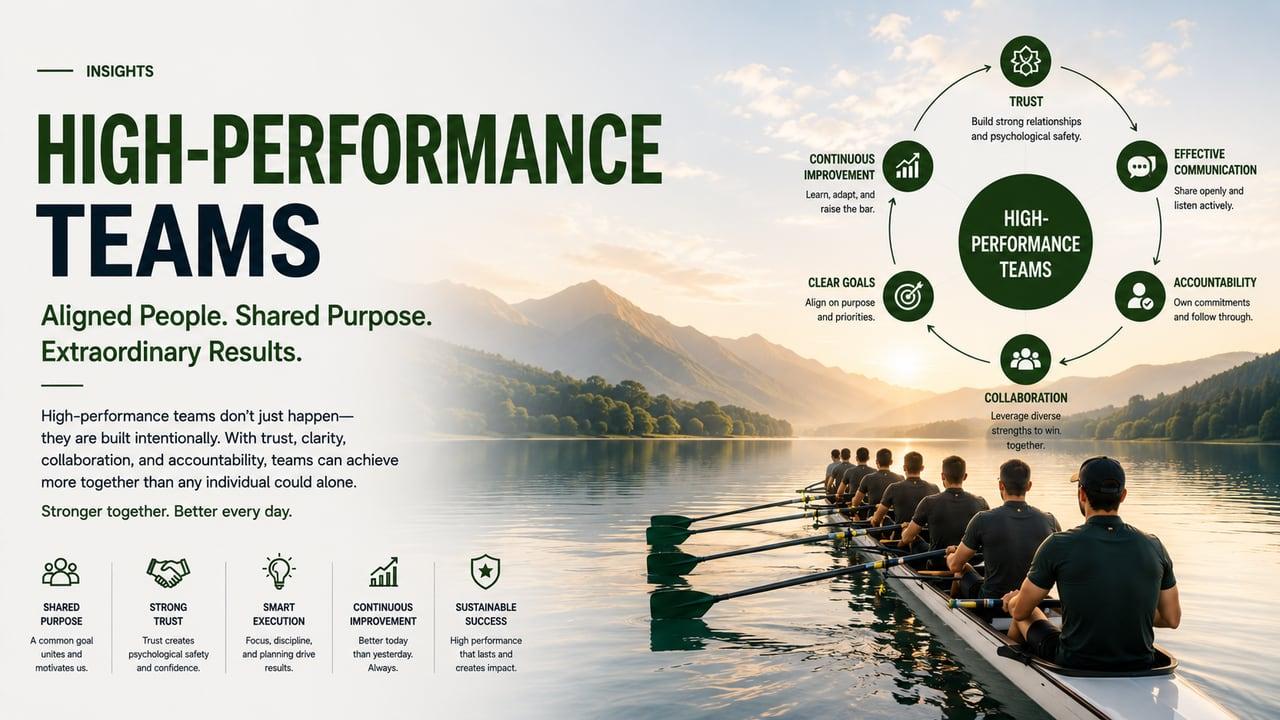
High-performing teams aren't the busiest ones. The Four Conditions of High Performance — clarity, trust, ownership, and feedback — are what separate real results from motion, and what to fix when a team stalls.
Some of the busiest teams we've ever met were also the least effective.
That sounds like a paradox until you've sat in enough rooms. The team is in constant motion — standups, threads, dashboards, a calendar with no white space. Everyone is working hard, and everyone can prove it. And yet the number that matters hasn't moved in a quarter. When we ask what they're actually trying to achieve, we get four slightly different answers.
We've learned to distrust the appearance of effort. Busyness is the disguise high performance wears in reverse. The most active-looking team in the building is often the one substituting motion for something that's missing — and until you name what's missing, more activity just buries it deeper.
The team that shipped everything and moved nothing
One founder we worked with was proud of his product team, and had reason to be. They shipped constantly. Every two weeks, a release. The changelog was a wall of green. If you measured a team by output, they were elite.
But retention was flat, activation was flat, and the roadmap had quietly become a list of whatever felt urgent that fortnight. When we asked six people on that team what the single most important outcome of the quarter was, we got answers ranging from "reduce churn" to "ship the redesign" to "keep engineering unblocked." All reasonable. None the same.
The team wasn't lazy. It was busy in place of being clear. Shipping had become the goal because shipping was the thing they could all agree on. Motion had replaced the harder work of deciding what actually mattered — and once we named that, the fix wasn't a new tool or a faster sprint. It was one sentence everyone could repeat about what the quarter was for.
The Four Conditions of High Performance
Over years of watching teams either compound or stall, we've stopped believing high performance is about talent, headcount, or hustle. It's about four conditions being present at once. Take any one away and the team starts to compensate with noise.
1. Clarity — everyone knows the goal and what "good" looks like. Not a mission statement. The specific outcome this team owns this quarter, and the threshold that counts as success. When clarity is missing, teams optimize for the nearest visible proxy — tickets closed, features shipped, meetings attended — because at least those can be seen.
2. Trust — it's safe to disagree, admit a miss, or ask for help. This is psychological safety in plain clothes. When it's missing, people stop surfacing bad news early, stop challenging a weak plan, and start managing how they look. The work gets slower and more polished at the same time, which is a tell.
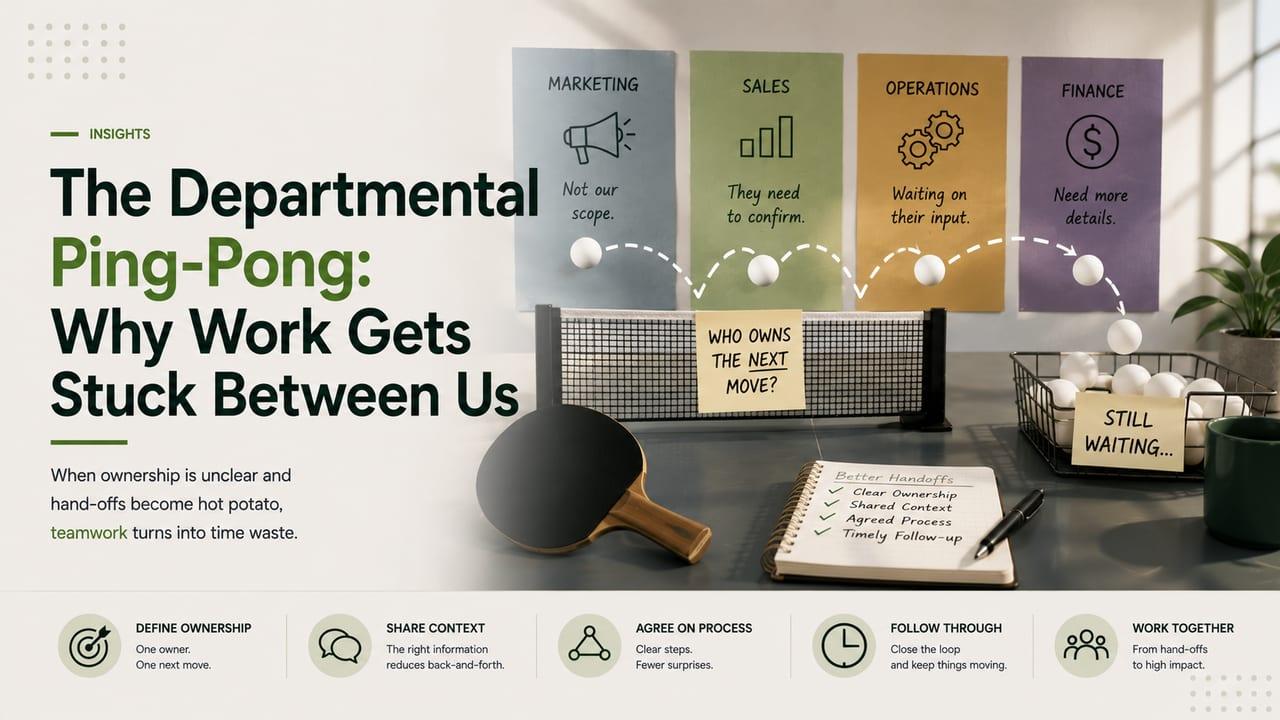
3. Ownership — people own outcomes, not just tasks. A team of people who each did their part but no one owned the result is the exact pattern we described in departmental ping-pong: the ball gets returned, never caught. When ownership is missing, effort is real and accountability is nowhere.
4. Feedback — the team sees its own results fast enough to adjust. A team that only learns whether it succeeded at the end of the quarter is flying blind for eleven weeks. When feedback is slow, the team can't tell motion from progress, so it defaults to motion.
Here's the diagnostic that makes this framework worth keeping: when a team is stuck, one of these four is almost always the thing that's missing — and the busyness is the symptom, not the cause. Name the absent condition and you know why the team is stalled. A team drowning in activity but arguing about direction is missing clarity. A team that's quiet and polite and slow is missing trust. A team where everyone did their job but the outcome failed is missing ownership. A team that discovers problems too late to fix them is missing feedback.
Why the four hold up
None of this is invented. The most cited modern research on what makes teams effective — the work that put psychological safety on the map — found that it wasn't the smartest people or the most resources that predicted high performance, but whether members felt safe to take interpersonal risks. That's condition two, and it underwrites the other three: without trust, clarity never gets challenged into sharpness, ownership curdles into blame-avoidance, and feedback gets softened until it's useless.
Clarity has its own deep literature. Goal-setting research has shown for decades that specific, meaningful goals outperform vague "do your best" ones — not because people work harder, but because they stop guessing. It's the same reason we're such advocates of OKRs done honestly: the value isn't the acronym, it's forcing a team to say out loud what outcome it owns and how it will know.
And feedback is simply the nervous system of the other three. A team can be clear, trusting, and accountable and still fail if it can't see its own results in time to change course. That's why the daily rhythm matters so much — though, as we've argued in the daily huddle: alignment or control?, the point of feedback loops is to help a team see itself, not to help a manager surveil it. Feedback that flows only upward isn't feedback. It's reporting.
A checklist for the team that looks busy but isn't moving
Run this honestly. If more than a couple ring true, don't add effort — find the missing condition.
- Ask five people on the team the single most important outcome this quarter. Do you get one answer or five?
- Is "good" defined by a threshold anyone could check, or is it a vibe?
- When was the last time someone junior openly disagreed with a senior decision — and nothing bad happened?
- Does bad news reach you early and quietly, or late and loud?
- For your last failed initiative, can you name the single person who owned the outcome, not the tasks?
- Does the team learn whether it's winning weekly, or only at the quarter's end?
- Is the team's activity level rising while its results stay flat? (This is the alarm bell.)
- Are your rituals — standups, reviews, dashboards — helping the team see itself, or helping someone above it check on it?
Ask yourself
- If I asked my team to write the one outcome they own this quarter on a card, how many different cards would I get back?
- When someone on this team is failing, do I hear about it early — or do I find out when it's too late to help?
- For the last thing that went wrong, was there a name on the outcome, or only names on the tasks?
- How long does it take this team to notice it's off course — a day, a week, a quarter?
- Which of the four conditions is my busiest team quietly missing?
The takeaway
High performance is not the same as high activity, and the two are easy to confuse because they look identical from across the room. The difference is underneath: clarity, trust, ownership, and feedback, all present at once. When a team is thrashing, resist the urge to demand more effort — effort is rarely the thing in short supply. Find which of the four conditions has gone missing, restore it, and watch the same people turn motion back into results.
Busy is what a team does when one of the four is gone. Name it, and you've found the work.
Frequently asked questions
- What defines a high-performance team?
- A team that reliably turns effort into outcomes, not activity. It has a clear shared goal, enough trust to disagree openly, real ownership of results, and fast feedback on whether it's working. Busyness is not on the list.
- How do you build a high-performing team?
- Install four conditions and keep them healthy: clarity about the goal and what good looks like, trust that makes candor safe, ownership of outcomes rather than tasks, and feedback fast enough to adjust. When a team stalls, one of the four is almost always missing.
- What is psychological safety?
- It's the shared belief that you can speak up, disagree, admit a mistake, or ask for help without being punished or humiliated. Research on team effectiveness has repeatedly found it near the center of what makes teams learn and perform.
- How do you measure team performance?
- Measure outcomes the team owns, not hours logged or tasks closed. Tie the team to a small set of shared results, make progress visible, and watch how fast the team notices and corrects a miss. Speed of self-correction is the truest signal.
- Why do busy teams underperform?
- Because motion often substitutes for a missing condition. When a goal is unclear, trust is low, ownership is diffuse, or feedback is slow, teams fill the gap with visible activity. The busyness looks like performance but hides the reason results aren't coming.
Related articles
 LeadershipBuilding an Executive Leadership Team — Hiring Senior People Is the Easy Half7 min read
 LeadershipThe Ping Pong Culture Nobody Talks About — And the One That's Quietly Killing Your Strategy7 min read
 LeadershipFrom Founder to CEO: Growing Into the Job as Your Company Grows4 min read
 Organization DevelopmentCulture Metrics for the Board — Stop Reporting the Weather8 min read