Change Management: Why Most Change Fails in the Middle
Most change doesn't fail at the announcement — it fails in the messy middle of adoption. The Three Gaps of Change is a practical model for what actually stalls a rollout, and how to close each gap.
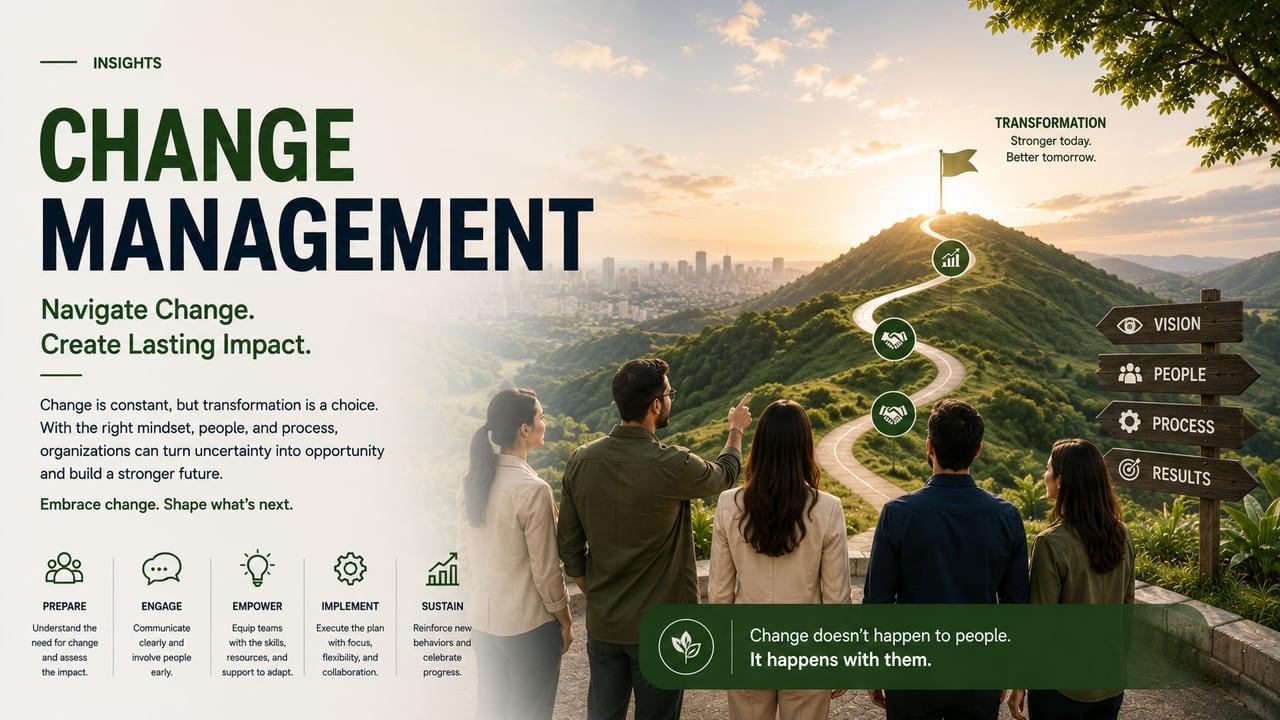
Every leader has watched it happen. The all-hands goes well. The slides are clear, the reasoning is sound, heads nod in the room. Three months later the new process exists on paper and almost nowhere else — people have quietly reverted, the old spreadsheet is back, and the change that was "done" turns out to have barely started. The strange part is that nothing dramatic went wrong. No revolt, no loud objection. The change just… faded.
We've come to believe that most change management fails in a place leaders rarely look: not at the announcement, but in the long, unglamorous middle where adoption actually happens.
The rollout that looked finished
A company we worked with rolled out a new way of running projects. Leadership had done the visible work well — a crisp launch, a written playbook, a genuinely better process. For two weeks it held. Then, team by team, the old habits crept back. When we asked people what happened, we heard three completely different answers.
One group said, honestly, "I still don't really get why we changed — the old way worked for us." A second group understood the why perfectly but admitted, "I know what I'm supposed to do, I just fumble it every time and fall back to what's fast." A third group knew the why and had the skill — and still didn't buy in: "We've launched things like this before. It'll be gone by Q3. Why sink into it now?"
Same rollout. Three different failures. And here is the trap most leaders fall into: they respond to all three with more of the launch — another town hall, another restatement of the vision. It lands on none of them, because none of them had a launch problem. They had an adoption problem, and adoption problems come in kinds.
The Three Gaps of Change
This is the model we now use with every organization we help through a transition. Change doesn't fail as one thing. In the messy middle, three distinct gaps open between the decision and the daily reality — and each one, left open, is enough to quietly kill a rollout.
- The Understanding gap — people don't grasp why. They can recite what changed but not the reason it matters, so the change feels arbitrary, and anything arbitrary gets deprioritized the first busy week.
- The Ability gap — people can't yet do the new way. They're bought in and willing, but the new process is slower and clumsier for them right now, and under pressure everyone defaults to what's fast and familiar.
- The Belief gap — people don't trust it will stick or serve them. They understand it and could do it — but they've seen initiatives evaporate before, so they wait it out rather than invest in something they expect to be reversed.
The reason naming the gap matters is that each gap has a different remedy, and the wrong remedy does nothing. A Belief gap is not closed with more training — the people stalling already have the skill; piling on workshops just signals you've misread them. An Ability gap is not closed with another town hall — they already believe; they need reps, coaching, and time. Diagnose the wrong gap and you spend real energy on a fix aimed at a problem no one has.
Most change budgets are spent on the announcement. Almost all change is won or lost in the weeks after it.
Why the middle is where change goes to die
There's a well-worn observation in change research — often traced to Kurt Lewin's "unfreeze, change, refreeze" — that the hard part isn't starting to move, it's the disorientation between the old state and the new one. That in-between is where people feel less competent than they did last month, where the payoff is still theoretical, and where the pull of old habits is strongest. It's precisely the phase a launch-heavy approach neglects.
Behavioral science says the same thing from a different angle: knowing why (Understanding), being able (Ability), and being motivated to persist (Belief) are separable conditions, and a behavior needs all three at once. Miss any one and the behavior doesn't hold. This is why over-investing in the launch is such a common, expensive error — a great announcement can fully close the Understanding gap while leaving Ability and Belief wide open, which feels like success in the room and reads as failure by the next quarter.
The decay is quiet because no single day is when it breaks. It's the slow reassertion of the default, the same erosion behind decision drift — the way agreements soften back toward the old normal when nobody is actively holding the new one in place.
A practical way to close the gaps
You don't need a bigger launch. You need to work the middle deliberately:
- Diagnose before you respond. When adoption stalls, ask the three questions directly: do people understand the why, can they actually do it, do they believe it will last? Don't guess — the answers are usually different across teams.
- Match the remedy to the gap. Understanding → clearer, repeated, honest reasons. Ability → coaching, practice, and removing the old fast path. Belief → visible follow-through and small proofs the change is real.
- Close the Belief gap with evidence, not words. Nothing rebuilds trust like leaders who don't quietly abandon the thing in month two. Name a reversal if there is one; protect the change if there isn't.
- Make the new way the easy way. If the old path is still faster, people will take it. Remove the legacy option once the new one is learnable.
- Watch your rituals honestly. A standup meant to reinforce a change can curdle into a compliance check — the ceremony trap. Ask whether your recurring meetings actually build ability and belief, or just perform progress.
Ask yourself
- When your last change stalled, which gap was really open — Understanding, Ability, or Belief? Did your response match it?
- Where are you answering an Ability or Belief problem with another announcement?
- Do people believe your changes stick, or have you trained them to wait each one out?
- Is the old, fast path still available — quietly undoing the new one?
- Does your daily rhythm reinforce the change or just police it? Even a daily huddle can be alignment or control, and the difference decides whether belief grows or hardens against you.
The takeaway
Change is not won at the announcement — it's won in the middle, where three gaps quietly open between the decision and the day-to-day. The leaders who succeed stop pouring energy into a better launch and start asking a sharper question: which gap is open right now? Because a Belief gap is not solved with more training, and an Ability gap is not solved with another town hall — and knowing which one you're facing is most of the work.
Frequently asked questions
- What is change management?
- Change management is the deliberate work of helping people adopt a new way of working — not just announcing it. It covers the understanding, the ability, and the belief a change needs to actually stick, not only the decision to make it.
- Why do change initiatives fail?
- Most fail in the middle, not at launch. Leaders over-invest in the announcement and under-invest in adoption, so the change decays quietly as people drift back to old habits nobody helped them replace.
- How do you reduce resistance to change?
- Name which gap is open first. Resistance is usually a Belief gap — people doubt the change will last or serve them. More training won't fix that; visible follow-through, honest reasons, and small proof points will.
- What are the stages of change?
- In practice a change moves through three: understanding why it's happening, building the ability to do the new way, and forming the belief that it will stick. Each stage can stall independently, and each needs a different response.
- How do you measure change success?
- Measure adoption in the middle, not attendance at the launch. Track whether people actually work the new way weeks later, whether the old workaround has disappeared, and whether the change survives without you pushing it.
Related articles
 Organization DevelopmentThe Real Challenges of Scaling a Startup (And How to Get Ahead of Them)5 min read
 Organization DevelopmentWhat Is Organization Development? A Practical Guide for Founders4 min read
 Organization DevelopmentOrganizational Development Strategies for High-Performing Companies5 min read
 Organization DevelopmentCorporate Governance for Growing Companies: More Than Compliance5 min read