Corporate Governance for Growing Companies: More Than Compliance
Corporate governance isn't a compliance binder you file away. It's how a company keeps making consistent decisions as it grows. The Governance Ladder makes it concrete — the three jobs governance does, and when to formalize each.
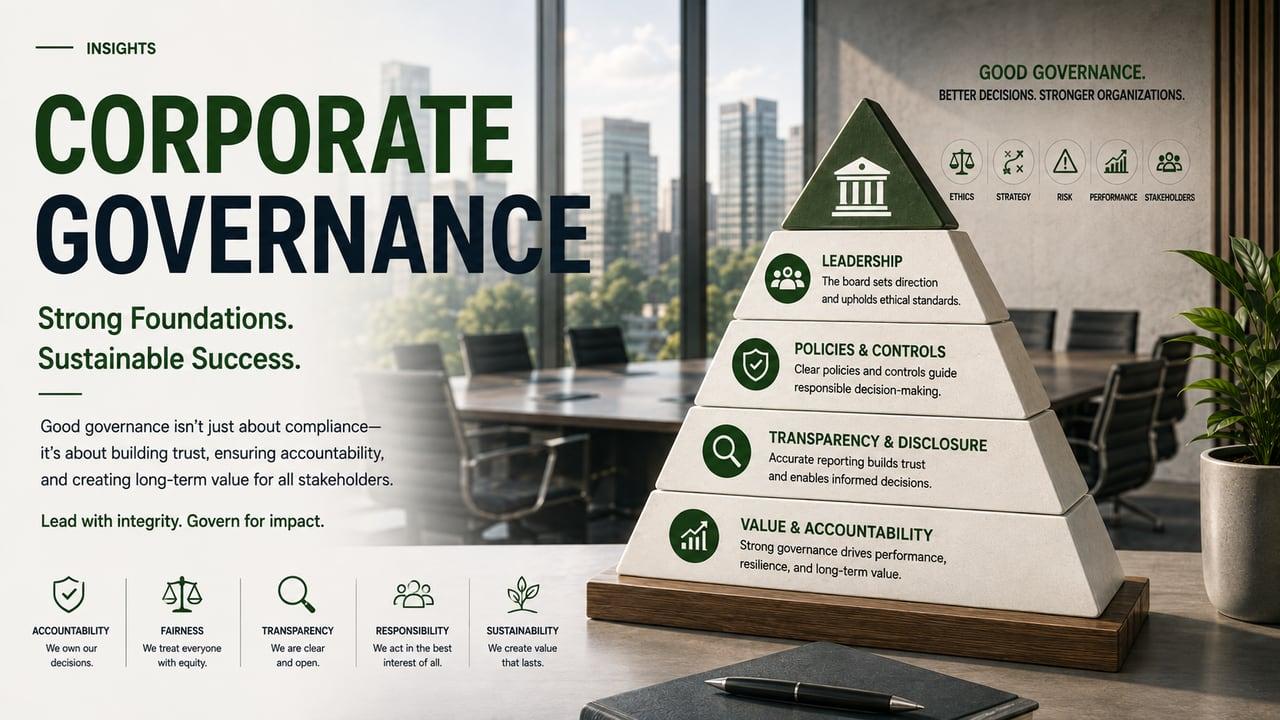
Most founders don't decide to build governance — they wake up one day realizing they've become the bottleneck for decisions they no longer remember choosing to own. Whether to give a discount. Which candidate clears the bar. How much a team can spend without asking. None of it is hard. It's just that all of it, still, runs through one person.
The moment it stops scaling
One founder told us they knew the exact meeting it broke. Their head of sales had brought a deal to the table — a bigger discount than usual, a fast close — and asked for a yes. The founder gave it, the same way they'd given a hundred before. Then a second rep asked for the same terms two weeks later, got a no, and quite reasonably wanted to know why the rules had changed.
"They hadn't changed," the founder admitted to us. "There were no rules. There was just me, in a mood, on a Tuesday." The company had crossed the point where a decision living in one head stops being agility and starts being a lottery. What they needed wasn't more control. It was a way for the company to decide without them — consistently — and to be able to say why.
That is what governance actually is. Not a binder. The machinery of consistent decisions.
The Governance Ladder
We describe governance to the teams we work with as four rungs, climbed in order as a company scales. Each rung exists to take a kind of decision off the founder's desk without losing consistency.
- Rung 1 — Founder judgment. Decisions live in one head. This is correct, and fast, and exactly right early on. The failure mode isn't being here; it's staying here too long.
- Rung 2 — Written policy. Recurring decisions get encoded so they stop being re-litigated. The discount threshold. The refund rule. The spend limit. A policy is just a decision you've agreed to stop making twice.
- Rung 3 — Governing bodies and delegated decision rights. Now the question is no longer what gets decided but who is allowed to decide it. A leadership team, a hiring committee, a budget council — each given explicit authority over a defined class of questions.
- Rung 4 — Accountable review. Decisions, and the reasoning behind them, get recorded and revisited. Not to police people, but so the company can learn: which bets paid off, which guardrails were wrong, what "we" actually believe when the founder isn't in the room.
Underneath all four rungs, governance is only ever doing three jobs: setting direction (where are we going), defining guardrails (what's in and out of bounds), and creating accountability (who owns the outcome, and did it work). Every policy, body, and review you build should trace back to one of those three. If it doesn't, it's theater.
Here's the contrarian part
Governance is not compliance paperwork, and treating it that way is why most teams get it exactly wrong in one of two directions. Some import board-grade governance far too early — committees and charters for a fifteen-person company — and produce elaborate theater that slows everything while deciding nothing. Others cling to founder judgment far too long, proud of being "non-bureaucratic," while the founder quietly becomes the single point of failure for the entire company.
The skill is climbing one rung ahead of the pain — never five. You add a policy when a decision has been re-litigated enough times to be expensive, not because a governance article told you to. You stand up a governing body when decision rights have genuinely gotten ambiguous, not to look like a real company. Governance that arrives one step early feels like relief. Governance that arrives five steps early feels like bureaucracy — because that's exactly what it is.
Why it works
This tracks what organizational research has long held: the informal coordination that works at small scale doesn't survive growth, and consistency has to be deliberately rebuilt as authority is distributed. Encoding a recurring decision as policy is the same move as separating the org chart from the real organizational structure — you're making explicit what was implicit, so it survives handoff. And accountable review is the direct antidote to decision drift, where choices quietly diverge from intent because no one recorded why they were made. Governance done well is simply organization development applied to the single hardest thing a company does: decide.
A practical checklist
- Name the decisions that keep coming back to you. List the five choices you're asked to make most often. Those are your Rung 2 candidates.
- Encode the expensive ones as policy — a threshold, a rule, a default — so they stop reaching your desk.
- Draw decision rights before drawing an org chart. For each recurring class of decision, name who is allowed to decide it.
- Stand up a body only when rights are genuinely ambiguous — and give it a clear remit, not a vague mandate.
- Record the consequential decisions and their reasoning, and revisit them on a cadence. This is Rung 4, and it's the one everyone skips.
- Delete governance that no longer earns its keep. A dead committee costs more than no committee.
Ask yourself
- If you went dark for two weeks, which decisions would simply stop — and which would get made badly because no one knows the rule?
- Which decision have you now answered differently on different days? That's your next policy.
- For your most consequential choices, could anyone say why they were made six months later?
- Are you one rung ahead of the pain, or several rungs into theater?
- Which governing body in your company exists mostly to look official?
The takeaway
Corporate governance isn't compliance, and it isn't a binder you file and forget. It's the machinery that lets a growing company make consistent decisions without routing every one through the founder — setting direction, defining guardrails, creating accountability. Climb the Governance Ladder one rung ahead of the pain, and it feels like relief. Climb it too early or too late, and you get theater or a bottleneck. The skill was never adding governance. It was timing it.
Frequently asked questions
- What is corporate governance?
- Corporate governance is the system a company uses to set direction, define guardrails, and hold decisions accountable. It's how a growing company makes consistent choices without routing every one of them through the founder.
- When does a startup need governance?
- When the same decisions keep coming back to the founder and get answered differently each time. That's the signal a recurring choice is expensive enough to encode — not company age or headcount, but repeated friction.
- How is governance different from compliance?
- Compliance proves you followed external rules. Governance is the internal machinery that produces consistent decisions in the first place. Compliance is a byproduct of good governance, never a substitute for it.
- What are governing bodies?
- Standing groups given the authority to decide a defined class of questions — a leadership team, a hiring committee, a budget council. They exist so decision rights are explicit rather than living informally in one person's head.
- How do you avoid bureaucracy in governance?
- Climb one rung ahead of the pain, not five. Add a policy or a body only when a recurring decision is genuinely costing you, and delete the ones that no longer earn their keep. Governance should remove friction, not manufacture it.
Related articles
 Organization DevelopmentOrganizational Development Strategies for High-Performing Companies5 min read
 Organization DevelopmentThe Real Challenges of Scaling a Startup (And How to Get Ahead of Them)5 min read
 Organization DevelopmentWhat Is Organization Development? A Practical Guide for Founders4 min read
 Organization DevelopmentCulture Metrics for the Board — Stop Reporting the Weather8 min read