Organizational Culture: How It Actually Drives Performance
Culture isn't a vibe — it's a system that either compounds performance or quietly erodes it. The Culture Operating Loop shows how strong cultures get stated, lived, reinforced, and measured.
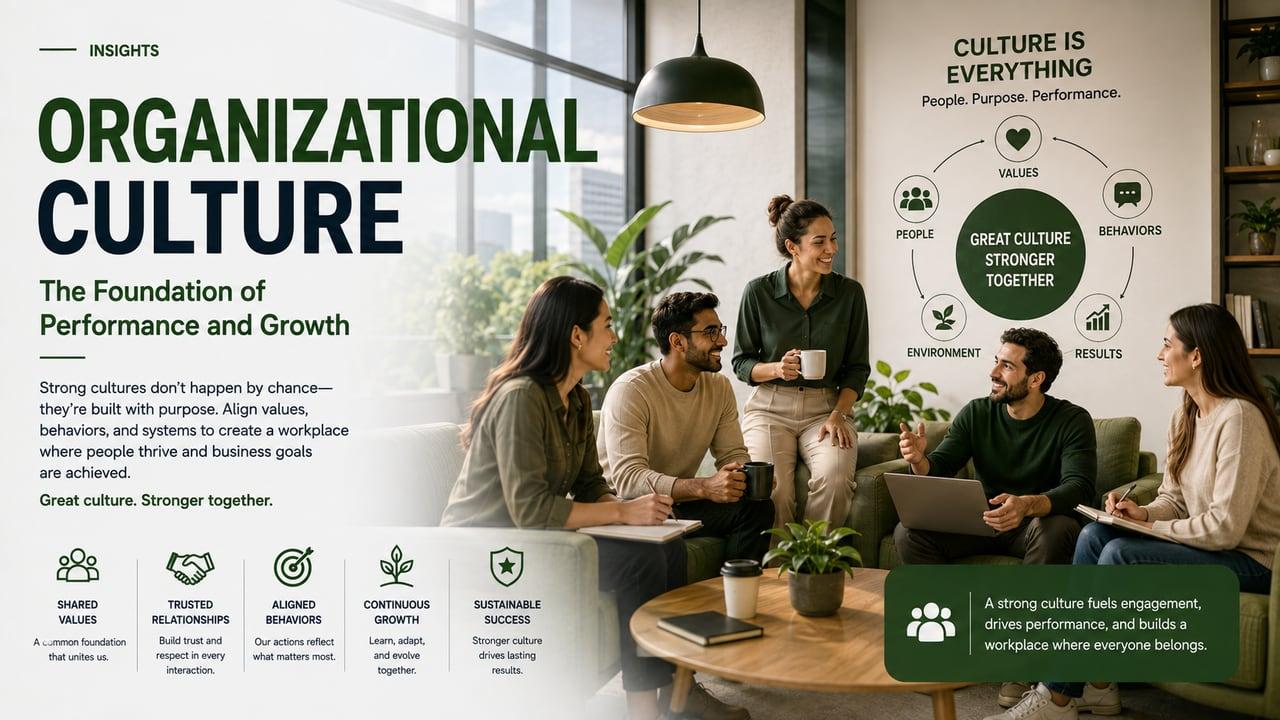
Ask a founder to describe their culture and you'll get the values page. Ask their newest hire the same question and you'll get the truth. We've run that experiment across dozens of organizations, and the gap between the two answers is the most reliable diagnostic we know. It isn't that leaders lie about their culture — it's that they describe the culture they stated, while everyone below them lives the one that's actually rewarded.
That gap is the whole subject of this article.
The founder who had a great culture on paper
A founder we worked with was proud of his values — collaboration, candor, ownership, all well-chosen and genuinely believed. Then his best engineer quit. In the exit conversation she said something he couldn't unhear: "We say candor, but the last three people who challenged you in a meeting are gone. I learned to read the room and stay quiet."
Nothing was wrong with the value. The value was stated clearly, even lived by the founder in the sense that he wanted candor. But it was never reinforced — the people who practiced it kept losing, quietly, and everyone else drew the obvious lesson. The poster said one thing. The promotions said another. People believe the promotions.
The Culture Operating Loop
Here's the shift we push every leadership team toward: culture is a system you operate, not a vibe you hope for. And like any system, it runs on a loop with four stages that either compound or decay together.
- Stated — the values you actually write down. Not aspirations, not adjectives everyone likes, but the small set of principles you're willing to be held to.
- Lived — whether behavior matches them day to day, in the meetings the founder isn't in, under deadline pressure, when it's inconvenient.
- Reinforced — whether hiring, promotion, recognition, and what leaders refuse to tolerate all reward the stated behavior. This is where culture is made or unmade.
- Measured — whether you can actually see the gap between stated and lived, instead of guessing from your own vantage point at the top.
The loop is the point. Stated feeds Lived, Lived is protected by Reinforced, and Measured tells you where the chain has snapped — then sends you back to adjust. Each stage feeds the next. Break the circuit at any stage and the whole thing leaks.
Culture doesn't erode because people stop caring. It erodes because the loop is never closed — values stated but never measured, or lived but never reinforced.
The contrarian part: most culture advice obsesses over the first stage. Better values, sharper words, a nicer offsite to unveil them. But we've almost never seen a culture fail at Stated. It fails in the space between Stated and Lived — and that gap is invisible until you measure it. The gap between what you say and what you reward is the whole game.
Why the loop holds — and why it leaks
None of this is our invention. It's the operating truth underneath decades of organizational research: people infer "how things really work here" from consequences, not declarations. Behavioral scientists call it social proof — we take our cues from what others around us actually do and what happens to them for doing it. When the candid engineer gets managed out, that's the signal, and it drowns out any number of workshops.
This is also why managers matter more than mission statements. Employees experience the company largely through their direct manager — the manager's tolerated behavior is the culture for that team, whatever the company-wide values say. A single unreinforced layer overwrites the loop for everyone beneath it. We go deeper on that transmission problem in building a culture that scales, and on why the Stated stage so often stays decorative in why slogans on the wall don't build culture.
A checklist to close the loop
- Stated: Can you name your values without the poster? Is the list short enough that people actually remember it — and specific enough to rule some behavior out?
- Lived: Would your newest cohort describe the same culture as your first ten employees? If not, it's transmitting secondhand.
- Reinforced: Look at your last five promotions. Did they reward people who live the values, or only people who hit the numbers? Name the last time someone was corrected — or let go — over behavior, not performance.
- Measured: Do you have any read on the stated-versus-lived gap that doesn't come from your own eyes? Anonymous pulse, retention by cohort, manager effectiveness — pick one and start.
- The loop: Which stage is your weakest link? Fix that one, not the one that's easiest to talk about.
Ask yourself
- If we surveyed everyone tomorrow, would the lived culture match the stated one — or would we be surprised?
- What behavior do our leaders quietly tolerate that contradicts a value we've written down?
- When did we last reward someone for how they worked, not just what they delivered?
- Can we see the gap between stated and lived, or are we managing culture blind?
- Which of the four stages have we simply never closed?
The takeaway
Culture isn't a feeling you protect; it's a loop you run. State the values, live them, reinforce them through the decisions that cost something, and measure the gap so you know where the circuit is broken. Skip any stage and culture doesn't collapse dramatically — it quietly decays, one tolerated moment at a time. The organizations whose cultures compound aren't the ones with the best words. They're the ones who close the loop, and keep closing it. For the long view on keeping it closed as you grow, see culture for the long haul.
Frequently asked questions
- What is organizational culture?
- It's the pattern of behavior a company actually rewards — how decisions get made, what gets tolerated, who gets promoted. Not the values on the wall, but the values in practice. Culture is what people do when no rule tells them what to do.
- Why does culture matter for performance?
- Because culture decides thousands of small choices no policy can reach — how fast people flag a problem, whether they cut a corner, how they treat a customer under pressure. Strong cultures compound those choices in one direction; weak ones let them scatter.
- How do you build a strong culture?
- Close the loop. State a small number of values, watch whether they're lived day to day, reinforce them through hiring and promotion and what leaders refuse to tolerate, and measure the gap. Culture erodes when any of those four stages is skipped.
- How do you measure culture?
- By reading the gap between stated and lived — anonymous pulse surveys, retention by cohort, and manager effectiveness reveal whether behavior matches the values. If you can't see the gap, you can't close it, and you're managing a poster instead of a culture.
- What role does leadership play in culture?
- Leaders set the culture through what they tolerate, not what they announce. The worst behavior a leader walks past becomes the new standard for everyone watching. Culture is reinforced or overwritten one tolerated moment at a time.
Related articles
 CultureBuilding a Culture That Scales (Without Slowing Down)4 min read
 CulturePeople Strategy Isn't an HR Document. It's a Business Model.12 min read
 CultureCulture at Pixar Was the True Guardian of Creativity4 min read
 CultureStop Treating Culture Like a First Date. It's Built for the Long Haul5 min read