The Business Model Canvas — A Coherent Canvas Is Not a Company
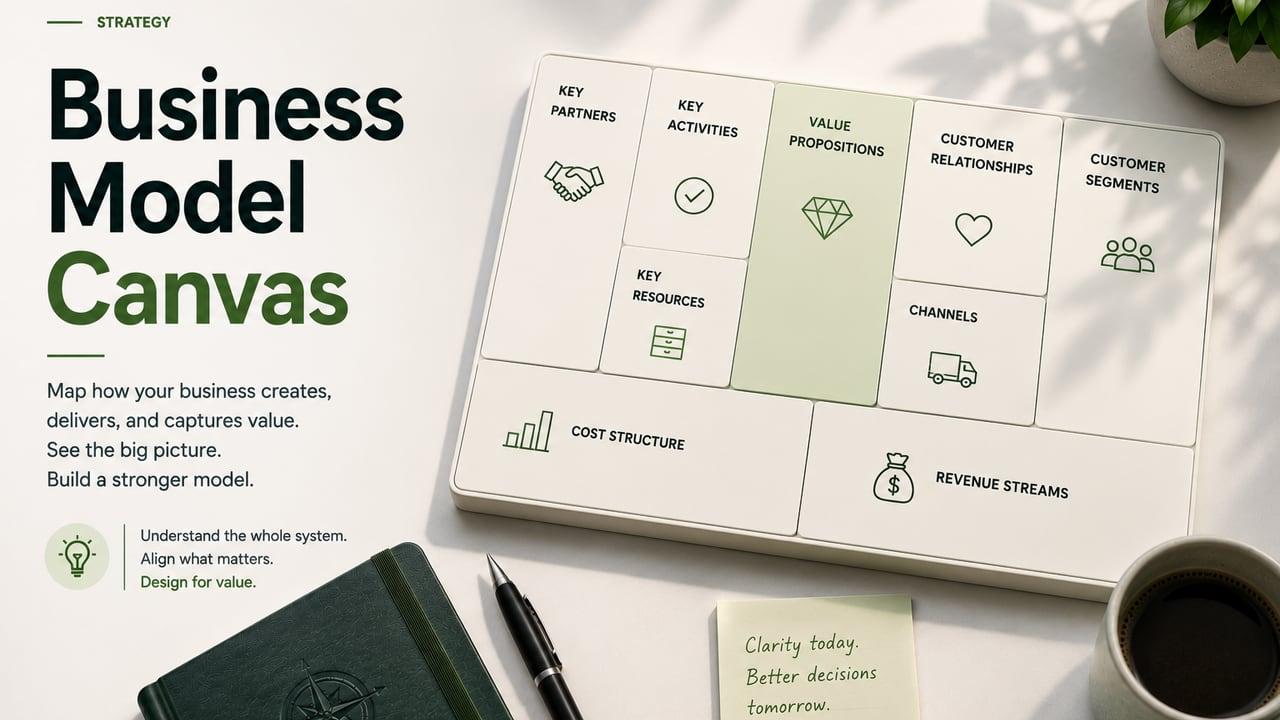
The Business Model Canvas gives you nine blocks that describe how a business creates, delivers, and captures value. Fill them all in and you get a coherent picture — and not one of the nine tells you whether the model is true, whether it's defensible, or whether your organization can actually build it.
A founding team at a healthtech startup in Abu Dhabi had been at it for fourteen months (product, team, pitch deck, a growing list of hospital meetings) and they still could not agree on who their customer was. Ask each of the five founders independently and you got four answers: the hospital, the insurer, the patient, the government. The value proposition was described a different way by every person who described it. The revenue model had changed four times.
An advisor sat them down with a blank canvas, nine boxes, and two hours. At the end of it they had their first honest conversation about the business model — not the product, the model — and it was the most useful two hours they had spent all year.
Here is the part worth being careful about. When they finished, the canvas was full, and a full canvas feels like an answer. It wasn't one. It was a list of nine things they had finally agreed to go find out. And the relief of seeing it all fit on one page was quietly telling them the work was done, when the work had just been named.
The most useful two hours, and what they bought
We are not about to tell you the canvas is bad. It is one of the genuinely good tools, and that healthtech session is exactly what it's for: it took five people who thought they agreed, proved they didn't, and gave them a shared picture to argue over. (That surfacing of buried disagreement is the whole subject of the 5Cs, and it's real work.) Most strategy tools can't do it.
But notice precisely what the two hours produced. Not a validated business. Not a defensible one. Not a buildable one. What they produced was a coherent description: nine boxes that no longer contradicted each other. Coherence is worth a lot; it's just not the thing anyone mistakes it for. A description of a business that hangs together is not the same as a business, the way a clean architectural drawing is not a building and tells you nothing about whether the ground will hold it.
What the canvas actually is
The Business Model Canvas came out of Alexander Osterwalder's 2004 doctoral thesis, "The Business Model Ontology," supervised by Yves Pigneur at the University of Lausanne, and reached the world in the 2010 book Business Model Generation. A nice detail about that book: the canvas was co-created by 470 practitioners across 45 countries, so the tool itself was designed the way it tells you to design a business, by argument and iteration. It has since sold over a million copies in some thirty languages, which makes it one of the most widely adopted strategy tools of the last two decades.
The idea was a good one, and pointed at a real problem: teams were writing forty-page business plans nobody read, when what they needed was a single page showing how a business creates, delivers, and captures value. Nine blocks (Customer Segments, Value Propositions, Channels, Customer Relationships, Revenue Streams, Key Resources, Key Activities, Key Partnerships, Cost Structure) laid out so the connections between them are impossible to hide. A value proposition with no customer segment underneath it is exposed on sight. A revenue stream with no channel to carry it jumps off the page. That legibility is the whole gift.
And Osterwalder was careful about what the tool was for. His own line is that "to thrive, a company must design and prototype business models like an architect designs buildings" — design and prototype. The canvas is a design surface. It was never claimed to be the answer, and the tell is that its own author kept building the things that were supposed to come after it.
The framework: a coherent canvas is not a company
Every strategy tool tells you what to decide. Almost none of them tell you whether your organization can actually do it. The canvas is the purest case of that gap on the whole shelf, because "fill in the nine boxes" feels so much like finishing:
A finished canvas is a set of assumptions in the shape of a company. The nine blocks tell you what the business is — not one of them tells you whether it's true, whether it's defensible, or whether you can build it.
Those three missing questions are the three ways business models actually die. Is it true: does the customer you named actually want the value you claim? Is it defensible: what stops the company across the street from drawing your identical canvas and running it cheaper? Can we build it: does the organization you have possess the capability the model demands? A canvas can be flawless on all nine blocks and fatal on all three questions, and it will look exactly as finished either way.
The last of the three is the one the canvas comes closest to touching, and it's the one this whole series keeps returning to. Two of the nine blocks (Key Resources and Key Activities) are the only place the question "can we actually do this?" could live. They are where you list the assets and the work the model requires. And here is what teams write in them, almost without exception: what the model needs, not what the organization can do. "Key Resources: a world-class engineering team." Do you have one? "Key Activities: build and operate a logistics network." Have you ever operated one? The two capability blocks quietly join the wish list with the other seven, and the canvas that results is a portrait of a company you don't run yet, drawn with the confident lines of one you do.
The company the canvas can't see
The healthtech founders' finished canvas said "Key Resources: proprietary clinical algorithm and integrations with hospital systems." Both were things they intended to have, not things they had. The gap between "the model requires a hospital-integration capability" and "we employ three people who have ever shipped one" is the entire distance between a canvas and a company. And the canvas has no notation for it. Every block is written in the present tense, which is a small grammatical lie the tool tells on your behalf. The customer you want and the customer you have, the partner you'd need and the partner who has signed, the capability the model demands and the capability you can staff on Monday: the canvas renders all of these in the same confident box, and the eye reads a plan where there is only a set of intentions.
None of this means you filled it in wrong. It means the tool has no place to record the one distinction that decides whether the model is a business or a hope: what is true today versus what you are betting will become true. This is the same failure of translation we describe in Decision Drift: the version at the top of the house is coherent and shared, and it still doesn't tell you whether the people downstream can execute it.
The maker knew — and built the missing halves
The strongest evidence that the canvas is a description rather than a strategy is that Osterwalder himself never claimed otherwise, and kept shipping the parts it was missing.
He built a companion he called the Business Model Environment, a map of four outside forces that surround the canvas: market forces, industry forces (competitors, new entrants, substitutes, suppliers), key trends, and macroeconomic forces. He framed them as the design constraints you don't control. Read that as what it is: an admission that the nine blocks have no room for the competitor. There is no block for "why won't this get copied," so he drew a whole outer ring for it. And it is the single most-skipped part of the entire method. Almost nobody fills it in. Which is why the canvas still needs Porter's Five Forces sitting next to it: the canvas describes the shape of your model; Porter tells you whether the structure around it will let you keep any of the value.
Then he built the other missing half. His later book Testing Business Ideas (2019) is a field guide of experiments whose entire premise is that the blocks of a canvas are hypotheses to be tested, not facts to be built on. That is the author telling you, in a whole separate volume, that drawing the canvas is step one of a method most people treat as the finish line. Joan Magretta made the underlying point back in 2002: a business model is a story of how a company works, and a story is not a strategy: strategy is what happens once you account for the rivals trying to end your story. The canvas is a superb way to tell the story. It was never the part where you find out if the story is true.
Two companies, one tool
Put two famous canvases side by side and the tool's blind spot stops being abstract.
Airbnb is the case everyone reaches for, and rightly, because the canvas genuinely illuminates why the model works. Fill in its Key Resources block and the striking thing is what you don't write: real estate. The company runs in over 220 countries and regions, with more than eight million active listings and over five million hosts as of the end of 2024, and it owns none of the property. Its real asset sits in that block instead — trust: the reviews, the verification, the payments rail that let strangers transact. The canvas shows you, on one page, that the inventory is contributed by the host ecosystem and the moat is a reputation system. That is the tool at its best: a real business, made legible.
Now draw WeWork's, as it looked in early 2019 when the company was valued at roughly $47 billion. Customer Segments: startups and enterprises wanting flexible space. Value Proposition: beautiful, community-driven workspace as a service. Key Resources: prime, long-leased buildings. Revenue Streams: short-term memberships. Key Partners: landlords. Nine blocks, internally consistent, widely admired. A gorgeous canvas.
It hid the thing that killed the company, because the canvas has no block for it. The fatal flaw was a mismatch in time: WeWork signed ten- and fifteen-year fixed leases and sold month-to-month memberships that could vanish in a downturn: long liabilities funded by short, cancellable revenue. There is no block on the canvas for the duration of a commitment, no block for defensibility (nothing stopped a landlord from doing the same thing), and no block for "does this make money at scale" (it never did). The IPO was pulled in September 2019; the company filed for bankruptcy in November 2023. The canvas was equally confident about Airbnb and WeWork. It illuminated a real asset in one and drew a clean picture of a time bomb in the other, in exactly the same nine boxes, with exactly the same air of completeness.
Using it for what it's actually good at
The canvas earns its place. The failures come from treating a finished description as a finished strategy. So:
- Mark every block: fact or bet. Go through all nine and label each entry as something true today or something you're wagering will become true. A canvas that's mostly bets isn't wrong: it's a research agenda, and knowing that is the point. An unmarked canvas is a wish wearing a plan's clothes.
- Write Key Resources and Key Activities in the present tense you can defend. Not the capability the model needs, but the capability you could staff on Monday. Where those two differ is your real build list, and it's usually longer and slower than the canvas made it look.
- Draw the competitor's canvas next to yours. If a rival can fill in the same nine blocks, you have a coherent model and no moat. The most dangerous canvas is the one anyone could have drawn. Then fill in the environment ring Osterwalder gave you and most people skip.
- Put a clock on it. Ask of each revenue stream and each cost how long the commitment runs and how fast it can be unwound. WeWork's whole story lives in the answer, and the canvas never asks the question.
- Redraw it, don't frame it. The canvas is a design surface, not a trophy. Careem's decade (from a Dubai corporate-car service to a regional super app) is a story of repeatedly redrawing blocks and checking whether the model still held together. If your canvas hasn't changed in six months, you're storing it, not using it.
Ask yourself
- If your leadership team each filled in the nine blocks alone tomorrow, how many would match, and are the mismatches ones you've named, or ones you didn't know you had?
- Go to your Key Resources and Key Activities. How many entries are capabilities you have, and how many are capabilities you'd have to build? Did anyone say that out loud when you drew it?
- Could a competitor fill in your exact canvas? If so, what (off the canvas) actually stops them?
- Which entries on your canvas are facts, and which are bets you've been treating as facts because they've sat in a box long enough to look settled?
- What is the longest commitment in your model, and the fastest your revenue could disappear? Do those two numbers match?
The takeaway
The Business Model Canvas is the best tool ever made for putting a business model on one page so a team can see it, share it, and argue about it. That is a real and valuable thing, and the Abu Dhabi founders were right to feel the two hours were well spent.
The mistake is the quiet one that happens when the last box is filled: the description starts to feel like a decision. It isn't. A coherent canvas tells you your model hangs together. It does not tell you the model is true, that anyone can't copy it, or that the organization you actually have can build the one you've drawn — and those are the three things that decide whether it lives. Osterwalder knew; he built an environment map for the second question and a whole testing method for the first. The third (can you build it) is still sitting in two blocks everyone fills in with wishes. Draw the canvas. Then go find out if the company in it is one you can actually become.
Frequently asked questions
- What is the Business Model Canvas?
- A nine-block map of how a business creates, delivers, and captures value: customer segments, value propositions, channels, relationships, revenue, resources, activities, partners, and costs. In practice its real job is giving a leadership team one shared description of the business.
- What are the nine blocks used for?
- Each block forces an explicit answer to a question most teams only answer implicitly. The value comes from the disagreements the blocks surface, not from filling them in.
- Is a completed canvas a strategy?
- No. A coherent canvas tells you the model hangs together; it says nothing about whether the model is true, defensible, or something your organization can actually build. Those three questions live outside the nine blocks.
- How do you use the Business Model Canvas well?
- Fill in all nine blocks, then do the work the canvas hides. Mark each entry as a fact today or a bet you are wagering on, write Key Resources and Key Activities as capabilities you could staff on Monday, and draw a competitor's canvas next to yours.
- Why doesn't the Business Model Canvas account for competitors?
- It has no block for defensibility. Osterwalder addressed this with a separate Business Model Environment ring covering market and industry forces, the most-skipped part of the method, which is why the canvas still needs Porter's Five Forces beside it to test whether you can keep the value.
Related articles
 StrategyWorkforce Planning for Next Year's Strategy — Start From the Bets, Not the Headcount7 min read
 StrategyOKRs — The Target Is Not the Capability14 min read
 StrategyThe BCG Matrix — You Can Move the Cash, Not the Company14 min read
 StrategyAnsoff's Matrix — Every Box Is a Different Company14 min read