The BCG Matrix — You Can Move the Cash, Not the Company
The BCG matrix tells you to milk the cows and fund the stars. But cash is the one input a real star can raise anywhere — and the capability that actually grows a business doesn't travel from the cow. The matrix rations the resource you're least short of.
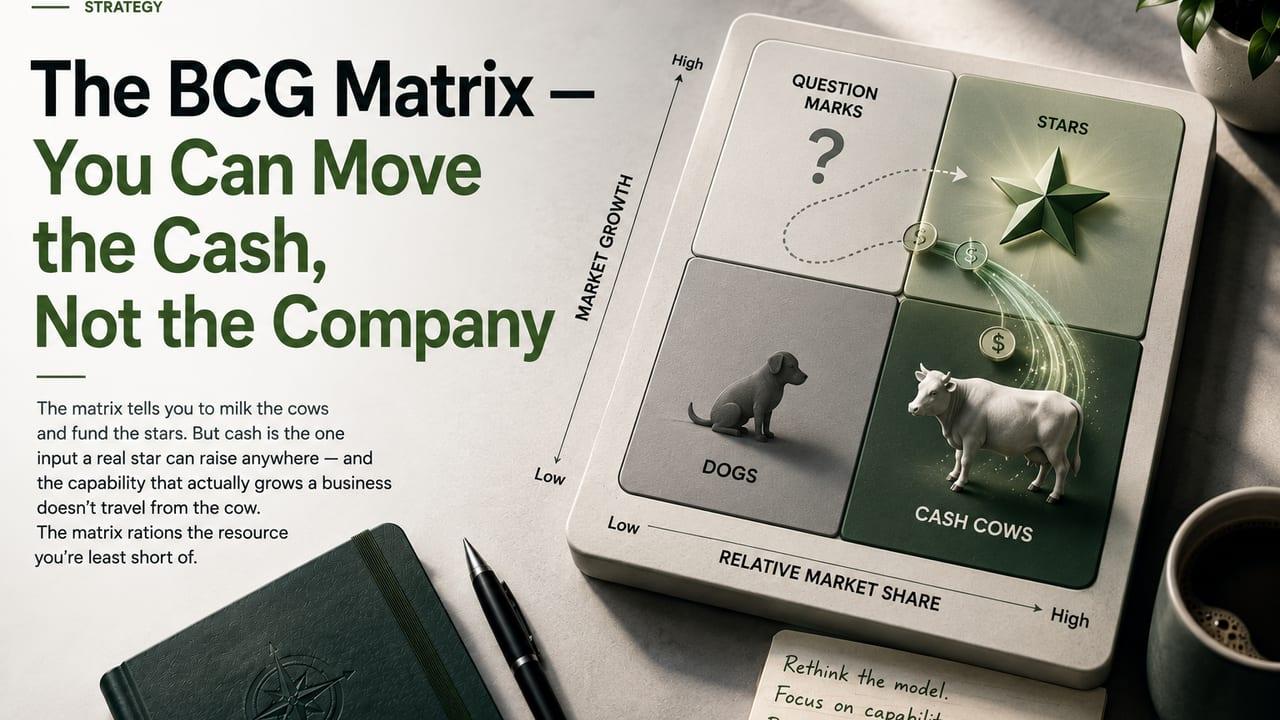
There is a particular calm that settles over a room during a portfolio review. Someone has plotted the business units on the four-box grid (growth up the side, market share across the bottom) and now the picture is doing the arguing. This unit is a cash cow: milk it. That one is a star: feed it. This little thing in the corner is a dog: wind it down. The decisions feel less like decisions than like reading a diagram out loud.
That calm is the tell. A question about whether the company can actually grow a business just got quietly converted into a question about where the cash sits, and cash is the one input in the whole problem that was never the hard part.
The portfolio review that felt like rigor
We sat with a mid-sized group a while ago that had done everything the matrix asks. Three divisions, cleanly plotted. The mature one (a genuinely good business, market leader, throwing off cash) got designated the cow. The plan was to hold its budget flat and route the surplus to a fast-growing division that needed the money. Textbook. Milk the cow, feed the star.
Eighteen months later the cow was in trouble, and not because anyone had gutted it. Flat budget meant no new hires on a team that had quietly been stretched thin. The two best people, reading the room correctly, saw that the growth and the promotions and the interesting problems had all moved to the other division, and they moved with it. Within a year the "cow" had lost the specific people who made it a leader — and a leader is a thing you are, not a box you sit in. The star, meanwhile, had more cash than it could usefully absorb and still wasn't growing, because money was never what it was short of.
The matrix had told them exactly what to do with the cash. It said nothing about the thing that actually moved.
What Henderson actually built
Bruce Henderson, the founder of the Boston Consulting Group, published the growth-share matrix in 1970, in a short BCG house essay called "The Product Portfolio." (It is worth knowing it was never a Harvard Business Review article, as it's often described: it was BCG selling its own thinking.) The idea was genuinely powerful for its moment, and the engine underneath it is a single sentence from the essay: "Margins and cash generated are a function of market share. High margins and high market share go together. This is a matter of common observation, explained by the experience curve effect."
The experience curve was BCG's prior big idea: the observation that unit costs fall a predictable amount (in Henderson's original case, about 25% each time accumulated production doubled), so whoever has produced the most, usually whoever has the largest share, has the lowest costs and the fattest cash flow. Stack that against market growth, which consumes cash, and you get the four boxes: high-share, low-growth businesses throw off cash; high-growth businesses eat it.
From there the whole model is a cash-routing machine. Henderson's own words: "The portfolio composition is a function of the balance between cash flows." The balanced company has stars, cash cows "that supply funds for that future growth," and question marks "to be converted into stars with the added funds." You take the surplus from the mature leaders and you spend it on the growth businesses. That is the entire prescription.
Two things about the original are worth having exactly right, because the popular version got both wrong. First, Henderson never wrote "milk." He wrote that a cash cow's surplus "need not, and should not, be reinvested" in the cow. Second, he never wrote "dog." His word for the low-share, low-growth box was "pets": "the product is essentially worthless, except in liquidation." The snarling "dog" everyone remembers is a later gloss, and the softening from "pet" to "dog" is a small tell that the animal metaphors were doing more work in people's heads than the analysis underneath them ever authorized.
The framework: the wrong scarcity
Every strategy tool tells you what to decide. Almost none of them tell you whether your organization can do it. The BCG matrix has a very specific version of that blind spot, and once you see it you can't unsee it:
The wrong scarcity — the matrix rations cash, the one input a real star can raise anywhere, and is silent on capability, the input that actually grows a business and cannot travel from the cow.
Start with what the matrix moves. It moves cash, out of the cow, into the star. And cash is the most fungible resource a company has. It is also, for any genuinely good business, the least scarce, because the outside world is full of people who will supply it. This isn't a hunch. It's the argument Michael Porter made in 1987, dismantling exactly this "the parent allocates capital between units" logic: "In the face of increasingly well-developed capital markets... simply contributing capital isn't contributing much. A sound strategy can easily be funded." A real star does not need to be fed from a cow; it can raise money on its merits. (Porter was attacking corporate portfolio strategy, not the 2×2 directly, but the premise he demolishes is exactly the one the matrix runs on, and it echoes the insight underneath his Five Forces work: advantage comes from structure, not from the size of your treasury.)
Now hold the other side. What actually turns a question mark into a star, or keeps a cow a leader, is not money. It's capability: the specific people, the accumulated knowledge, the management attention, the culture that knows how to do the hard thing. And capability is the opposite of fungible. You can wire a cow's cash into a star overnight. You cannot wire its organization into one. The team that makes the cow a leader does not decompose into a bank balance you can redeploy. When the matrix says "take the surplus from here and spend it there," it is moving the one thing that moves freely and staying dead silent about the things that don't, which are the things that decide the outcome.
So the tool optimizes the abundant resource and stays silent on the scarce one. That is why a portfolio can look beautifully balanced on paper while quietly losing the plot in the building.
Every box is a room full of people
Here is the part the diagram hides most completely. A "cash cow" is not a cash flow. It is a few hundred people who come to work. "Question mark," "star," and "pet" are not asset classes; they are teams, with names.
And the labels travel downward. "Milk this cow" is a spreadsheet instruction at the top and a lived reality at the bottom: no new hires, no new tools, no new problems worth solving, and a clear signal that the future is happening somewhere else. People are very good at reading that signal. The strongest ones, the ones with options, leave first, and they are exactly the ones the "leader" was made of. So the label doesn't describe the business. It changes it. Call a division a cow and starve it of everything but its budget number, and you will, in time, have manufactured the decline the box predicted.
This is not in Henderson's essay, and to be honest it is not really in the academic literature either. It's a pattern you learn by sitting across the table from the people inside the boxes. But it rests on something old and well established: label a group as low-potential and treat them accordingly, and behavior bends to meet the label. Sociologists have called that a self-fulfilling prophecy since Robert Merton named it in 1948. The growth-share matrix is an unusually efficient machine for producing them, because it hands managers a chart that makes withdrawing belief from a group of people look like disciplined capital allocation. It's the same gap between a decision made at the top and the capability that has to carry it out that we described in Decision Drift — except here the tool actively disguises the gap as rigor.
The cracks its own makers left
You don't have to take our word that the model is shakier than it looks. Its own foundation has been contested for forty years, sometimes by the very people who built the case for it.
The whole engine, remember, is "cash generated is a function of market share." The great empirical prop for that was the PIMS study, whose 1975 write-up reported that businesses with market share under 10% averaged about 9% ROI while those above 40% averaged around 30%, the "share pays" finding in its purest form. But read the same paper to the end and its own authors offer the escape hatch: "the simplest of all explanations for the market-share/profitability relationship is that both share and ROI reflect a common underlying factor: the quality of management." In other words, maybe good management produces both the share and the profit, and share isn't causing anything. Ten years later Jacobson and Aaker took PIMS's own data and concluded roughly that: much of the celebrated link is "spurious," the joint outcome of some third factor. The premise that makes a cow a reliable cow is, at best, an open question.
Then there's the quieter problem that sits upstream of every quadrant: where you draw the market decides everything. Relative market share is your share divided by the largest rival's, but "share of what?" is a choice, and the matrix doesn't show you making it. George Day's 1977 critique named this plainly. Draw Mercedes' market as "passenger vehicles" and it's a low-share dog; draw it as "luxury cars" and it's a cash cow. Same business, opposite prescription, and the only thing that changed was a definition nobody in the room had to defend. Even the PIMS methodology quietly conceded that its markets were "defined... in much narrower terms than the industries" reported in public data — which is to say the numbers move with the boundary.
And when researchers actually tested whether using the matrix produced better decisions, it didn't. In a controlled experiment run across six countries over five years, Armstrong and Brodie found that managers handed the growth-share matrix chose the less profitable investment markedly more often than those working without it. The tool didn't just fail to help; it actively pulled people toward the worse call.
Even BCG has walked the claims back, carefully. Its own 2014 retrospective insists the matrix still matters, but concedes the load-bearing part: market share "is no longer a strong predictor of performance," and the horizontal axis may need replacing altogether. The firm that built the tool now says its main axis no longer measures the thing it was built to measure. And the sharpest concession came from inside BCG years earlier. Alan Zakon, later the firm's CEO, admitted it never dawned on them that "the way to manage a dog was not to starve it, but to LBO it": that the wind-it-down reflex the matrix taught was, more often than they realized, the wrong one, and the low-share business was worth buying and backing rather than killing.
Schlitz, and what milking really looks like
The cautionary tale everyone reaches for here is Schlitz, and it's worth telling honestly, including the part where it isn't actually a BCG story.
At mid-century Schlitz was the number-one beer in America. Through the 1970s, chasing margin, the company reformulated: corn syrup in place of malted barley, cheaper hop pellets, an accelerated fermentation that cut brewing time by roughly a third. On a spreadsheet it looked like superb cash management: same brand, lower cost, fatter margin. A textbook cow, efficiently milked. Drinkers noticed. Quality cratered, a botched 1976 batch forced a near-secret recall of some ten million bottles, and a brand that had led the country lost more than 90% of its value before being sold off in 1982.
Nobody at Schlitz was holding a BCG chart; this was ordinary margin engineering, not portfolio doctrine. That's exactly why it's useful. "Milking a cow" is not a metaphor that stays on the whiteboard. In the real world it means removing, one reasonable-looking decision at a time, the investment that made the business good, and the difference between a cow and a corpse turns out to be the stuff the matrix has no box for. Schlitz didn't run out of cash. It ran out of the thing the cash was standing in for.
Using it without getting used
The matrix isn't useless. It's a fine first-pass map of where cash is born and where it's consumed, and that's worth knowing. The failures come from treating the map as the decision. So:
- Under every box, name the people. Before you accept "cow" or "pet," write down whose team it is and who specifically would leave if the label stuck. If the answer changes how you feel about the box, the box was hiding the real decision.
- Ask what the star is actually short of. If it's cash, the capital markets can solve that and you don't need to starve a cow to do it. If it's talent, attention, or capability (it usually is) then moving money accomplishes nothing, and moving money out of the cow costs you the very capability you'd want to borrow.
- Draw the market three ways. Plot each unit under a narrow, a medium, and a broad definition of its market. If a unit changes quadrants, you haven't found its position — you've found how much the answer depends on a choice no one defended. This is the same discipline that keeps Ansoff's Matrix honest: "new" and "leader" are both claims about a boundary you drew.
- Never milk and starve in the same breath. Deciding a business generates cash is not the same as deciding it deserves no investment. The first is an observation; the second is a choice, and it's usually the one that turns a leader into a former leader.
- Treat "pet" as a question, not a verdict. Henderson's own firm now suspects the wind-it-down reflex was wrong more often than it was right. A low-growth, low-share business can be a durable niche, a capability you'll need later, or a team worth keeping, none of which the box can see.
Ask yourself
- In your last portfolio decision, what actually moved between the units: cash, or the people and capabilities that make a business grow? Which one did the framework let you talk about?
- Name your clearest "cash cow." If its two best people left this quarter, would it still be a cow in two years, or was "cow" always a statement about specific people you've been quietly under-investing in?
- Is your fastest-growing business actually short of money, or short of capability? If you fed it more cash tomorrow, would it grow faster, honestly?
- Draw one business unit's market as narrowly and as broadly as you plausibly can. How many quadrants does it move through? Who decided the boundary you've been using?
- What have you labeled a "dog", and would you still call it that if you had to say it to the faces of the people who work there?
The takeaway
The growth-share matrix is a machine for moving cash between the parts of a company. Its deep flaw isn't that it's too simple; it's that it's confident about the wrong resource. Cash is fungible, and for any business worth keeping it's the input the outside world is most willing to supply. The inputs that actually decide whether a business grows (the capability, the people, the accumulated knowledge of how to do the hard thing) are the ones that don't move between boxes, don't show up on either axis, and don't survive being "milked."
So when the four boxes make a portfolio decision feel obvious, that's the moment to stop and ask what you're really proposing to move. If it's only money, the matrix has answered a question you could have answered anyway. The question worth the meeting is the one the diagram can't hold: whether the organization inside each box can do the thing you've just assigned it — and whether the decision you're about to make will build that capacity or quietly spend it.
Frequently asked questions
- What is the BCG growth-share matrix?
- A portfolio tool plotting each business or product on market growth against relative market share, producing four quadrants: stars, cash cows, question marks, and dogs.
- What are the four quadrants for?
- They prescribe a cash posture. Cash cows fund, stars reinvest, question marks get a bounded bet, dogs get divested. The matrix is fundamentally a capital-allocation argument.
- What does the matrix leave out?
- That you can move cash far more easily than you can move an organization. Reassigning budget from a cow to a question mark is a spreadsheet edit; moving the people, capabilities, and attention that made the cow work is the actual project.
- Should you milk a cash cow?
- Be careful with the phrase. Henderson never wrote milk; he said a cow's surplus need not be reinvested in the cow, not that you should starve it. Deciding a business generates cash is not the same as deciding it deserves no investment, and confusing the two turns leaders into former leaders.
- Is market share still a good predictor of profitability?
- Increasingly it isn't. The link was always contested, with the PIMS study's own authors suggesting management quality drives both share and profit, and BCG's 2014 retrospective conceding that market share is no longer a strong predictor of performance and its main axis may need replacing.
Related articles
 StrategyWorkforce Planning for Next Year's Strategy — Start From the Bets, Not the Headcount7 min read
 StrategyOKRs — The Target Is Not the Capability14 min read
 StrategyThe Business Model Canvas — A Coherent Canvas Is Not a Company12 min read
 StrategyAnsoff's Matrix — Every Box Is a Different Company14 min read