Who Green Apple Is Built For: Company Size, Roles, and When It Is the Wrong Fit
An honest fit guide from the people who build it: the company size where Green Apple starts to earn its keep, the five roles that get the most from it, and the five situations where we tell buyers to look elsewhere.
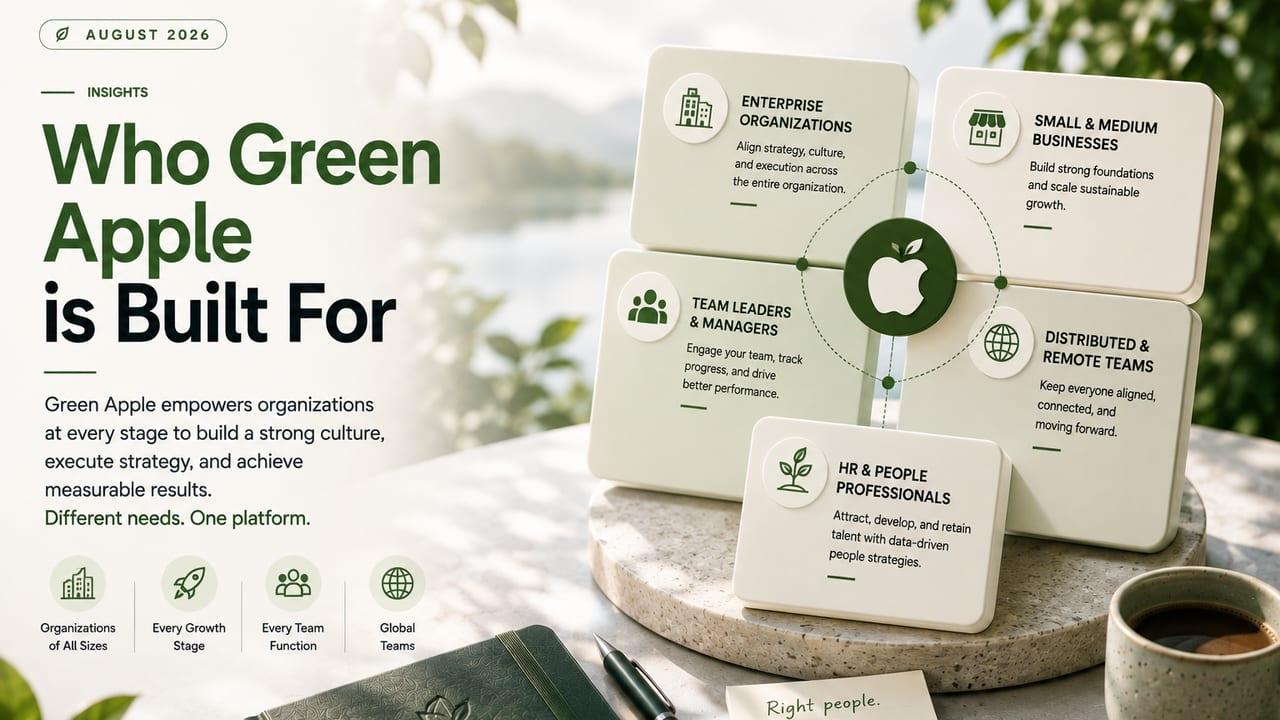
Green Apple is built for small-to-medium enterprises of roughly 20 staff and above, mostly in Saudi Arabia and the wider GCC, where someone senior has noticed that the company's daily decisions no longer resemble its stated strategy. The buyers are CEOs and founders, HR leaders, chiefs of staff, chief strategy officers and strategy officers, and OD practitioners. It is a culture-first talent management and organizational development platform, organized around four pillars across the talent lifecycle: Organization Development, Talent Acquisition, Talent Experience, and Team Building. It is not an HRIS, not payroll, and not an ATS-only product. And there are companies we tell to wait.
Why is the honest answer not a headcount number?
A founder of a nine-person design studio in Jeddah once asked us for the biggest plan we had. Sharp operator, real revenue, ambitious roadmap. We told him to take Starter, spend nothing, and come back in a year.
He was annoyed. He was also, in the end, right to be sold nothing. His whole company still ate lunch together. Every decision of consequence passed through him within twenty-four hours. What he wanted from software was reassurance that he was building properly. What he actually needed was six more clients.
Three weeks later we spoke to a 58-person contracting firm in Riyadh. The CEO described a specific symptom: two project managers had quoted the same client two different discount structures in the same week, both convinced they were following company policy. Neither was wrong about the policy. They were working from different mental copies of it.
That is the moment. Not a headcount, a symptom. We've written about the mechanics of it in Decision Drift — the gap opens where people are deciding in good faith without access to the reasoning behind the strategy. Headcount is only a proxy for how often that happens.
What are the Three Gates of Fit?
We assess fit with three questions, in order. We call them the Three Gates, and they have to all be open.
Gate 1 — The Proximity Gate. Has the company outgrown alignment-by-being-in-the-room? If the founder is still present for every consequential decision, the organization does not yet need a shared external model. It has one, and it walks around. This gate usually opens somewhere between 15 and 30 people, earlier if the company is multi-site or multi-shift.
Gate 2 — The Ownership Gate. Is there one named person accountable for how the organization works, not just for a function inside it? A CEO who has accepted that the org is now part of the job. A chief of staff. An HR leader with a strategic mandate rather than an administrative one. A strategy officer. Without this gate, the platform becomes a project nobody owns, which is the most expensive kind.
Gate 3 — The Intent Gate. Is there a strategy and a set of values someone is willing to write down and be held to? Not a polished deck. A stated bet. Green Apple builds a canonical model of your DNA, strategy, structure, governance and ownership. If leadership isn't ready to commit that to text, the model will faithfully reflect the ambiguity — and everyone will blame the tool.
Three gates open: we are almost always the right call. Two open: come back, and in the meantime read The Real Challenges of Scaling a Startup. One open: you have a leadership question, not a tooling question, and we'd rather say so.
Why does this pattern hold?
None of this is our invention. Larry Greiner argued in the early 1970s that growing organizations pass through predictable revolutions, and that the first serious one is a crisis of delegation: the founder can no longer make every call, but the systems that would let others make it well don't exist yet. Chandler's older observation still stands too — structure follows strategy, and it usually follows late, after the strategy has already changed underneath it.
What's new is not the crisis. It's that the reasoning behind a strategy used to live only in the heads of the four people who set it, and could only be transmitted by meetings. A shared, consultable model of the company's DNA and strategy changes the economics of that transmission. That is what we mean by a company brain: one canonical version every member can consult, so decisions at every level are made in alignment with it rather than in isolation.
Which roles get the most out of it?
| Role | What they usually arrive with | What good fit looks like |
|---|---|---|
| CEO / founder | "I explain the strategy constantly and it still doesn't land" | Willing to write the DNA down and be governed by it |
| HR leader | An activity calendar dressed as a people strategy | Has a mandate to change systems, not just run events |
| Chief of staff | Twelve open threads and no shared source of truth | Owns cadence and can enforce one model across functions |
| Chief strategy officer | A strategy that dies below the leadership layer | Wants execution alignment, not another planning artifact |
| OD practitioner | Diagnosis in slides, no operating layer to change | Ready to move from workshops to structure and governance |
If you're an HR leader whose remit stops at compliance and payroll, we're the wrong purchase this year. That case is made properly in People Strategy Isn't an HR Document.
When is Green Apple the wrong fit?
We'd rather lose the deal than the second year. Five honest no's:
- You need a system of record. Payroll, leave balances, contracts. Buy an HRIS and keep it. Green Apple sits above that layer, not inside it.
- You want a document repository. Green Organization is an AI company assistant, not document management. It builds a model of the organization rather than storing files about it.
- You want a pulse-survey tool. We are not a survey or engagement-polling product. Engagement signals feed a broader alignment model anchored in company DNA. If your board asked for a quarterly score, buy a survey tool.
- You want the AI to decide. Our AI surfaces alignment and drift, predicts risks, and suggests actions. People stay in control of every decision. Leaders looking to outsource judgment will be disappointed, deliberately.
- Nobody senior will spend time in it. A canonical model that leadership never consults becomes a wiki with better lighting.
One more, less obvious: if your leadership team can't hold a real disagreement in a room, a shared model will surface conflict faster than you can metabolize it. That is a coaching problem first. It's why we also offer human-led executive advisory and leadership team development alongside the platform.
Which plan fits which situation?
| Situation | Plan | Price (USD/month) |
|---|---|---|
| Two people testing the model before involving the team | Starter (2 seats) | $0 |
| A leadership team of 20–60 staff putting DNA and strategy in one place | Growth | $35 |
| Multi-function company running OD, hiring and team building together | Pro | $189 |
| Larger organization needing custom scope, regions and governance | Enterprise | From $2,499, custom |
Paid plans are uncapped on seats, because a company brain that only three people can open isn't one.
What can you check this week?
- Ask two managers in different functions to explain your strategy in three sentences. Compare them.
- Find one decision made twice, differently, in the last month. Name what information was missing.
- Write down who owns the organization itself. If the answer is "all of us," it's no one.
- Check whether your values exist as behaviors anyone could observe, or only as nouns on a wall.
- Confirm your language reality: if leadership works in Arabic or English and the front line doesn't, note it. The platform supports 15 languages, including Arabic and Urdu with full RTL.
- Ask your legal or IT lead where data must live. Primary region is Frankfurt for GDPR; a Saudi region is planned for PDPL and GCC customers.
Questions worth asking your leadership team
- If a manager had to make a judgment call tonight without us, what would they consult?
- Which of the Three Gates is genuinely open for us today, and which are we pretending about?
- What are we hoping software will decide for us that we should be deciding ourselves?
- Has our structure changed since our strategy did, or are we running last year's shape?
The takeaway
Fit is not a headcount, and it isn't ambition either. It's whether the same question is already getting two different answers in your company on the same day. If it is, and someone senior owns it, we're built for you. If your whole company still eats lunch together, keep your money and go win customers. For the underlying discipline, start with What Is Organization Development?
Frequently asked questions
- What size company is Green Apple built for?
- Green Apple is built for small-to-medium enterprises of roughly 20 staff and above. Below about 15 people, most alignment still happens by proximity — the founder is in every meaningful conversation — and a platform adds process before it adds clarity. Above 20, decisions start getting made by people who never heard the reasoning behind the strategy, and that is the problem Green Apple is designed for.
- Who is the typical buyer of Green Apple?
- The primary buyers are CEOs and founders, HR leaders, chiefs of staff, chief strategy officers and strategy officers, and OD practitioners. The common trait is not the job title but the mandate: someone accountable for how the organization itself works, not only for a function inside it. Green Apple's primary market is Saudi and GCC SMEs.
- Is Green Apple an HRIS, an ATS, or a survey tool?
- No. Green Apple is a culture-first talent management and organizational development platform. It is not an HRIS, a payroll system, an ATS-only product, a document management system, or a survey and engagement-polling tool. If you need a system of record for payroll and leave, buy that separately and keep it.
- When is Green Apple the wrong fit?
- It is the wrong fit if you want a system of record for payroll, a document repository, or a pulse-survey tool; if you want AI to make organizational decisions for you rather than surface drift and suggest actions; or if nobody in leadership will spend time with the model each month. Under about 15 people with everyone in one room, it is usually too early.
- Does Green Apple work for companies outside Saudi Arabia and the GCC?
- Yes, though the product is shaped around Saudi and GCC SMEs. The platform supports 15 languages, including Arabic and Urdu with full RTL support, which matters in workforces where leadership and the front line do not share a first language. Primary data region is Frankfurt for GDPR, with a Saudi Arabia region planned for Saudi PDPL and GCC customers.
- How much does Green Apple cost, and which plan should we start on?
- There are four plans in USD: Starter at $0 per month with 2 seats, Growth at $35 per month, Pro at $189 per month, and Enterprise starting at $2,499 per month with custom pricing for larger organizations. Paid plans are uncapped on seats. Most first-time buyers start on Starter or Growth and move up when more than two people need to work in the model.
Related articles
 Organization DevelopmentThe Business Case for an OD and Talent Platform — Sell the Decision, Not the Software7 min read
 Organization DevelopmentOrganizational Development Strategies for High-Performing Companies5 min read
 Organization DevelopmentCulture Metrics for the Board — Stop Reporting the Weather8 min read
 Organization DevelopmentGovernment vs Private Sector Structure — Different Owners, Different Design Rules7 min read